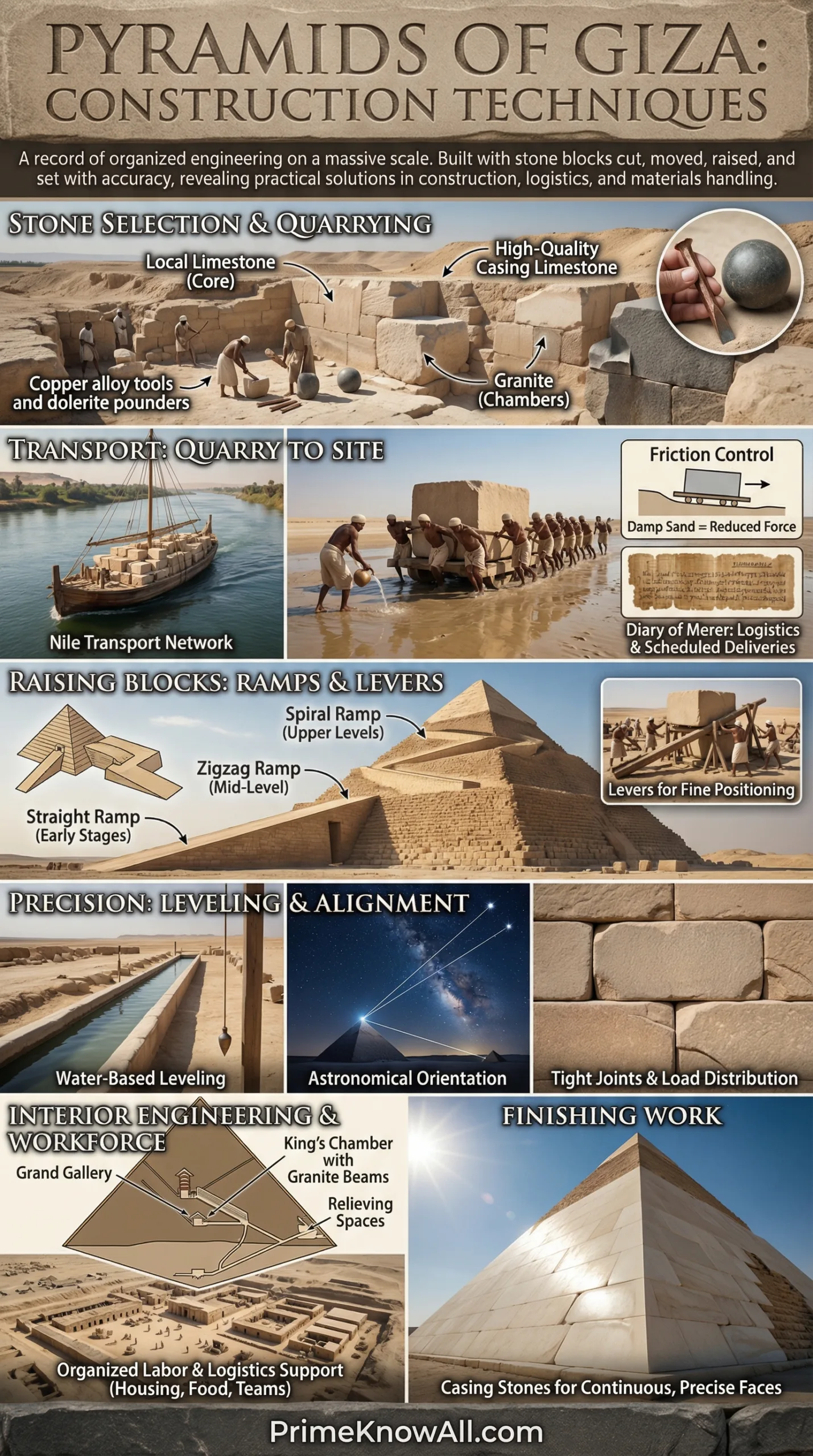
The Pyramids of Giza are not just ancient monuments; they are a record of organized engineering on a massive scale. Built with stone blocks that had to be cut, moved, raised, and set with surprising accuracy, these structures reveal practical solutions to problems that still matter in construction, logistics, and materials handling.
Because very little “how-to” writing survives from the builders themselves, modern understanding comes from archaeology, tool marks, quarry evidence, and a few rare texts that mention day-to-day work. The result is a picture that is both clear in some places and open in others, with certain techniques supported by strong evidence and others remaining well-tested hypotheses.
The Core Engineering Challenge
At Giza, the builders faced a simple-sounding task with brutal constraints: move large stone pieces using human power, basic materials, and clever process design. It was not one challenge, but several stacked together: quarrying the stone, transporting it across land and water, raising it up a growing structure, and aligning it so the final form remained stable and precise.
- Scale: The Great Pyramid (Khufu) used a vast volume of limestone, plus granite in key interior areas.
- Distance: Some stone came from nearby quarry zones, while premium materials traveled much farther.
- Time pressure: Work had to be scheduled around seasons, labor availability, and transport conditions.
- Accuracy: The structure demanded consistent levels, clean joints, and reliable load paths, not just “a big pile of stone.”
The striking part is not that the Egyptians had “mystery technology,” but that they combined repeatable methods with tight supervision and well-managed labor. The pyramids are a demonstration of systems engineering long before the term existed.
Stone Selection And Quarrying Methods
Construction begins with material choices. At Giza, the majority of blocks are local limestone, available in large quantities close to the plateau. But the builders also used higher-quality casing limestone for smooth outer faces and granite for chambers and structural elements where strength and durability mattered most.
What Tools Could Cut Hard Stone?
Old Kingdom toolkits relied on copper alloys for many cutting tasks, paired with abrasives like sand to increase effectiveness. For harder stone such as granite, builders also used dolerite pounders—rounded stones that could batter surfaces and gradually shape them. This is slow work, but it is predictable, and predictability is often more valuable than speed when you must repeat a process thousands of times.
Quarrying techniques likely combined chisel work, percussion, and strategic splitting. Even without iron tools, stone can be separated by carefully creating grooves, exploiting natural bedding planes, and using wedges. The important point is that quarrying was not an improvised activity; it was a specialized trade supported by planning and standardized block sizes where possible.
Transport: From Quarry To Building Site
Moving stone was a bigger challenge than cutting it. The builders needed reliable ways to move blocks that weighed tons, across uneven ground, and often over long distances. Evidence strongly supports a combination of water transport (where possible) and sledges on land, supported by roads, ramps, and coordinated work crews.
Using The Nile As A Transport Network
Egypt’s biggest “machine” was the Nile. Boats could move heavy loads far more efficiently than dragging them over land. For the finest casing limestone, the journey likely involved quarry zones near the river, then transport by boat toward Giza, and finally a controlled approach to the plateau using canals, basins, and staging areas. This is a classic multimodal supply chain: water movement for the long leg, then short-haul land transport for final placement.
What A Rare Work Diary Adds
A surviving text known as the Diary of Merer describes teams involved in transporting limestone by boat during Khufu’s reign. It does not explain every construction step, but it supports the reality of scheduled deliveries and managed logistics rather than random hauling.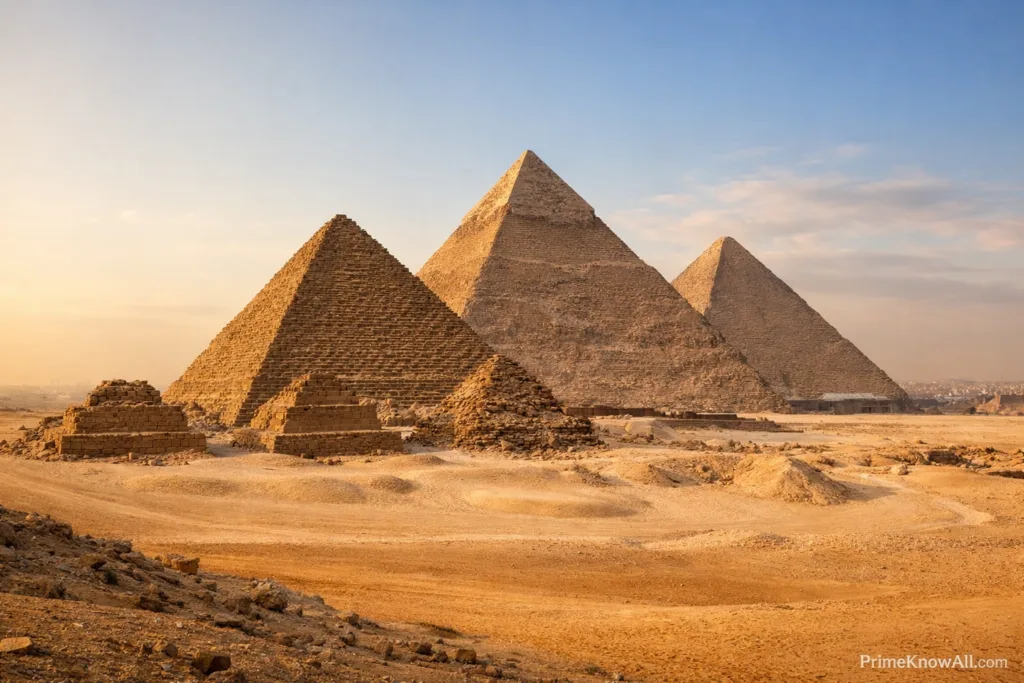
- Named crews operating under an inspector.
- Repeated trips moving stone from quarry zones toward Giza.
- Administrative rhythm that looks like organized project management, not ad hoc labor.
Sledges, Friction, And A Simple Advantage
On land, the most widely supported method is the wooden sledge. Instead of rolling blocks on logs (which can be unstable on soft ground), sledges distribute weight and reduce sinking. A key improvement is friction control: dampening sand can make it behave more like a firm surface, reducing the force needed to pull a heavy load. This is not magic; it is materials behavior, and it shows that the builders likely paid close attention to small optimizations that saved time and energy across thousands of hauls.
Transport also required path preparation. Even a simple route becomes dramatically easier if it is leveled, compacted, and kept clear. At Giza, the plateau itself served as a stable base, but approach routes, staging yards, and work zones still needed constant maintenance. The construction site was a living infrastructure system built to keep stone moving with minimal delays and predictable flow.
Raising Blocks: Ramps, Levers, And Work Cycles
Once stone reached the pyramid base, the hardest step began: getting blocks upward as the structure grew. The broad consensus is that ramps played a central role, likely combined with levers, careful staging, and disciplined crew routines. The debate is less about whether ramps were used and more about what ramp designs were practical at different phases.
Why There Is No Single “Ramp Answer”
A ramp has trade-offs. A shallow ramp is easier to pull loads up, but it requires a huge volume of fill material and a long footprint. A steeper ramp saves material and space, but increases pulling forces and demands better control. The most realistic picture is a changing ramp strategy: different ramp types or configurations could have been used as the pyramid rose and the available working space changed.
A Real Ramp Discovery That Shows The Principles
At Hatnub, an ancient quarry site, archaeologists identified a ramp system with a central track and side stairways containing post holes. The design suggests a method where ropes could be tensioned around posts to help move heavy loads up steeper slopes than a simple straight ramp would allow. While Hatnub is not Giza, it demonstrates a practical concept: mechanical advantage can come from anchoring and control, not only from complex machines.
| Ramp Model | How It Works | What It Explains Well | Main Limit |
|---|---|---|---|
| Straight External Ramp | One long ramp from ground to work level | Early stages and heavy lower courses | Needs enormous material and space |
| Zigzag Or Switchback Ramp | Ramps turn along one face in segments | Reduces footprint while keeping moderate slopes | Corner turns complicate hauling and alignment |
| Spiral External Ramp | Ramp wraps around pyramid as it grows | Continuous access to higher levels | Can hide edges; hard to maintain precise corners |
| Internal Ramp Hypothesis | Ramp runs inside outer shell or galleries | Explains limited external ramp remains in some models | Harder to confirm directly; depends on internal evidence |
Ramps alone are not the whole story. Builders could lift and fine-position blocks using levers, raising one side at a time, placing supports, and repeating the process. This sounds slow, but it is safe, precise, and well-suited to a job where the cost of a mistake increases with every course.
Precision: Leveling, Alignment, And Tight Joints
The Giza pyramids are famous not just for size, but for geometry. Maintaining stable angles and clean faces required careful measurement and quality control. Even when blocks vary, a construction team can achieve consistent results if it uses reference lines, repeated checks, and a shared measurement culture.
Keeping The Base Level
Leveling is foundational. A slight tilt at the base becomes a major deviation at height. Evidence and practical reasoning support techniques like water-based leveling (using water as a natural level reference) combined with surveying lines. The goal was a base that behaved like a calibrated platform, letting every subsequent course follow predictable geometry.
Orienting To Cardinal Directions
The pyramids show remarkably close alignment to the cardinal directions. Achieving this likely involved astronomical observation paired with ground marking. The method does not need advanced instruments; it needs repeatable observation and clear sight lines. This is another example of the same theme: simple tools can produce exceptional results when procedures are consistent.
Fitting Stones So Closely
Close-fitting stones are not only about aesthetics. Tight joints distribute loads more evenly and reduce weak points. Builders could shape faces using abrasion and careful dressing, then adjust placement by testing contact points. For fine casing, the process was probably even more demanding, because the final surface needed to look continuous and remain stable under temperature swings and long-term settling.
Interior Engineering: Corridors, Chambers, And Load Control
The interior is where construction technique becomes structural engineering. The Great Pyramid includes the Ascending Passage, the Grand Gallery, and major chambers built with large stone elements. These spaces are not carved after completion; they are integrated during building, meaning the team had to coordinate internal layout with the rising exterior mass.
Granite Placement And Stress Management
Granite blocks are heavy and harder to shape than limestone, but they offer high compressive strength. In the King’s Chamber, granite beams and roof elements required controlled placement and careful support during installation. Above some chambers, the builders created relieving spaces to manage how weight transfers downward. This reflects an intuitive grasp of a key principle: redirect load away from vulnerable voids using geometry and layered stonework.
How A Passage Can Be A Construction Tool
Some interior features may have served more than one function during the build. A sloped corridor can be both an architectural element and a potential route for moving materials or balancing forces with counterweights. It is difficult to prove a single “mechanism,” but it is reasonable to treat the interior as part of the construction system, not only as a finished tomb layout. In large projects, temporary and permanent features often overlap, and Giza is no exception.
Workforce Organization And Site Logistics
Construction techniques are not only tools and ramps; they are also people systems. Archaeological evidence at Giza supports the idea of organized labor, with housing zones, food production, and administrative control. This matters because a ramp without timing and coordination becomes a bottleneck. A well-run site keeps quarry output, transport arrivals, and placement crews aligned so that stones do not sit idle and momentum is not lost.
- Dedicated teams: Specialized crews for quarrying, hauling, setting, and finishing.
- Staging areas: Temporary yards for sorting blocks by size and destination.
- Food and water supply: Essential “invisible infrastructure” that keeps physical work sustainable.
- Quality checks: Supervisors and markers ensuring courses stayed level and aligned.
Even the smallest efficiency gains would scale. If damp sand reduces hauling force, or if a staging yard reduces confusion, the benefit multiplies across thousands of moves. The pyramids can be read as a case study in process improvement, achieved through practice, standardization, and tight feedback loops.
Finishing Work: Casing Stones, Faces, And Final Geometry
Today, the Giza pyramids look stepped because most casing stones are gone. Originally, at least the largest pyramids likely had smooth outer faces made from fine limestone casing. Installing this layer required different thinking than core masonry. The casing had to be precise, visually continuous, and aligned with the overall slope. It also had to be placed in a sequence that allowed safe access while maintaining the integrity of the surface.
Finishing likely involved dressing stones in place, using reference lines and repeated checks to maintain a consistent face. The final result was not just a beautiful surface; it protected the core and signaled craftsmanship. This is where geometry becomes public: if corners drift or faces bulge, the pyramid looks wrong. The builders’ ability to keep shape under such scale suggests strong surveying discipline and a clear understanding of tolerances.
What Evidence Supports, And What Remains Uncertain
Some techniques are strongly supported: sledges, water transport, quarry tool marks, and organized labor systems. Other parts—especially the exact ramp geometry used at each stage—remain debated because large temporary ramps were dismantled, reused, or eroded. That uncertainty does not weaken the story; it highlights how ancient builders likely used flexible methods that adapted to changing constraints.
A useful way to think about Giza is that the builders combined three ingredients: simple machines (sledges, levers, ramps), measurement practice (leveling and alignment), and project management (teams, schedules, logistics). Remove any one of these, and the project becomes dramatically harder. Together, they form a coherent engineering approach that still feels recognizable in modern construction, just executed with different materials and different power sources.
Sources
- Harvard University – The Giza Project [Archaeological records and research context for Giza monuments and settlements]
- IFAO – Catalogue (MIFAO 145) Wadi el-Jarf Papyri Publication [Official publication entry related to the Wadi el-Jarf papyri, including Merer’s logbooks]
- American Physical Society – Sliding Friction on Wet and Dry Sand (Physical Review Letters) [Experimental work explaining why damp sand can reduce sledge friction]
- University of Liverpool – Ancient Quarry Ramp System At Hatnub [University report on a ramp system that illustrates steep-slope hauling principles]
- Smithsonian Institution – The Egyptian Pyramid [Accessible overview of pyramid orientation, leveling, and transport imagery]
- Egypt Ministry of Tourism and Antiquities – Workers’ Town and Cemetery [Official summary of the workers’ settlement evidence at Giza]
FAQ
Note: The questions below focus on construction techniques and evidence-based interpretations, using non-sensational and widely discussed research paths.
Did the builders use ramps, and if so, what kind?
Most researchers agree that ramps were used in some form, supported by practical engineering and comparable ancient hauling methods. The main uncertainty is configuration: a single long straight ramp is possible early on, while zigzag, spiral, or hybrid approaches may have been used as the pyramid rose and space became limited.
How were multi-ton blocks moved without wheels?
The strongest evidence supports sledges pulled by teams over prepared surfaces. Studies show that damp sand can reduce resistance, making hauling more efficient. Water transport on the Nile likely handled long-distance movement, especially for high-quality limestone and granite.
How did the pyramids stay so well aligned?
Alignment likely depended on consistent surveying procedures, including astronomical observation for cardinal directions and careful leveling for the base. High accuracy is achievable with simple tools when methods are repeatable and checks are frequent throughout construction.
Were the pyramids built by enslaved people?
Modern archaeological evidence from Giza supports organized labor with living areas, food production, and administrative systems. This points to structured workforces rather than a purely punitive model. Large state projects often relied on rotating crews and specialized workers supported by a broader supply network.
What is the single most important technique behind the pyramids?
There is no single trick. The pyramids reflect the combination of simple machines (ramps, levers, sledges), measurement discipline (leveling and alignment), and logistics (steady deliveries, staging, and team coordination). Together, these create a system capable of producing monumental scale with reliable control.
