Pompeii was a real city before it became a ruin. Its streets, blocks, shops, fountains, baths, and houses formed a working urban system, not a collection of isolated monuments. Reading Pompeii through its city layout makes daily Roman life easier to see: where people moved, where they met, where they bought food, and how status showed itself in stone, paint, and plumbing.
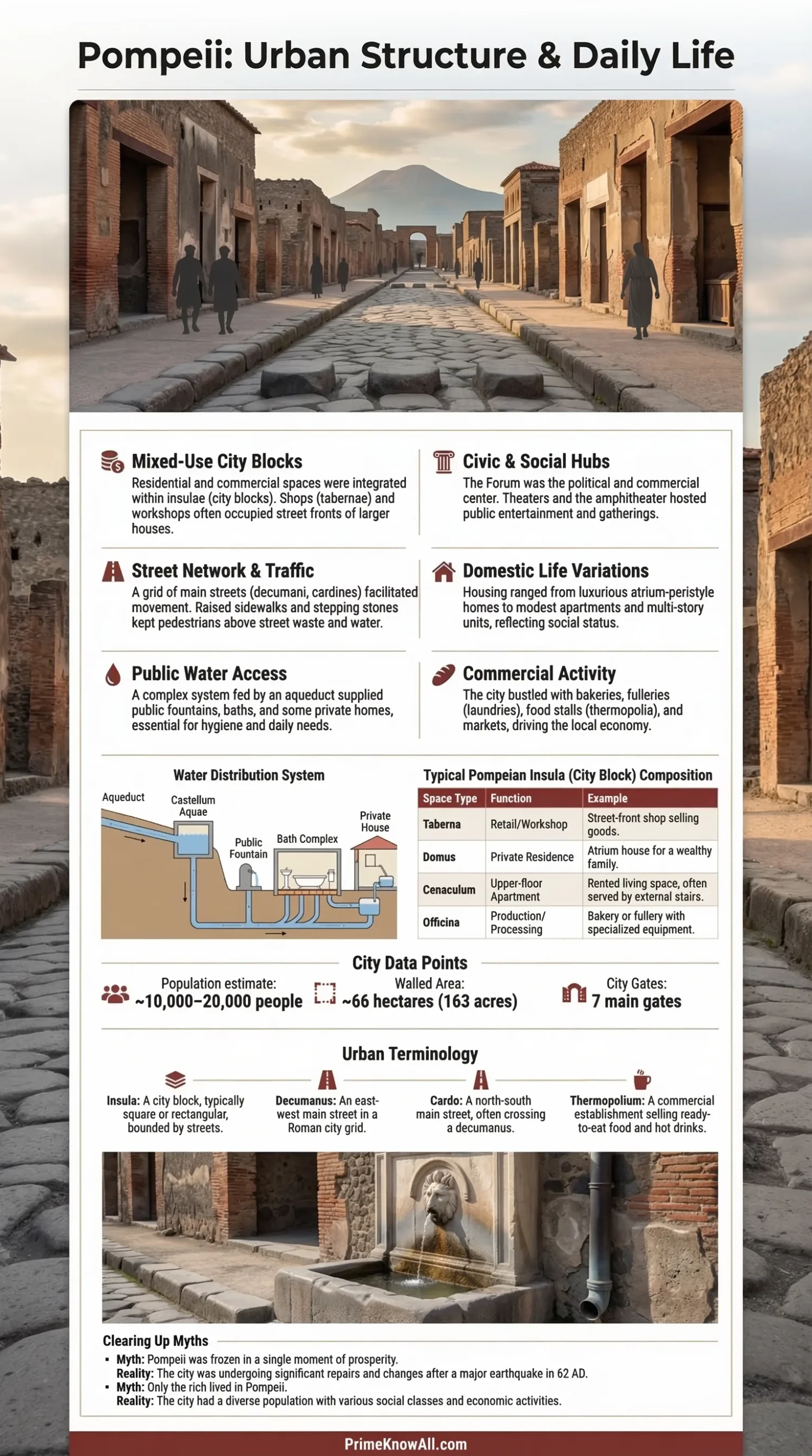
What To Keep In Mind
- Pompeii was mixed-use. Homes, shops, workshops, shrines, and rented spaces often sat side by side.
- The street plan was ordered, but not perfectly rigid. Older growth and later Roman rebuilding left slight shifts in alignment.
- Water shaped movement. Fountains, drains, stepping stones, and pressure from the aqueduct all affected daily routine.
- The city was still changing in AD 79. After the earthquake of AD 62, repairs and rebuilding were still visible.
- Public life was spread across many places. The Forum mattered, but so did baths, theaters, the amphitheatre, markets, and neighborhood corners.
Pompeii survives so well because volcanic deposits sealed a busy town at a rough, unfinished moment. That makes it one of the best places to study urban life in the Roman world: not only elite houses, but also food counters, laundries, workshops, graffiti, traffic patterns, and the small services that made a city function.
If you remember one thing… Pompeii makes the most sense when it is read as a network of routines. The city plan did not just organize buildings; it organized movement, water, trade, status, and social contact.
What Kind Of City Pompeii Was
Pompeii was a medium-sized Roman city with a port-facing setting, a strong local identity, and a street plan shaped over several historical phases. It was not Rome in miniature, and it was not a sleepy resort either. Archaeologists usually place the resident population around 10,000 people, though older estimates can run higher, and that number should be treated as a model rather than a census.
Built on a lava plateau above the Sarno plain, Pompeii sat in a useful position for trade, farming, and regional travel. The excavated area alone covers 44 hectares, and within that space the city includes a Forum, bath complexes, two theaters, an amphitheatre, temples, workshops, food outlets, and hundreds of domestic spaces. Forum, in Roman terms, means the city’s public center for administration, commerce, religion, and civic display.
- Urban scale: large enough to support several bath complexes, entertainment venues, and specialized trades.
- Social mix: wealthy homeowners, renters, traders, enslaved workers, freedpeople, artisans, and visitors all used the same streets.
- Economic mix: agriculture, retail, food service, textile work, religion, politics, and leisure all shared space.
A useful analogy helps here. Pompeii worked less like a neatly zoned modern suburb and more like a dense town center where a bakery, a shrine, a bedroom, and a street-front shop could belong to the same stretch of wall. That is why the ruins feel so vivid: the city was arranged for daily use, not for visual symmetry alone.
How Pompeii Was Organized
Pompeii was divided into neighborhoods and blocks, but its layout was not drawn in one single act. The city is usually discussed through its nine regiones and many insulae. A regio is a city district. An insula is a block bounded by streets. Those labels are modern archaeological tools, yet they mirror a real urban logic: Pompeii was built as a city of connected neighborhoods.
Some parts of Pompeii follow a strongly orthogonal, or grid-like, order. Other parts shift slightly in angle or density, which reflects older growth, topography, and later Roman rebuilding. This matters because it corrects a common oversimplification. Pompeii was planned, but it was also adapted. Roman rule sharpened and regularized the city, yet it did not erase every earlier line.
The Forum sat as the civic heart, while major streets connected gates, market activity, religious spaces, and residential districts. Via dell’Abbondanza acted as one of the city’s busiest east–west routes, lined with shops, workshops, houses, and public traffic. Via Stabiana linked different quarters north to south. Gates opened the city toward roads, burials, trade routes, and the countryside outside the walls.
| Part Of The City | What Was There | Everyday Role | What It Reveals |
|---|---|---|---|
| Forum Area | Temple precincts, basilica, market spaces, civic buildings | Law, trade, worship, public display | Urban life centered on more than shopping; politics and religion were always nearby |
| Main Streets | Shops, bars, doorways, fountains, carts, graffiti | Movement, buying, gossip, delivery, navigation | Street life was dense, noisy, and social |
| Neighborhood Blocks | Houses, rentals, workshops, shrines, service areas | Sleeping, working, storing, worshipping, producing | Private and commercial life often overlapped |
| Bath And Theater Zones | Baths, seating areas, gathering routes | Leisure, health, conversation, performance | Routine social life needed purpose-built public spaces |
| City Edge And Gates | Road links, tombs, traffic access, amphitheatre quarter | Arrival, departure, spectacle, memory | The city stayed tied to its region, not sealed off from it |
People, carts, animals, and goods entered through controlled edges rather than random openings.
Routes such as Via dell’Abbondanza carried traffic, retail activity, public writing, and everyday visibility.
Each insula could mix domestic rooms, rented units, storage, workshops, and street-front commerce.
Aqueduct-fed storage and distribution supported fountains, baths, some houses, and parts of the urban economy.
The Forum, baths, theaters, and temples gave the city shared routines beyond private home life.
Pompeii was still being altered after the AD 62 earthquake, so the city plan captures motion, not stillness.
- The layout of Pompeii was ordered, but not mechanically uniform.
- Forum, main streets, and insulae worked together as one urban pattern.
- City planning in Pompeii is easiest to read when movement and daily use are kept in view.
How Streets, Water, And Movement Worked
Pompeii’s streets were practical machines for circulation. They carried pedestrians, wheeled traffic, drainage, water access, advertising, and social contact all at once. A Roman street was not just a path between buildings. It was a shared urban surface where infrastructure and behavior met.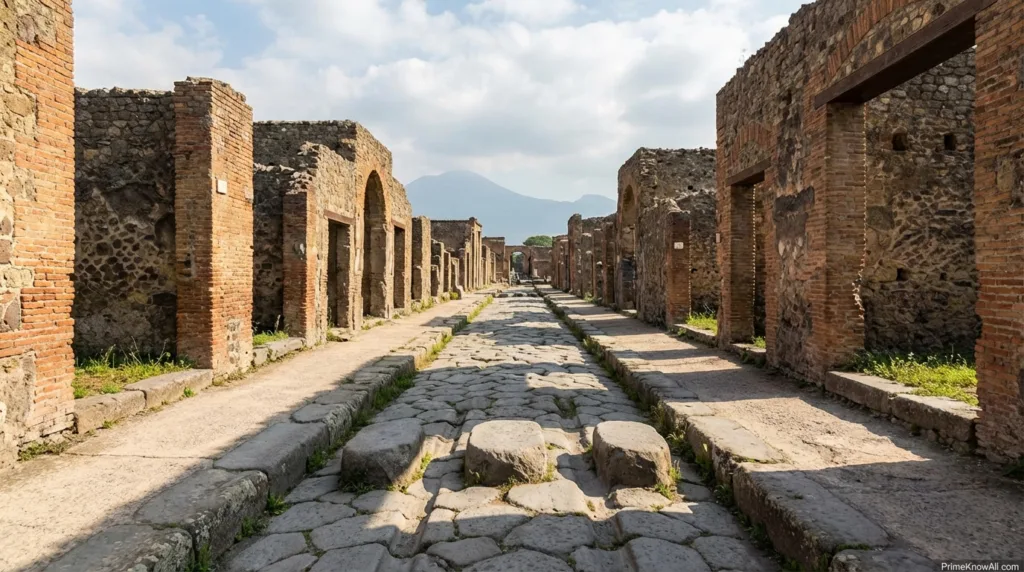
Stone paving, wheel ruts, raised sidewalks, and stepping stones reveal how movement was managed. The stepping stones let people cross the street while water and waste could continue to run below them. The gaps between stones were wide enough for wheels to pass. That detail matters. It shows that the city plan had to serve both feet and vehicles, and that wet, muddy conditions were part of normal life.
Water was another hidden organizer. By the early imperial period, water from the Serino aqueduct reached Pompeii and was controlled through the castellum aquae, the main distribution tank at one of the city’s highest points. From there, pressure helped move water toward public fountains, baths, and some private users. A castellum aquae is a distribution tower or tank that receives water and sends it into smaller lines.
- Street fountains gave neighborhoods regular access to water.
- Baths depended on stable supply and heating systems.
- Private connections existed, but not every household had the same access.
- Distance and elevation affected pressure and delivery.
Water also marked status. Houses with decorative fountains, gardens, and controlled flow were making a social statement, not just solving a practical need. At the same time, public fountains kept basic water access visible on ordinary streets. That mix of public provision and unequal comfort is one of the clearest signs that Pompeii was a living city rather than an archaeological diagram.
Where People Lived, Worked, And Ate
Pompeii’s blocks were rarely single-purpose. Domestic rooms, commercial units, storage spaces, workshops, and rented quarters often sat under one roof or within one block. This is one of the most useful corrections to the postcard version of Pompeii.
A domus was a townhouse, often organized around an atrium and, in larger cases, a peristyle. An atrium is the main reception space with a roof opening and a basin below. A peristyle is a colonnaded garden court. Yet even these houses were not always purely residential. Some had tabernae, or street-front shops, built into the façade. Others absorbed smaller neighboring units over time, which helps explain the irregular plans seen in several large homes.
The less glamorous side of urban life appears just as clearly. Shops with mezzanines or upper sleeping areas, food counters, bakeries, bars, and laundries show that work and family life often overlapped. Upper floors survive badly in Pompeii, so they are easy to underestimate. That is a real limit of the evidence. Even so, doorways, stairs, beam holes, and mixed-use plans make it plain that much of the city lived vertically as well as horizontally.
- Thermopolium: a hot-food counter or snack bar serving prepared food and drink.
- Fullery: a laundry and textile-cleaning workshop, sometimes converted from an earlier house.
- Bakery: a place of milling, dough preparation, ovens, storage, and retail.
- Taberna: a street-front shop, often attached to a larger property.
The street economy could be blunt and practical. Many small units had no full kitchen, which helps explain why prepared food outlets mattered. The official excavation guide also notes that in some shop-house units, families likely lived above the street-level room. That arrangement feels familiar even now: front-of-house commerce below, family or storage space above.
Textile work gives a sharp example of urban adaptation. The Fullery of Stephanus shows a former house turned into a worksite, with the old atrium altered for washing and processing cloth. That is urban flexibility in plain view. Pompeii did not keep “home” and “industry” in separate clean boxes.
- Mixed-use blocks were normal in Pompeii.
- Many ruins that look purely domestic were also tied to rent, retail, or production.
- The loss of many upper floors means the city was probably even more crowded than the ground plan alone suggests.
How Public Buildings Shaped Daily Routine
Pompeii’s public buildings did not sit outside ordinary life. They gave the city a rhythm. The Forum handled civic and economic business. Baths structured social time. Theaters organized performance and gathering. Temples anchored ritual. The amphitheatre pulled in crowds on a scale that could exceed the city’s own resident population.
The Forum was the strongest single statement of urban order. It concentrated religion, law, trade, and civic identity in one place. Nearby sat the Macellum, a market building, and the Basilica, used for legal and business activity. This clustering was not accidental. It made public visibility part of everyday city life. One did not simply “go downtown”; one entered a space where status, law, commerce, and worship were all in view at once.
The bath complexes matter just as much. The Stabian Baths are among the oldest bath installations in the city, the Forum Baths served a central area, and the Central Baths were still unfinished at the time of the eruption. The official excavation record notes that more than 500 lamps were found at the entrance to the men’s section of the Forum Baths, a small but vivid hint that bath use extended into evening hours.
The Amphitheatre of Pompeii, built around 80 BCE, is often described as the earliest surviving permanent Roman amphitheatre. Its seating, often estimated at about 20,000, suggests that Pompeii served a wider region, not only its residents. That mismatch between arena capacity and population is revealing. Pompeii was tied to surrounding communities through spectacle, travel, and regional identity.
- Forum: civic business, markets, temples, formal display.
- Baths: washing, exercise, conversation, waiting, reputation.
- Theaters: performance, crowd culture, civic identity.
- Amphitheatre: large-scale entertainment with regional pull.
- Street shrines and temples: religion woven into routes and neighborhoods.
Why The Eruption Preserved A City Mid-Repair
Pompeii was not frozen at a calm, finished peak. It was caught during a period of repair, rebuilding, and uneven recovery after the earthquake of AD 62. That changes how the city should be read. Some missing decoration, rough surfaces, and awkward alterations are not signs of neglect alone; they can be signs of active work.
This point has grown stronger with recent research. Official work in Regio IX in 2024 highlighted tools, lime, stacked tiles, and walls under construction, while a 2025 scientific study used that same unfinished area to discuss Roman concrete practice. Those discoveries matter for urban history because they show that a Roman city could remain fully alive while pieces of it were still in flux. Pompeii was not a sealed model town. It was a place of maintenance, investment, and repair.
That also affects social interpretation. A house without an atrium, or a small unit with refined paintings, cannot be dismissed too quickly as “minor.” Recent finds have shown that decorative ambition could appear in smaller properties as well. The city’s social map was real, but it was not simple. Wealth, aspiration, taste, and rebuilding all left marks on the same walls.
Current museum work is widening the picture further. Recent exhibitions and publications from the Archaeological Park have pushed attention toward women, children, enslaved people, graffiti, and service labor. That shift is useful. Urban life is easier to understand when the city is read through its full population, not only through elite houses and famous frescoes.
- The AD 79 eruption preserved a city that was still changing.
- Post-earthquake rebuilding is part of the layout story, not a side note.
- New excavations keep correcting older habits that focused too narrowly on elite display.
Common Misreadings About Pompeii
- Wrong: Pompeii was mostly a city of grand villas.
Better Reading: It was a mixed city with elite houses, modest units, shops, workshops, rentals, and service spaces.
Why This Gets Missed: Famous houses attract more attention than small commercial rooms. - Wrong: The city followed a flawless Roman grid.
Better Reading: Many streets show ordered planning, but the whole layout preserves older phases and local adjustments.
Why This Gets Missed: Simplified maps flatten the city into cleaner geometry than the ruins support. - Wrong: The eruption captured a fully finished city.
Better Reading: Many properties and public works were still being repaired after AD 62.
Why This Gets Missed: Ruins are easy to read as timeless, even when the evidence points to active rebuilding. - Wrong: Most people cooked at home in a self-contained household.
Better Reading: Prepared food outlets and street commerce mattered, especially where full kitchen space was limited.
Why This Gets Missed: Modern readers often project the private kitchen model backward. - Wrong: Streets were just empty stone corridors between buildings.
Better Reading: Streets carried noise, water, animals, carts, messages, trade, and social watching.
Why This Gets Missed: The silence of ruins hides the intensity of urban routine.
Scenes That Make City Life Easier To Picture
- A shopper stops at a fountain before going home. Public water points turned street corners into everyday meeting places because water access was a repeated need.
- A worker sleeps above the shop. Many street-facing units likely used lofts or upper rooms, which fits the mixed-use logic of dense Roman neighborhoods.
- A wealthy owner receives guests in the atrium while trade happens outside. Public reputation and private domestic display could share the same façade.
- A family buys hot food instead of preparing a full meal indoors. Small commercial counters mattered because not every unit had the space or equipment for full domestic cooking.
- Bath time becomes networking time. Bath buildings were social spaces where washing, waiting, talk, and status mixed together.
- Builders leave lime and tiles ready for tomorrow’s work. The city still carried the marks of repair and investment right up to the eruption.
- A crowd heads toward the amphitheatre from beyond the walls. Some urban spaces served not only residents, but also the wider region around Pompeii.
- Pompeii becomes easier to understand when it is pictured as a city of repeated routines.
- The best clues are often small: a stair, a fountain, a shop counter, a wheel rut, a repair scar.
- Urban life in Pompeii was made from overlap, not separation.
What We Know Well And What Stays Hard To Prove
Pompeii is unusually informative, but it is not perfectly transparent. Some parts of urban life stand out clearly, while others remain partly hidden by preservation bias, excavation history, and the loss of upper stories and organic materials.
- Population: estimates are reasoned models, not exact counts.
- Upper floors: many are poorly preserved, so density can be understated.
- Traffic behavior: wheel marks and street form help, but not every rule of movement is written down.
- Social identity: decoration, house size, and water access matter, yet they do not tell the whole story of rank or income.
- Excavation history: early digs did not record everything with the level of care expected now.
This limitation matters because it keeps the reading honest. Pompeii gives a rare city-scale picture of Roman urban life, but that picture is still uneven. The safest approach is to combine architecture, inscriptions, finds, infrastructure, and recent fieldwork instead of leaning on one type of evidence alone.
Pompeii is best read as a working city whose layout directed water, movement, trade, leisure, and social display at the same time. The ruins feel so immediate because they still preserve the links between street and house, shop and status, repair and routine. The most common mistake is to treat each building as a separate postcard. The rule worth keeping is simple: in Pompeii, every space belonged to a wider urban pattern.
Quick Test
Was Pompeii mainly a residential city with a few public monuments?
No. Housing, shops, workshops, baths, temples, markets, and entertainment buildings were closely interwoven.
Did Pompeii follow one perfectly regular grid?
Not exactly. Many sectors are strongly ordered, but older growth, terrain, and later rebuilding left visible shifts in alignment.
Did every household enjoy the same access to water?
No. Public fountains served neighborhoods widely, while private comfort and decorative water display varied by property and by connection to the network.
Were homes and workplaces usually separate?
Often they were not. Pompeii shows many cases where living, selling, storing, and making happened in the same building or block.
Did the eruption preserve a city in perfect condition?
No. Pompeii was still marked by repairs, unfinished projects, and post-earthquake rebuilding when AD 79 arrived.
Sources
- UNESCO – Archaeological Areas Of Pompei, Herculaneum And Torre Annunziata — Reliable because it is the official World Heritage record, and it is useful here for the 44-hectare excavated area and the summary of Pompeii’s public monuments.
- Pompeii Archaeological Park – A Guide To The Pompeii Excavations — Reliable because it comes from the official site authority, and it supports details on houses, shops, baths, streets, fountains, repairs, and specific finds.
- Encyclopaedia Britannica – Pompeii — Reliable because it is a long-standing reference work with expert editorial control, and it is useful here for historical context, the Forum, and broad city facts.
- Journal Of Archaeological Method And Theory / Springer – Scaling In Pompeii — Reliable because it is peer-reviewed academic research, and it is useful here for the cautious discussion of population estimates and urban scaling.
- American Journal Of Archaeology – Water, Wealth, And Social Status At Pompeii — Reliable because it is a respected archaeology journal, and it is useful here for the relationship between water distribution, infrastructure, and social difference.
- Pompeii Archaeological Park – Regio IX Construction Techniques Press Release — Reliable because it comes from the excavation authority itself, and it helps explain why Pompeii should be read as a city still marked by active rebuilding.
- Nature Communications – An Unfinished Pompeian Construction Site Reveals Ancient Concrete Practice — Reliable because it is a peer-reviewed science journal, and it adds a current research layer to the story of post-earthquake repair.
- Pompeii Archaeological Park – Being A Woman In Ancient Pompeii — Reliable because it is based on museum and research work from the site authority, and it is useful here for widening urban life beyond elite male space into household labor, status, and daily experience.
FAQ
What Was The Main Center Of Pompeii?
The Forum was the main civic center. It brought together religion, trade, legal activity, and public display in one connected space.
Was Pompeii A Planned Roman Grid City?
Partly. Pompeii has many ordered, grid-like sectors, but the full city also preserves older growth patterns and later adjustments, so the layout is planned yet layered.
How Many People Lived In Pompeii?
Many scholars place the population around 10,000, though the exact number remains debated because no direct census survives for the final moment before the eruption.
Why Are So Many Shops Attached To Houses In Pompeii?
Because the city was mixed-use. Roman urban properties often combined domestic space, rental income, retail, and production within the same building or block.
Did Pompeii Have Running Water?
Yes, but unevenly. Aqueduct-fed water reached the city and supplied fountains, baths, and some private users, though access and comfort were not identical for every property.
Why Does The AD 62 Earthquake Matter For Understanding Pompeii?
Because it means Pompeii was still in a phase of repair and rebuilding when the eruption happened in AD 79. The city plan records a town in motion, not a perfectly settled one.
