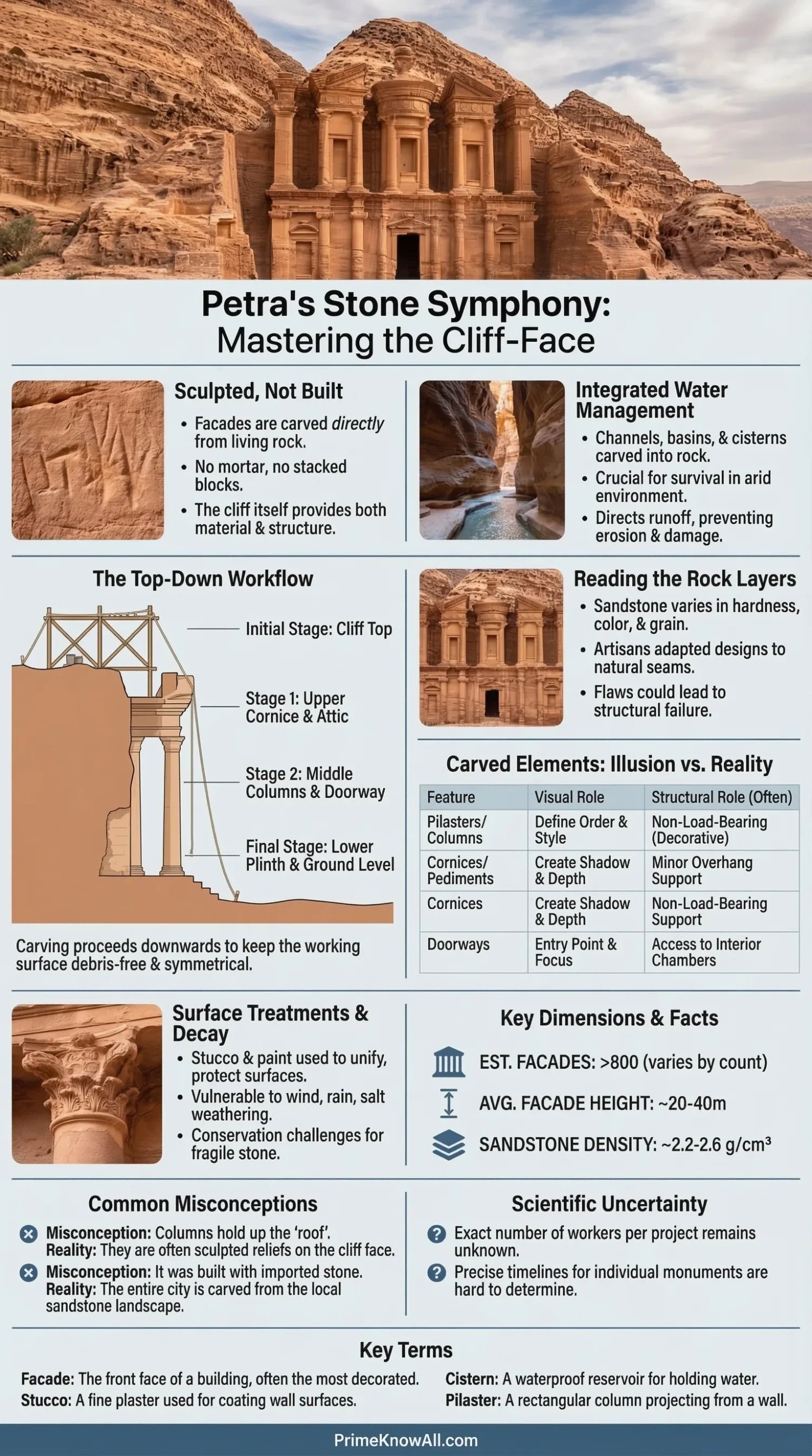
Petra’s rock-cut buildings were shaped by a simple method: workers mapped a facade on the cliff, then carved downward in controlled stages so the final surface stayed clean and symmetrical. The “buildings” are often sculpted fronts, not stacked blocks, and the sandstone itself acts like both material and structure.
That sounds straightforward, but Petra’s cliffs behave like a living blueprint: layers, cracks, and softness shift across a single wall. The techniques that worked on one face could fail a few meters away, so planners had to read the rock before they could safely shape it.
If you remember one thing… Petra’s rock-cut architecture is less about “digging out a cave” and more about precision carving—like turning a cliff into a finished facade by controlling order, lines, and surfaces.
What Matters Most In Two Minutes
- Rock-cut facade means a building front carved directly from living rock, not assembled stone by stone.
- Many Petra monuments use a top-down carving order so falling debris does not ruin finished work below.
- Sandstone is workable, but its layers and weak seams force constant adjustments to keep edges and columns sharp.
- Some “architectural” parts are visual rather than structural; a carved column can be non-load-bearing.
- Petra’s rock cutting and Petra’s water cutting belong together: channels, basins, and cisterns are part of the same stone craft.
Understanding Rock-Cut Architecture At Petra
Rock-cut architecture is architecture made by removing material instead of adding it. In Petra, that usually means carving a facade, an entry, and interior chambers into sandstone cliffs, producing monuments that feel “built” while staying geologically rooted.
Petra is often linked to the Nabataeans, a culture that turned a desert-crossroads location into a wealthy city by managing trade and water. The rock-cut approach fits that setting: it reduces transport of building stone, uses the cliff as a massive pre-made wall, and can be scaled from small tombs to large ceremonial fronts.
A useful detail: many facades function like stone billboards. They signal status and identity with carved order—pilasters, capitals, cornices—while the interior can be comparatively plain. That split between display surface and usable space shapes the techniques you see in tool marks and finishing choices.
Reading The Sandstone: Why Rock Choice Matters
Petra’s sandstone is not one uniform “brick.” It is layered rock with bands that can be softer, harder, or more fragile depending on grain size and natural cement. A bedding plane, meaning a natural layer boundary inside sedimentary rock, can act like a hidden tear line if carving crosses it the wrong way.
Before any dramatic cutting, workers likely checked for vertical joints, crumbly zones, and water staining that hints at seepage. Even today, you can see how some facades “step” their details to respect layers. That is not sloppy work; it is risk management in stone, done with practical eyes.
One more constraint: sandstone weathers. Wind, salt, and occasional heavy rain can roughen sharp lines over decades. That makes finishing decisions—smoothing, plaster, paint—more than decoration. They are also a way to protect and unify surfaces that would otherwise look patchy as the rock ages unevenly.
Pocket Recap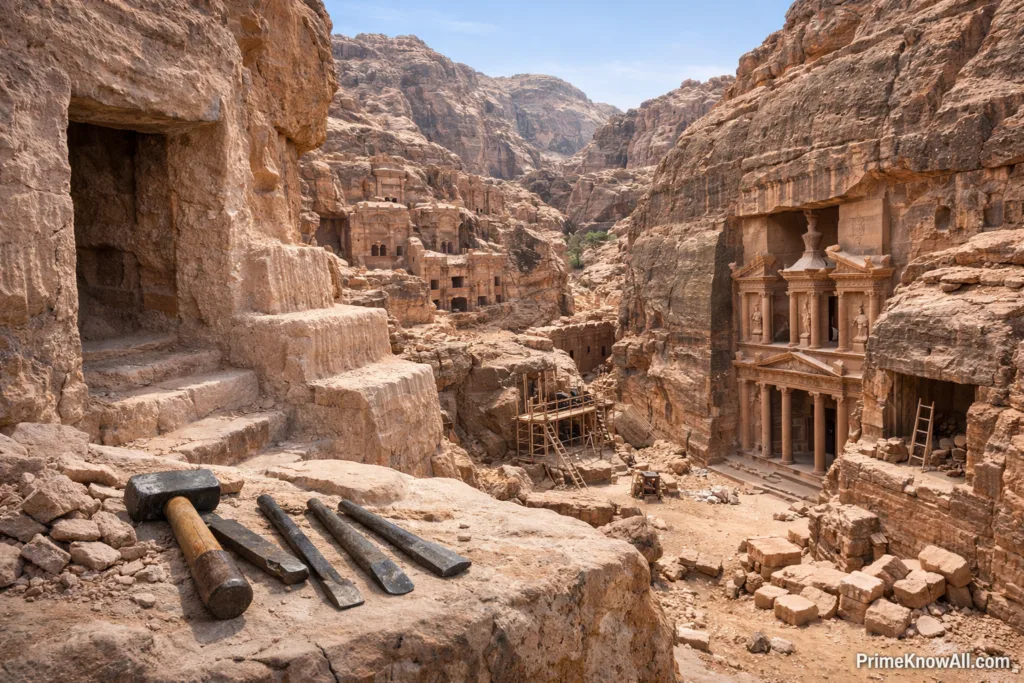
- Stone quality changes across a wall; technique has to change with it.
- Many “odd” details make sense as layer-aware carving.
- Finishes often help with appearance and weathering at the same time.
Planning The Facade Before Cutting
Good rock cutting starts with lines. A datum line, meaning a reference line used to keep measurements consistent, can be lightly carved or marked so every later step stays aligned. From that, teams can lay out centerlines, cornice heights, and the spacing of columns or pilasters, keeping symmetry even when the rock is not perfectly flat.
At Petra, planning likely balanced three realities: the desired “classical” look, the cliff’s natural shape, and the need to keep fragile areas from becoming the focal point. A quick way to spot planning is to look for straight edges that stay true across large distances; they usually signal measured layout, not freehand carving by feel.
There is also a practical scheduling side. A large facade needs scaffolding, debris management, and steady access to tools and water. So planning includes where workers stand, where rubble falls, and how to keep a half-finished surface from being damaged by the next stage below.
A Small Comparison Table Of Carving Choices
This table summarizes common rock-cut decisions and what they help control, using plain terms you can apply while looking at Petra’s facades.
| Decision | What It Helps Control | What You Might Notice On The Rock |
|---|---|---|
| Top-down workflow | Protects finished surfaces from falling chips and dust | Crisper detailing higher up, with rougher zones left lower until late |
| Leaving “safety margins” | Reduces the chance of overcutting a final edge | Small extra thickness near corners, trimmed at the end |
| Following bedding planes | Prevents carving across weak layers that can flake | Details that subtly “step” with natural bands |
| Using surface finishes | Unifies color and texture; can slow weathering in spots | Areas that look smoother or more uniform than raw sandstone |
Carving From The Top Down: Workflow And Safety
Top-down carving is one of the most repeated observations about Petra because it solves two problems at once: it keeps falling debris from damaging finished work, and it allows scaffolding to be moved downward as the wall is shaped. The basic rhythm is: rough out the upper mass, set major outlines, then refine details as you descend, leaving lower sections intentionally unfinished until late.
Here is the subtle part: “top-down” does not mean “finish the top completely first.” Teams often alternate between roughing and refining, because the cliff can reveal weaknesses only after some mass is removed. A cornice might be brought close to final shape, then paused while workers adjust the next band down, keeping the whole facade balanced rather than perfect in one strip and chaotic in another below it.
One analogy helps: carving a Petra facade is like cutting a layered cake for a big event. If you frost the bottom first, you will ruin it while slicing the upper layers. If you work from the top, you control crumbs and keep the final presentation clean. The cliff is the cake, the falling chips are the crumbs, and the finished edges are the frosting you don’t want to smear.
Fast Reality Check
- Order matters: carving is planned like a sequence, not a single act.
- Lower areas often stay rough on purpose until the end, to protect the final surface.
- Good work looks “slow” because it avoids irreversible cuts too early.
A Vertical Infographic: How A Petra Facade Gets Made
This simplified infographic shows a typical top-to-bottom workflow, with what happens and why it happens in each band. It is not one strict recipe; it is a repeatable pattern seen across many rock-cut sites.
Tools And Tool Marks You Can Still Spot
Stone tools leave signatures. A point tool tends to leave pitted, dotted impact; a flat chisel leaves straighter, broader facets; a toothed chisel, meaning a chisel with ridged teeth, can leave parallel grooves that look like a comb dragged across stone. These marks often stay visible in areas that were meant to be hidden or later covered, giving you a glimpse of work stages.
You can sometimes read the work rhythm too. Roughing marks tend to be larger and more irregular, while finishing marks look tighter and more consistent. That difference is useful because Petra’s facades can include both on the same surface, showing that teams returned to areas for refinement rather than carving everything once and walking away.
A detail many visitors miss: some “architectural” edges were likely sharpened last with careful trimming, because the final millimeters matter most for shadow. In strong sun, a crisp groove creates a dark line that visually “draws” the facade. That is stone carving used as lighting design, and it is part of why Petra photographs so well even when the color is subtle.
Small But Useful Reminder
- Tool marks can show sequence: rough first, refine later.
- Sharp lines are often a late-stage choice for better shadow.
- Mixed finishes on one wall usually reflect planning, not carelessness.
Finishing Layers: Smoothing, Stucco, Pigment, And Joints
Finishing is where Petra stops looking like a quarry and starts looking like a designed facade. Smoothing can reduce weak surface grains and make carving look more “architectural.” In some cases, artisans used stucco, meaning a plaster-like coating applied over stone, to even out imperfections and provide a better base for paint.
Paint matters because it changes how details read from far away. A thin color wash can strengthen contrast between moldings and flat fields, especially on sandstone with variable banding. That is a practical move: it helps a facade hold a consistent look even when the rock naturally shifts between pink, tan, and deeper red layers in one cliff.
Not everything had to be carved from the same block. A socket, meaning a cut recess designed to hold an inserted piece, can allow wooden doors, metal fittings, or other add-ons. When you see neat rectangular cut-ins around entries, think of them as the hardware layer that turns a carved opening into a functioning doorway for people.
Water And Drainage Carved Into The City
Petra’s rock craft includes water craft. Channels, basins, and cisterns are stone-cut infrastructure that made long stays possible in a dry region. A cistern, meaning a storage chamber designed to hold collected water, can be carved into bedrock and lined to reduce leakage. Even small carved gutters can redirect sudden rain away from steps, entrances, and fragile surfaces below.
This matters because Petra’s setting can produce fast runoff. When intense rain hits hard ground, water concentrates into narrow paths—especially in canyon-like spaces. Managing flow helps protect carved monuments from repeated soaking, sediment abrasion, and the kind of forceful surges that can damage lower walls and walkways. Modern visitors sometimes see drainage work as “background,” but for the builders it was part of the same stone problem: shape the cliff, shape the water.
One easy-to-grasp example is the Siq, the narrow approach canyon. It is often described as roughly 1.2 kilometers long in many references, and its tight shape highlights why flow control matters. In a corridor like that, even small channels and curb cuts can make a big difference in where water goes—and where it does not hit.
Clear It Up In Seconds
- Rock cutting and water routing are linked at Petra.
- A cistern is not “just a hole”; it is a planned container with shape and often lining.
- Drainage reduces long-term surface damage from repeated wetting and runoff abrasion.
Structural Illusions: Non-Load-Bearing Columns And Hidden Stresses
A carved column can be “real” visually and “light” structurally. On many rock-cut facades, columns and pilasters are part of the cliff face, so they do not carry roof weight the way free-standing columns do. They still matter, though, because carving deep grooves and undercuts changes stress in the rock. A cliff face is stable partly because it is continuous; carving introduces new edges where weathering and cracking can begin over time.
That is why a lot of rock-cut design favors strong vertical masses and avoids extreme undercutting in weak layers. Even when you see dramatic shadows, the stone behind them often stays thick enough to resist breakage. In simple terms: artisans used style, but they also kept a quiet engineering margin in the rock itself most of the time.
When you look at a facade like Al-Khazneh (the Treasury), it is easy to read it as a built temple because the forms echo classical architecture. The surprise is that it is closer to high-relief sculpture on a cliff. That is part of Petra’s lasting impact—and part of why it became a pop-culture symbol, including its use as a film location in Indiana Jones and the Last Crusade for the facade scene.
Conservation Limits And Visitor Impact
Conserving rock-cut monuments is a different job than conserving block-built walls. You cannot “replace a stone” easily when the stone is the cliff. Treatments often focus on slowing decay, managing water, and limiting abrasion from touching, dust, and foot traffic. Even small changes—like visitors rubbing a surface for photos—can polish soft sandstone and gradually blur tool marks that hold clues about how it was carved in the first place.
There is also a measurement shift in recent years: teams can use 3D scanning, meaning dense spatial recording of surfaces to track change over time, to compare cracks and erosion in repeat surveys. That does not “freeze” a monument, but it helps confirm where deterioration is accelerating and where simple management—drainage fixes, barriers, controlled access—can slow it without turning the site into a museum that feels closed off to real people.
Simple Takeaway Box
- With rock-cut sites, the monument is the bedrock.
- Small actions can speed up wear on softer sandstone, so access rules help protect detail.
- Modern scanning supports conservation by measuring change, not by rewriting the past.
Common Misconceptions About Petra’s Rock Cutting
- Wrong: “Petra was dug like a mine, so the inside came first.”
Correct: Many monuments show a facade-first logic, with top-down surface control guiding the work.
Why it gets misunderstood: People picture “excavation” as tunneling, not sculpting a wall. - Wrong: “All the columns are structural.”
Correct: Many columns are carved as part of the cliff face and mainly shape the look, even though carving still affects rock stress.
Why it gets misunderstood: The forms resemble free-standing buildings, so the brain assigns familiar roles. - Wrong: “The rock color is natural, so paint was unnecessary.”
Correct: Pigment and plaster can unify color bands and sharpen visual contrast on uneven sandstone.
Why it gets misunderstood: Modern photos favor raw stone texture, so added surface layers feel unexpected. - Wrong: “One team could carve a huge facade quickly with brute force.”
Correct: Large work needs staging, debris control, and careful refinement; speed varies with rock and detail level.
Why it gets misunderstood: Clean lines look “instant” when you only see the final result. - Wrong: “Water features are separate from architecture.”
Correct: Channels, cisterns, and runoff shaping are part of the same stone planning that protects entrances and walkways.
Why it gets misunderstood: Visitors focus on facades and miss quieter infrastructure carved into the landscape.
Practical Scenarios That Make The Techniques Click
This section uses everyday situations to anchor the ideas, without turning Petra into a puzzle. Each example links a small scenario to a clear reason the technique makes sense in practice.
- You notice painters tape on a wall before painting. That is like a carved datum line: it keeps boundaries straight so the finish looks clean. Why: Reference lines prevent small errors from growing across a large surface.
- You trim a hedge from the top so clippings fall away from finished areas. That mirrors Petra’s top-down workflow. Why: Falling debris can damage or dirty surfaces you already refined.
- You sand rough wood first, then switch to finer grit. That resembles the shift from roughing tools to finishing tools. Why: Coarse steps set shape; finer steps control surface and shadow.
- You avoid hanging a heavy shelf on cracked drywall. That is like choosing a stable sandstone face over one with weak seams. Why: Hidden fractures turn a beautiful plan into a long-term failure.
- You add a waterproof strip where rain hits a doorway. That connects to Petra’s drainage cuts and protective surfacing. Why: Small water control can prevent repeated wetting and material loss.
- You install door hinges into a prepared recess. That maps to carved sockets for doors and fittings. Why: Carved openings become usable only when they accept real hardware.
- You choose a matte wall finish to hide uneven patches. That echoes plaster or paint used to unify variable sandstone. Why: Surface layers can smooth visual noise without changing the underlying rock.
Stop-And-Remember Box
- Petra’s methods often match everyday sequencing: rough first, refine later.
- Many “style” choices also serve maintenance and stability.
- Look for lines, layers, and shadow edges; they reveal the hand of planning.
Quick Test
Tap each statement to check your understanding. The goal is not trivia; it is to confirm the method and logic behind Petra’s rock cutting choices.
“Carving top-down helps keep lower sections clean while the upper parts are being shaped.”
Mostly true. Debris and dust naturally fall, so working downward helps protect surfaces that are already refined.
“A bedding plane is just a color stripe, so it does not affect stability.”
False. A bedding plane is a natural layer boundary; it can become a weakness where flaking or splitting starts, especially if carving undercuts it.
“Many carved columns at Petra are designed more for appearance than for holding weight.”
Often true. Carved columns can be part of the cliff face, shaping the look even when they do not carry a built roof load.
“Tool marks can hint at which parts were rough-shaped first and which parts were refined later.”
True. Roughing marks tend to be larger and less regular, while finishing marks look tighter and more controlled.
“Water channels are unrelated to Petra’s rock-cut architecture because they are ‘engineering,’ not ‘design.’”
False. Channels and cisterns are also rock-cut work, and they protect entrances, paths, and carved surfaces by controlling runoff.
What We Still Don’t Know And Where Certainty Drops
Some parts of Petra’s technique are visible in stone. Lines, tool marks, and carving order can be inferred from surfaces. But other parts are harder to confirm because scaffolding, work teams, and planning marks were often temporary. That means reconstructions can be well-supported without being absolute.
Numbers can be fuzzy. You will see counts like “hundreds” or “800+” monuments because catalogs vary in what they include—full facades, small niches, unfinished cuts, and nearby satellite sites. Using ranges is often more honest than one perfect number everywhere.
Finishing layers are unevenly preserved. Traces of plaster or pigment may survive only in protected spots, so it is hard to map exactly how widespread surface coatings were across all facades. When you see a claim that “everything was painted,” treat it as a possibility that depends on location, preservation, and evidence, not as a blanket statement for the whole site.
Last Mini Recap
- Visible clues support many explanations, but some steps stay inferred.
- Counts and timelines often vary by definition and preservation.
- When a claim sounds too universal, add the question: “For which monument, in which condition?”
Petra’s rock-cut techniques blend planning, careful sequencing, and a sharp eye for sandstone behavior. Once you look for reference lines, layer-aware choices, and top-down carving, the facades start to read like process, not just spectacle.
The most common mistake is treating Petra like a hollowed cave instead of a carved surface system. Memorable rule: if the detail looks “architectural,” first ask how the stone was protected while it was being made.
Sources
- UNESCO World Heritage Centre – Petra [Confirms World Heritage listing details and offers institution-level summaries; UNESCO pages are reviewed and maintained by an official global heritage body.]
- ICOMOS – Advisory Body Evaluation For Petra (PDF) [Provides technical evaluation context used in UNESCO decisions; ICOMOS is a long-standing professional organization for monument and site assessment.]
- The Metropolitan Museum Of Art – Nabataeans (Heilbrunn Timeline Of Art History) [Museum scholarship explains historical context with editorial oversight; Met essays are curated and updated for public education.]
- Encyclopaedia Britannica – Petra [Useful for cross-checking basic facts with professional editors; it is a mainstream reference but not a primary research outlet.]
- Wikipedia – Rock-Cut Architecture [Good for terminology and starting points, but should be verified against institutional and academic sources.]
FAQ
Why do many experts think Petra’s facades were carved from the top down?
Because debris falls. Working top-down helps keep lower areas clean and prevents falling chips from damaging finished details, while scaffolding can be lowered in stages.
What does “rock-cut facade” mean in simple terms?
A rock-cut facade is a building front shaped directly out of a cliff. The “walls” are the original rock, carved into architectural-looking forms.
Did Petra’s monuments have paint or plaster?
Sometimes, yes. Evidence for surface coatings exists in some areas, but preservation is uneven, so the safest view is that use varied by monument and exposure.
Are the carved columns at Petra actually holding up weight?
Often not. Many are carved from the cliff face and mainly shape appearance, though deep carving still affects the rock’s stress and weathering behavior.
Why is sandstone both helpful and risky for carving?
It is workable, which allows fine shaping, but its layers and weak seams can flake. Builders had to adapt to the rock’s structure to keep edges stable.
How is water management connected to Petra’s rock-cut architecture?
Water channels and cisterns are also carved stone systems. They help protect entrances and paths by guiding runoff and storing water for daily use.
