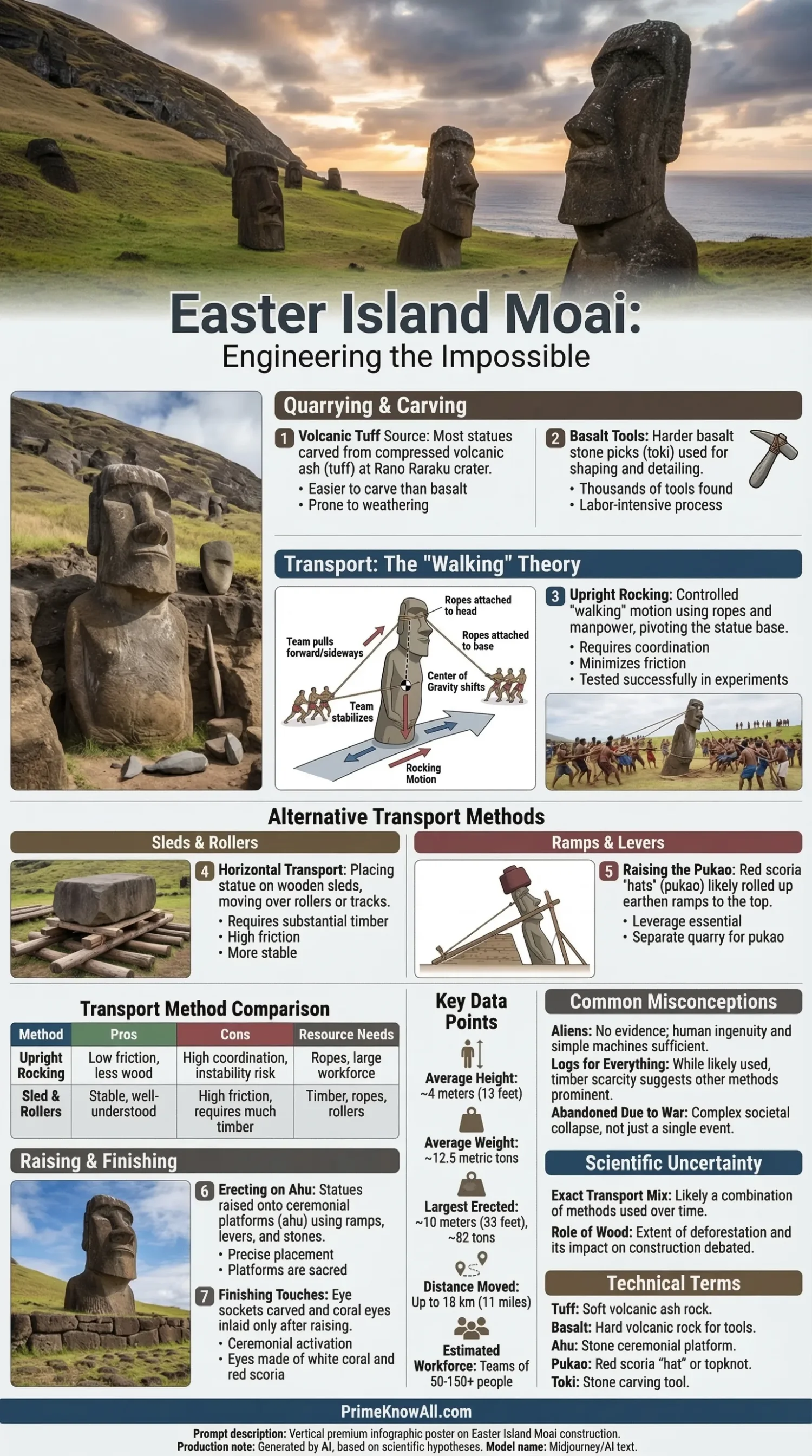
The final finishing (details, eye sockets, and in some cases the red scoria “hat”) likely happened near the destination.
What To Remember In 30 Seconds
- Material matters: tuff is workable, but it chips—so control and padding mattered at every step.
- Shape helps: many moai have a forward lean and a rounded base that can support rocking movement.
- Transport is not one story: teams likely used more than one method depending on size, route, and timing.
- Platforms came last: raising a statue onto an ahu was its own project, with ramps, levers, and coordinated pulls.
- Some details were “ceremonial finish”: eye sockets and coral eyes fit the idea of a final activation moment.
Moai construction looks impossible until you treat each step as a repeatable job with a clear goal and tight control of balance.
The famous statues on Rapa Nui (Easter Island) were not made by “mystery tech.” They were built with stone tools, human coordination, and careful choices about shape, friction, and leverage. The hard part is not imagining a single trick. The hard part is seeing how the whole chain can work without breaking the statue—or the crew.
If you remember one thing… the moai were likely moved the same way people move heavy objects today: reduce friction, keep control of tipping, and trade brute force for smart angles—then repeat the process slowly and consistently.
What Makes A Moai Movable In The First Place
Short answer: a moai is tall, but it can be made stable through its base shape, forward lean, and weight distribution, which allows controlled rocking and careful steering with ropes.
A helpful term here is center of mass. Center of mass, meaning the point where an object’s weight balances, is what decides whether a statue wants to tip or settle. Many moai designs place that balance point so the statue can lean slightly forward without becoming uncontrollable.
- Forward lean: a small lean can help a rocking move stay predictable instead of random.
- D-shaped or rounded base: a base that can pivot helps the statue “step” while still staying upright.
- High friction control: rough ground can be a problem, but it also helps prevent runaway sliding when ropes are managing the motion.
- Head-heavy look, not always head-heavy physics: the head is visually large, yet the overall mass can still sit in a controllable position.
Small win box
Think “controlled wobble,” not “drag it.” If a tall object can rock safely, every rope pull becomes smaller, and the team spends more effort on steering than on raw pulling.
What The Quarry Reveals About Carving
Short answer: the main quarry at Rano Raraku shows moai in every stage—rough outlines, nearly finished bodies, and statues still attached—so the carving process can be reconstructed from tool marks and unfinished work.
Most stone moai were cut from volcanic tuff, a rock made from compacted volcanic ash. Tuff, meaning a relatively soft volcanic stone, is easier to shape than hard basalt, but it can flake if struck poorly. This fits a workflow where carvers do heavy shaping at the quarry and leave some riskier details for later.
- Outline first: carve the front while the statue lies on the bedrock, keeping the work surface stable.
- Undercut later: once the front and sides are shaped, workers undercut the back to free the statue.
- Basalt “toki” tools: toki, meaning a basalt pick/adze used for stoneworking, can leave recognizable pecking patterns and impact scars.
- Staging areas matter: once freed, a statue can be stood up for finishing, repair, and preparation for travel.
| Stage | What We Can Observe | What It Suggests | What It Does Not Prove |
|---|---|---|---|
| Quarry Carving | Tool marks on tuff and unfinished statues in place | Front-first carving, then undercutting | A single “standard” method for every statue |
| Release | Moai still attached at the back, plus keel-like ridges | Statues freed by controlled undercutting and supporting wedges | Exact order of every tool move |
| Transport | Ancient roads and “road moai” abandoned along routes | Movement was planned, with prepared paths | Whether the statue traveled upright or prone in each case |
| Raising | Ahu platforms, ramps, and placement patterns | Use of ramps, levers, and steady rope control | The exact number of people used on a given day |
| Finishing | Eye sockets and evidence of added materials (e.g., coral eyes) | Some final details likely happened after placement | That all finishing happened at the same location for all moai |
- Rano Raraku is a “process archive.” The quarry preserves steps, not just statues.
- Tuff shapes the workflow. It allows fast shaping, but it demands careful handling near the end.
How A Statue Gets From Bedrock To “Ready To Move”
Short answer: after carving, workers likely freed the statue, protected weak points, and adjusted the base so it could be handled without snapping or grinding away key features.
This step is where the work feels most like a modern moving day. If you have ever moved a tall bookcase, you do not “lift and sprint.” You tilt, shim, and shift in small moves so the object stays predictable. The same logic fits moai preparation: controlled release, then controlled support.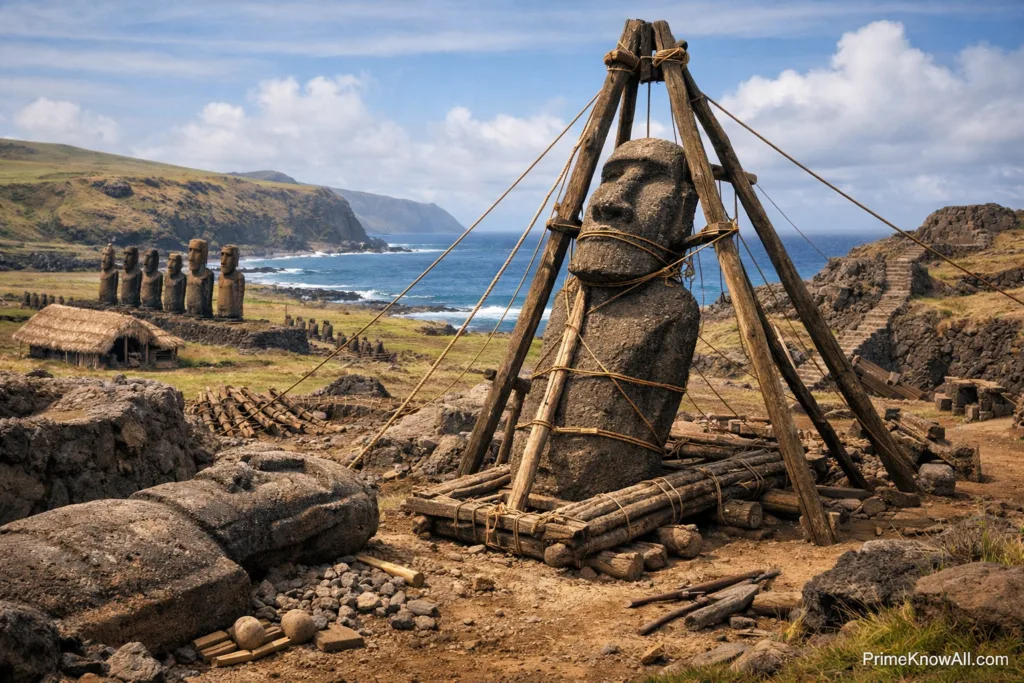
- Undercutting with wedges: wedges can open space under the statue so it can be separated gradually.
- Keel and belly surfaces: smoothing the underside helps reduce “catch points” that cause chips.
- Edge protection: ears, nose, and brow ridges are fragile; padding and careful rope placement matter.
- Base tuning: shaping the base can help a statue pivot without sudden tipping.
Plain-language definition
Leverage, meaning the advantage you get by applying force at a distance (like a crowbar), lets a small crew make precise moves that would be risky with pure lifting.
How Moai Were Moved Across The Island
Short answer: the strongest modern proposals center on rope-controlled movement along prepared routes—either upright rocking (a “walk”) or low transport (sled-like support or rollers)—with the choice shaped by statue size and terrain.
It helps to treat “transport” as a set of constraints, not a single magic method. The crew needed to avoid face-down damage, keep the statue from spinning, and handle small changes in slope without losing control. That is why rope placement and pace matter as much as raw pulling.
Option 1: Upright Rope-Rocking (“Walking”)
Short answer: an upright statue can “walk” if a team keeps it slightly forward and alternates rope pulls left-right, making the base pivot in small steps while another line manages braking.
The popular mental image is dramatic—statues striding like people—but the actual movement is closer to a careful rock. Picture a heavy vending machine that you shift across a floor: you rock it a few centimeters, catch it, then rock again. That slow rocking rhythm is the point. The statue does not need to go fast; it needs to stay upright and steerable.
- Three rope roles: left pull, right pull, and a stabilizing line that keeps the lean controlled.
- Road-ready base: a base that pivots helps the statue “step” instead of scraping flat.
- Team coordination: the crew’s timing matters more than individual strength, which keeps surprises low.
Option 2: Low Transport With Supports
Short answer: a moai can also be moved by lowering it onto a support (like a sled or cradle) and dragging or sliding it, using ropes and ground preparation to cut down friction spikes.
This family of methods is less “viral-video friendly,” but it has a simple benefit: you reduce the risk of a full tip-over because the statue is closer to the ground. The tradeoff is that a prone or low statue is exposed to scraping and impacts, so the crew needs padding, route smoothing, and careful handling around the face.
- Supports can be temporary: small rollers or skids can be swapped as the statue moves forward.
- Route prep is the hidden labor: leveling, clearing stones, and managing slope are part of the “machine.”
- Damage control: the method needs protection for delicate edges, which fits leaving fine detail for later.
Option 3: Mixed Strategies
Short answer: the most realistic picture is a mix—upright control on some segments, low support on others—depending on route sections, weather, and how much the crew wants to avoid risk.
- Short steep sections: slowing down and adding extra control lines can matter more than the transport style.
- Turning corners: pivoting an upright statue might be easier than re-positioning a long prone load.
- Work scheduling: a crew might choose methods that fit available time, not just theory.
- “Walking” is a control method. The core idea is managed rocking, not speed.
- Multiple methods can be true. Different statues, routes, and seasons can push crews toward different choices.
How Moai Were Raised On Platforms And Finished
Short answer: raising a moai onto an ahu likely relied on earthen ramps, incremental lifts, and levering, with final details completed after placement when the statue was no longer at transport risk.
An ahu, meaning a stone ceremonial platform, is not just a base. It is a construction site with space for ramps and staging. The statue can be pulled up a ramp in small steps, with supports placed beneath it as “safety catches.” That pattern—pull, block, adjust, pull again—is slow, but it reduces the chance of catastrophic slipping.
- Ramps: earth and stone ramps create manageable angles for pulling.
- Levers and blocks: small lifts repeated many times are safer than one big lift.
- Final orientation: minor rotations can be done near the top where the statue is already under tight control.
How The Red “Hats” (Pukao) Fit In
Short answer: pukao, meaning a cylindrical red scoria stone often called a “topknot,” could be moved and placed using ramps and rope techniques such as parbuckling—rolling a heavy cylinder up a slope while a rope wraps around it to keep it from sliding back out of control.
Red scoria is a different material than tuff. Scoria, meaning a porous volcanic rock full of bubbles, can be lighter for its volume than solid stone, but it still weighs enough to demand careful restraint. In practice, a ramp plus parbuckling turns “lift the hat” into “roll it with control.” That is the kind of engineering move that looks boring in a drawing and very real on a hillside.
- Why ramps help: they trade height for distance, making the pull force smaller.
- Why parbuckling helps: the rope wrap acts like a built-in brake.
- Why this stays plausible: the method matches the simple goal: control a heavy cylinder on a slope.
Eyes, Final Carving, And The “Last-Moment” Details
Short answer: many researchers support the idea that eye sockets and inlays were part of a later stage because they are delicate and because a “finished face” can be tied to ceremonial moments at the destination rather than the quarry.
- Practical reason: keep fragile features safe until the statue is stable on its platform.
- Social reason: finishing touches can mark the statue as “ready” for its role.
- Evidence reality check: this is a strong interpretation, but not every statue preserves the same clues.
Why Moai Construction Still Matters Right Now
Short answer: understanding construction methods helps explain how small crews can build huge projects, and it also supports conservation decisions because moai are made of porous tuff that can weather and crack under modern climate stress.
Recent reporting and research on Rapa Nui has tied moai preservation to real environmental pressure: drought, wildfire risk, and shoreline impacts. A dried crater lakebed at Rano Raraku revealed a previously undocumented moai, showing that the landscape is still changing and still exposing new evidence. At the coastline, modeling work has warned that future wave action could reach major sites such as Ahu Tongariki under sea-level rise scenarios, which adds urgency to careful planning.
- Better construction models: help identify where statues are most vulnerable (bases, weak points, old repairs).
- Better route thinking: supports decisions about foot traffic and site access that reduce erosion.
- Better collaboration: puts emphasis on local stewardship and realistic site management rather than “one-off” fixes.
- Engineering details help conservation. Knowing where stress concentrates can guide safer protection.
- New evidence can still appear. Landscape changes can expose features that reshape what we think we know.
Common Misconceptions About Moai Construction
- Wrong: “They are just heads.”
Better reading: Many moai have full bodies; some are buried up to the neck by sediment over time.
Why it gets misunderstood: photos from the quarry show only heads above ground, which makes the illusion stick. - Wrong: “A single technique moved all statues.”
Better reading: Multiple approaches can exist in one society, especially across different statue sizes and routes.
Why it gets misunderstood: people prefer one clean story, but real construction behaves like a toolbox of options picked as needed. - Wrong: “Moving moai required huge armies.”
Better reading: experiments and modeling suggest smaller crews can work if the method is control-focused rather than lift-focused.
Why it gets misunderstood: the statues look massive, so people jump straight to massive manpower as the only explanation available. - Wrong: “No planning was involved.”
Better reading: roads, staging zones, and platform preparation point to organized work, even if it was done by separate groups.
Why it gets misunderstood: “preindustrial” gets wrongly treated as “improvised,” when many societies run tight routines. - Wrong: “The hats were lifted straight up.”
Better reading: ramps and rope control (including parbuckling) can raise a cylinder safely without a vertical lift.
Why it gets misunderstood: modern cranes train our imagination; older methods look too simple to be believable at first glance but solve the same problem. - Wrong: “Transport explains everything about meaning.”
Better reading: transport is the how; meaning depends on social role, ancestry, and place-based practice.
Why it gets misunderstood: engineering puzzles are easier to discuss than cultural context, so the story slides toward mechanics alone by default.
Everyday Cases That Feel Surprisingly Similar
These are not perfect matches, but they help translate moai methods into familiar actions without turning the story into fantasy. Each example highlights a single principle with real-world logic.
- Moving a fridge across a kitchen: you rock it, slide a pad under it, then repeat.
Why it maps: rocking turns one hard pull into many small, controlled shifts. - Carrying a tall couch through a doorway: one person leads the angle while others stabilize.
Why it maps: the job is mostly steering, not lifting. - Rolling a heavy barrel up a ramp: the barrel wants to run away unless you add a brake.
Why it maps: parbuckling adds control so gravity does not turn into failure. - Using a crowbar to lift a paving stone: you gain height with tiny movements.
Why it maps: levers and blocks let crews raise a moai in small steps. - Walking a tall wardrobe across a room: you “wobble” it forward, catch it, then wobble again.
Why it maps: this is the everyday version of controlled rocking transport. - Loading a motorcycle onto a trailer: ramps make it doable, but you still need steady guiding hands.
Why it maps: ramps reduce force requirements, while ropes keep the statue from drifting into a bad angle. - Watching a time-lapse restoration clip online: the small steps look slow until you notice how little damage happens.
Why it maps: construction that protects material tends to look patient, not dramatic.
Quick Test
Tap each line to check the answer. The examples are written as short statements you could say out loud after reading, with clear meaning and no jargon overload.
Sentence: “Tuff is a soft volcanic stone that lets carvers shape a moai quickly, but it can chip during transport.”
Answer: True. Tuff is workable, which helps carving, and its weakness helps explain why crews would plan for damage control and leave delicate finishing for later.
Sentence: “If a moai can rock in small steps, the team can focus on steering instead of lifting.”
Answer: True. Rocking turns a hard problem into repeatable micro-moves where ropes manage balance and direction step by step.
Sentence: “Parbuckling means pulling a cylinder up a ramp while a rope wraps around it to reduce runaway sliding.”
Answer: True. That rope wrap acts like a brake, which is why the method is a good match for pukao placement when ramps are used.
Sentence: “Finding roads and abandoned statues proves every moai was moved upright.”
Answer: Not proven. Roads and “road moai” show planned movement, but they do not lock us into a single transport style for every case across time.
Sentence: “Eye sockets and inlays may reflect a later finishing stage tied to ceremony, not just carving.”
Answer: Plausible. It fits practical handling (protect fragile details) and social logic (a final “ready” moment), but the pattern can vary by statue and preservation.
Limitations And What We Still Can’t Confirm
Moai construction is supported by physical evidence, experimental archaeology, and careful measurement, but there are honest limits. There are no surviving step-by-step written instructions from the builders, and some clues are lost to time, weathering, and site disturbance. That means any model should be treated as well-supported or plausible, not “locked forever.”
- Methods can change over generations: a technique that works for 12-ton statues may be adjusted for larger ones.
- Wood and rope availability is debated: how much was available at different times affects what methods would be easiest to sustain.
- Road conditions vary: a “good road” segment and a rough slope segment can push crews toward different tactics.
- Preservation is uneven: many details that would resolve debates—rope marks, ramps, temporary supports—do not survive cleanly.
- Modern experiments are informative, not time machines: they show what is feasible, but not exactly what happened every time.
Summary: Moai construction makes sense when it is broken into manageable tasks—carve in tuff, free the statue carefully, move with rope control, raise with ramps, then finish in place. It is a chain of small wins, not a single breakthrough.
The most common mistake: assuming one method must explain every statue, route, and time period on Rapa Nui.
Memorable rule: if a method keeps the statue’s balance predictable, it stays plausible; if it needs uncontrolled force, it probably breaks something before it succeeds.
Sources
UNESCO World Heritage Centre – Rapa Nui National Park
(Official site entry with verified designation details and property context; high institutional accountability.)
Easter Island Statue Project – Moai Paro Digital Reconstruction
(Specialist research archive with measured statue data; maintained by long-running fieldwork leadership focused on primary documentation.)
PLOS ONE – Megalithic Statue (Moai) Production On Rapa Nui
(Peer-reviewed open-access research; methods and claims are public and reviewable, with data-driven argument.)
University Of Oregon Scholars’ Bank – S. Hixon Pukao Ramp And Parbuckling Evidence (PDF)
(University-hosted academic work with explicit test conditions and measurements; useful for how ramp placement can be feasible.)
University Of Arizona News – Newly Observed Moai In Rano Raraku Lakebed
(University newsroom reporting based on expert interviews and on-site access; reliable for event context and direct statements.)
ScienceDaily – University Of Hawai‘i Release On Wave-Impact Modeling For Ahu Tongariki
(Secondary distributor, but it points to a university release summarizing modeling work; useful for why conservation urgency is discussed.)
Encyclopaedia Britannica – Easter Island Overview
(Editorial reference source with named editors and revision dates; helpful for baseline context and definitions, though it is not a primary research paper.)
Encyclopaedia Britannica – Easter Island Archaeology
(Curated reference section that summarizes archaeological history; useful for broad context, but details should be checked against peer-reviewed work when needed.)
FAQ
How were the moai moved without wheels?
Most explanations focus on rope-controlled movement. Some models use upright rocking that lets a statue “walk” in small steps, while others use low supports that reduce friction. The shared idea is control of balance, not speed.
Were the moai carved at the quarry or finished at the platforms?
Many moai were shaped at Rano Raraku, but finishing choices can vary. Some details that are fragile or ceremonial—like eye sockets and inlays—fit the idea of later completion once the statue is stable.
What tools did the Rapa Nui use to carve tuff?
Carvers used basalt tools, including toki (stone picks/adzes). Basalt is harder than tuff, so it can peck and shape the surface while leaving recognizable impact patterns.
What is a pukao and how did it get on top?
A pukao is a red scoria cylinder often called a “hat” or topknot. One well-supported idea uses ramps plus parbuckling, a rope method that rolls a cylinder upward while keeping it from sliding back uncontrolled.
How heavy were the largest moai that were successfully raised?
Measured examples include very large erected statues such as Moai Paro (around 10 meters tall, often reported near 82 metric tons). Exact weight estimates can vary by method, but the scale is well documented in specialist datasets.
Why are some moai still at the quarry?
Some were left in place due to work interruptions, shifting priorities, or transport decisions. The quarry preserves statues in mid-process, which helps researchers infer work sequences even when direct records do not survive.
Is the “walking” idea proven?
It is supported by experiments and modeling, but “proven” is a high bar for ancient construction. The safest statement is that upright rocking is feasible under controlled conditions and fits some observations, while other methods may also have been used.
