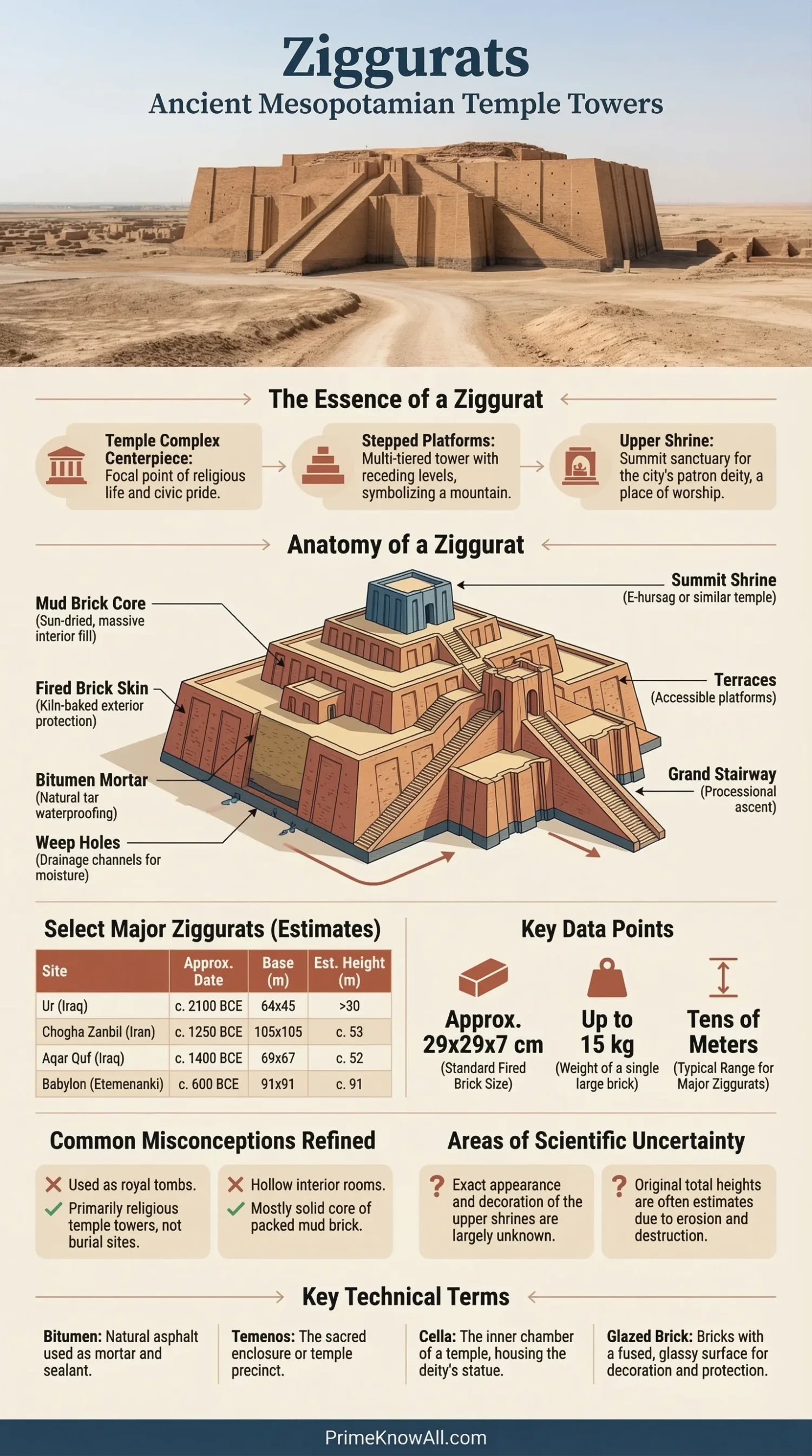
Ziggurats were the skyline of ancient Mesopotamian cities: brick-made hills raised on purpose, not by nature. A ziggurat is an stepped temple tower built in stacked levels, with an upper shrine that sat above the noise and dust of daily life. In practical terms, it was a city’s tallest religious platform, built from mud brick and protected with baked brick and bitumen (natural tar).
When people picture Mesopotamia, they often think of writing, canals, and city walls. Ziggurats belong on that short list, because they mix belief, engineering, and city planning in one shape that is easy to recognize even in ruins.
If you remember one thing… a ziggurat was not “a pyramid tomb.” It was a raised route toward a god’s shrine, built to be seen, maintained, and used as part of a temple complex.
The Fast Summary
- Ziggurats were temple towers, usually tied to a city’s main deity.
- They were built from mud brick with protective layers of fired brick and bitumen for water resistance.
- Most had terraces and stairways designed for processions and controlled access.
- Many details of daily ritual use are unclear, so careful writing separates excavated facts from best-fit interpretations.
- Today, weathering, salt, and water are as big a threat as looting or war, so conservation choices matter.
What A Ziggurat Is
A ziggurat is a tiered tower made of receding platforms, built as part of a temple district, with a shrine on its upper level. The key idea is elevation: height created a visible place for worship and a controlled path upward.
It helps to separate three parts that often get blended together in casual descriptions:
- Core: the inner mass, commonly sun-dried mud brick, stacked as a solid fill rather than hollow rooms.
- Skin: an outer shell of baked brick, often set with bitumen to slow water damage.
- Top shrine: a small temple or sacred structure, which is the point of the climb.
Bitumen, a naturally occurring tar used as mortar and waterproofing, matters here because Mesopotamian rain is not constant, but when it comes, water can cut into mud brick fast. Builders treated the exterior like a raincoat for a clay body.
Where Ziggurats Fit In Mesopotamian History
Ziggurats did not appear out of nowhere. Early temples often sat on raised platforms, and later builders turned that idea into stacked stages that read as a single monument from far away.
- Early platforms: earlier periods used high terraces that lifted temples above flood-prone ground.
- Staged towers: by the late 3rd millennium BCE, many cities built the recognizable stepped form.
- Long afterlife: ziggurats continued into later Mesopotamian eras, with repair cycles that sometimes replaced upper levels.
That timeline matters because it explains a common puzzle: at some sites, older layers look like a platform, while later phases look like a true multi-stage tower. The “ziggurat shape” is a design choice that sharpened over time.
Pause And Lock It In
- Terraces came first; stacked stages spread later.
- A “ziggurat” is a form used across multiple kingdoms, not one single culture.
- If a date feels too neat, treat it as a range, because many sites were rebuilt.
Why Mesopotamian Cities Built Ziggurats
Ziggurats solved a religious and civic problem at once: they made the god’s house visible and gave the city a shared focal point. They also created controlled access—a slow climb that could be managed during ceremonies.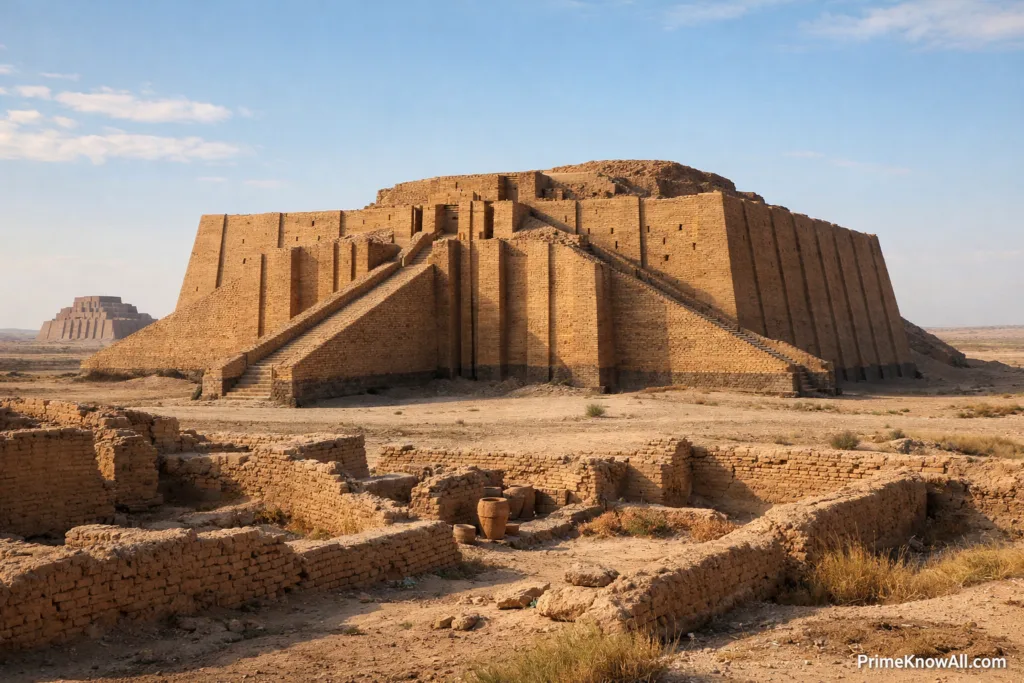
- Symbol: a public sign of a city’s patron god and the ruler’s duty to support that cult.
- Procession: stairways and ramps shaped how groups moved, paused, and looked up.
- Order: placing the shrine high above street level separated sacred space from everyday traffic.
- Memory: rebuilding the same tower after damage kept a place-name and cult alive across generations.
One useful analogy: a ziggurat worked like a city’s home screen. Daily life had many “apps”—markets, canals, workshops—but the tower stayed on top as the always-visible symbol that told everyone what the city valued most.
How Ziggurats Were Built
Most ziggurats were earth architecture on a huge scale: packed mud brick inside, tougher baked brick outside, and water-management details that kept the mass from slumping. This is less “mystery tech” and more smart material matching.
- Mud brick, a sun-dried clay block made from local soil, water, and often straw, formed the bulk because it was cheap and fast to make.
- Fired brick, a kiln-baked brick, resisted rain and abrasion better, so it protected faces and stairways.
- Bitumen, a sticky natural tar, helped bond bricks and shed water where it mattered.
- Drainage and layered surfaces reduced trapped moisture, which is a quiet killer for mud brick.
At the Ziggurat of Ur, researchers have described baked bricks around 29 × 29 × 7 cm and weights that can reach about 15 kg per brick. Numbers like that make the labor legible: brick-making, hauling, and setting mortar were the real “machines” behind the height.
Two-Point Recap So Far
- Build a huge mud-brick body, then protect it with fired brick and bitumen.
- Design the climb so the shrine stays special even when the city is crowded.
How Big Ziggurats Could Get
Sizes varied by city and era, but some ziggurats reached tens of meters in height and sat on bases wider than a modern city block. “Big” here is not just height; it is mass, because solid mud brick adds up fast.
The table below compares a few famous examples using published measurements and estimates. Where a number is an estimate, it is labeled that way, because many upper levels have not survived.
| Ziggurat Site | Approximate Date | Base (Meters) | Height (Meters) | Notes |
|---|---|---|---|---|
| Ur (Iraq) | Ur III period (around 2100 BCE) | 64 × 45 | Over 30 (estimate) | Often linked to Nanna/Sîn; best-known surviving stairway core. |
| Chogha Zanbil (Iran) | 2nd millennium BCE | About 105 × 105 | About 53 (estimate); about 24 today | UNESCO-listed; strong preservation of brickwork and layout. |
| Aqar Quf / Dur-Kurigalzu (Iraq) | 14th–12th century BCE | About 69 × 67 | About 52 today | Near Baghdad; visible monument that helped travelers orient themselves. |
| Etemenanki (Babylon, Iraq) | Mostly known from texts and later rebuilding | Text-based descriptions suggest ~91 × 91 | Text-based descriptions suggest ~91 | Often linked to the Tower of Babel story; physical remains are limited. |
A helpful way to read these numbers: height is what gets remembered, but base width is what makes a tower stable. Mud brick does not forgive narrow foundations, so builders “paid” for height with an even larger footprint.
What Happened On Ziggurats
Most evidence points to ziggurats being used as routes and stages for worship, not as living spaces or burial chambers. The shrine at the top is the focal point, while the terraces shape movement and visibility during festivals.
- Offerings: food, incense, and ritual objects were brought upward along a planned path.
- Processions: groups moved in lines, with the stairways acting like a choreography.
- Temple economy: nearby rooms and courtyards supported staff, storage, and record-keeping.
- Calendars: many cults tied events to lunar or seasonal rhythms; the ziggurat anchored those days in a place.
One detail that is easy to miss: ziggurats can be quiet architecture. Even when thousands lived nearby, the climb creates a slow shift in sound and view—less street chatter, more sky, more wind. That physical change can support a ritual mood without needing words.
How Ziggurats Compare With Egyptian Pyramids
Ziggurats and Egyptian pyramids can look similar in silhouette, but they were built for different purposes and sit in different city settings. A ziggurat is tied to an active temple; a pyramid is tied to a royal burial system.
- Primary role: ziggurat as temple tower; pyramid as tomb monument.
- Access: ziggurat stairways are part of the design; pyramid interiors are restricted and complex.
- Material logic: ziggurats lean on mud brick and protective skins; pyramids lean on stone at far larger weight per block.
- Urban fit: ziggurats sit inside busy temple districts; pyramids usually sit in planned necropolis zones.
A Simple Memory Hook
- Ziggurat = climb to a shrine in an active city.
- Pyramid = protect a burial in a planned cemetery landscape.
What Survives Today And How Sites Are Protected
Many surviving ziggurats are partial cores, but even a truncated tower can show the geometry of terraces and the logic of materials. Modern threats are also easy to see: mud brick breaks down with salt, wind, and standing water, and repairs must match the original materials or they can trap moisture.
Recent reporting has tied this risk to modern climate patterns in Iraq, including hotter summers and more aggressive salt buildup in soils. At the same time, UNESCO and local teams have been running projects that focus on documentation, drainage, and careful repair at sites that include ziggurats.
- Environmental pressure: erosion, water infiltration, salt crystallization, and sand abrasion.
- Human pressure: urban growth near sites, uncontrolled foot traffic, and occasional looting.
- What helps: regular monitoring, compatible repair materials, and keeping water away from the brick core.
If ziggurats feel familiar today, it is partly because their shape lives on in modern design—terraced buildings, stadium seating, and even pixel-step landscapes in games. That familiarity can be useful: it turns an “ancient ruin” into an engineering problem and a heritage asset that needs ongoing care.
Common Misunderstandings About Ziggurats
Many misconceptions come from mixing together different “step tower” traditions, plus later stories that reused ziggurats as symbols. The fixes below keep the core facts clear while leaving room for open questions.
- Wrong: “Ziggurats were built as tombs.” Better: Most evidence links them to temple worship and an upper shrine. Why it gets mixed up: pyramids are the famous “ancient triangle,” so the purpose gets borrowed.
- Wrong: “They were hollow towers with many rooms.” Better: Many known ziggurats are largely solid cores with exterior stairways. Why it gets mixed up: people picture “tower” as interior space.
- Wrong: “Every ziggurat looked the same.” Better: shape is shared, but sizes, stair layouts, and shrine plans vary by city and rebuilding phase. Why it gets mixed up: textbooks show one classic diagram.
- Wrong: “They were built only by Sumerians.” Better: multiple Mesopotamian cultures built and repaired them across many centuries. Why it gets mixed up: the earliest famous examples are often Sumerian.
- Wrong: “The Tower of Babel was just one ziggurat we can point to.” Better: the story pulls from Mesopotamian tower traditions; the exact building is debated, and physical evidence is incomplete. Why it gets mixed up: later retellings prefer one clear location.
- Wrong: “They were observatories.” Better: temples did track calendars, but a ziggurat is best explained first as a ritual platform, not an instrument. Why it gets mixed up: height feels “scientific,” so astronomy gets attached.
Everyday Situations That Make Ziggurats Click
These short scenarios ground the idea in familiar patterns. Each one maps a modern habit onto a ziggurat feature without pretending the past was the same as the present.
- A stadium walk-up: the higher rows change what the crowd sees and hears. Why this fits: ziggurat terraces shift view and sound as the climb goes on.
- A courthouse staircase: the steps slow you down and signal that rules change inside. Why this fits: controlled access helps separate public space from restricted space.
- A rooftop garden: elevation adds wind and sun, so materials and drainage matter more. Why this fits: ziggurats rely on water management to keep brick stable.
- A parade route: the path is part of the event, not just the destination. Why this fits: stairways create processional movement that the crowd can watch.
- A city landmark: meeting “under the clock tower” works because everyone can see it. Why this fits: ziggurats were visual anchors for travelers and locals.
- A phone’s home screen: one icon stays front and center, even when everything else changes. Why this fits: the tower keeps a city’s main cult visible across generations.
- A repair patch: the wrong fix can make the next problem worse. Why this fits: incompatible repairs can trap moisture and speed up decay.
Quick Test
Tap each statement to check whether it fits what archaeologists can support, and why the wording matters.
“A ziggurat is a stepped temple tower with a shrine on top.”
Mostly correct. This matches the core definition: stepped levels, an upper shrine, and a role inside a temple complex. Individual stair layouts and top-shrine designs still vary by site and period.
“Ziggurats were tombs like Egyptian pyramids.”
Not supported. Ziggurats are linked to temple worship more than burial. The confusion comes from shared “stepped” silhouettes, not from matching functions.
“Most ziggurats were built from mud brick, then protected with fired brick.”
Generally supported. Many excavated examples show a mud-brick core and a tougher exterior. The exact pattern differs by local resources and later repairs.
“A ziggurat was the tallest building in its city.”
Often true in a local context. For many cities, the ziggurat likely dominated the skyline. Still, “tallest” can shift if later walls, towers, or rebuilt phases changed the profile.
“The Tower of Babel can be matched to one surviving ziggurat with certainty.”
Unclear. Texts and later traditions link the story to Mesopotamian tower building, but the physical record does not support a single identification with full confidence.
Limitations And What Still Is Unclear
Even with famous sites and decades of excavation, parts of the story stay fuzzy because upper levels often collapsed and because temple rituals were not always described in “how-to” detail. A careful view keeps hard measurements separate from interpretation.
- Top shrines: many are reconstructed from foundations and parallels, so details of roof forms and decoration can be debated.
- Ritual routines: texts and archaeology hint at festivals and offerings, but daily practices may differ by city and century.
- Exact heights: “original height” is often an estimate based on stair slopes, brick debris, and comparanda.
- Color and symbolism: glazed bricks and color schemes appear in later Mesopotamian monuments, but not every ziggurat preserves that evidence.
Still, enough is known to say this with confidence: ziggurats were planned monuments that combined labor, materials, and belief into a single public form—and their survival today depends on slow, careful choices.
Two-sentence recap: Ziggurats were stepped temple towers built from mud brick and protected with fired brick and bitumen, designed around a controlled climb to an upper shrine. They shaped city skylines and temple life, and many now face erosion, salt, and water damage.
The most common mistake: treating “stepped tower” as a single category and assuming it means tomb by default.
A memorable rule: if the structure is a climb to a shrine in a living city, think ziggurat, not pyramid.
Sources
- Merriam-Webster – Ziggurat (Dictionary Entry) [Sets a clean baseline definition: a stepped temple tower with an upper shrine.] Why reliable: Edited reference dictionary with a long-standing editorial process.
- Oxford Learner’s Dictionaries – Ziggurat [Plain-language definition helpful for a first orientation.] Why reliable: Produced by Oxford University Press and maintained by a professional editorial team.
- Encyclopaedia Britannica – Ziggurat At Ur [Dating context and a widely repeated estimate for how many ziggurats survive.] Why reliable: Edited encyclopedia entries are reviewed and periodically updated.
- The Metropolitan Museum Of Art – Ur: The Ziggurat [Museum overview of function, context, and excavation history.] Why reliable: Written and curated by a major museum with research staff.
- Smarthistory – Ziggurat Of Ur [Brick size, material choices, and construction notes used for the engineering sections.] Why reliable: Specialist-authored educational content with editorial review.
- UNESCO World Heritage Centre – The Ahwar Of Southern Iraq (Ur, Uruk, Eridu) [Official page linking Ur and other city sites to their broader landscape context.] Why reliable: UNESCO listing pages reflect formal documentation for World Heritage properties.
- UNESCO World Heritage Centre – Tchogha Zanbil [Authoritative site listing for a major ziggurat complex with documented measurements.] Why reliable: UNESCO summaries are tied to the property’s nomination and evaluation record.
- UNESCO – Protecting The Ziggurat Of Ashur [Modern conservation context: how erosion and water infiltration are handled in practice.] Why reliable: Official UNESCO project communication describing ongoing work.
- Reuters – Cradle Of Civilisation At Risk Of Erosion In Iraq Due To Climate Change (2025) [Modern risk factors such as salinity and erosion affecting sites like Ur and Babylon.] Why reliable: Reuters is a global newsroom with strict sourcing and editing standards.
- UNESCO World Heritage Centre – Archaeological Site Of Aqar Quf (Ancient Dur-Kurigalzu) [Background on a key Kassite-era ziggurat site near Baghdad.] Why reliable: Hosted in UNESCO’s heritage database and based on formal submissions.
- University Of Baghdad Journal (PDF) – Dur-Kurigalzu / Aqar Quf Context And Measurements [Used for the modern height figure and citations to earlier field reports.] Why reliable: University-hosted journal article with references.
- Harriet Crawford (PDF) – Sumer And The Sumerians [Explains early terraces vs later staged towers and discusses Ur III building practice.] Why reliable: Authored by a specialist and widely cited in Near Eastern studies.
- Athens Journal Of History (PDF) – The Appearance Of Bricks In Ancient Mesopotamia [Brick technology background for why mud brick dominates the building record.] Why reliable: Peer-reviewed journal article with a bibliography.
FAQ
What is a ziggurat in one sentence?
A ziggurat is a stepped Mesopotamian temple tower built in stages, with an upper shrine reached by ramps or stairways.
Were ziggurats used as tombs?
Most evidence ties ziggurats to worship and temple activity, not to burial. Their shape can resemble pyramids, but the function is different.
How tall was the Ziggurat of Ur?
Published reconstructions commonly place the original height at over 30 meters, but the exact number is an estimate because upper levels have not survived intact.
Why were so many built from mud brick?
Mud brick used local soil and was fast to make in large numbers, which mattered for huge monuments. Builders often added fired brick and bitumen where weather protection was needed.
Do any ziggurats still have their temples on top?
In most cases, the top shrine has not survived. What remains best is the terraced core and parts of stairways, which still show how the climb worked.
Is the Tower of Babel a ziggurat?
Many scholars connect the story to Mesopotamian tower temples, but the exact identification is not settled because the physical record is incomplete and later texts reshape the story.
