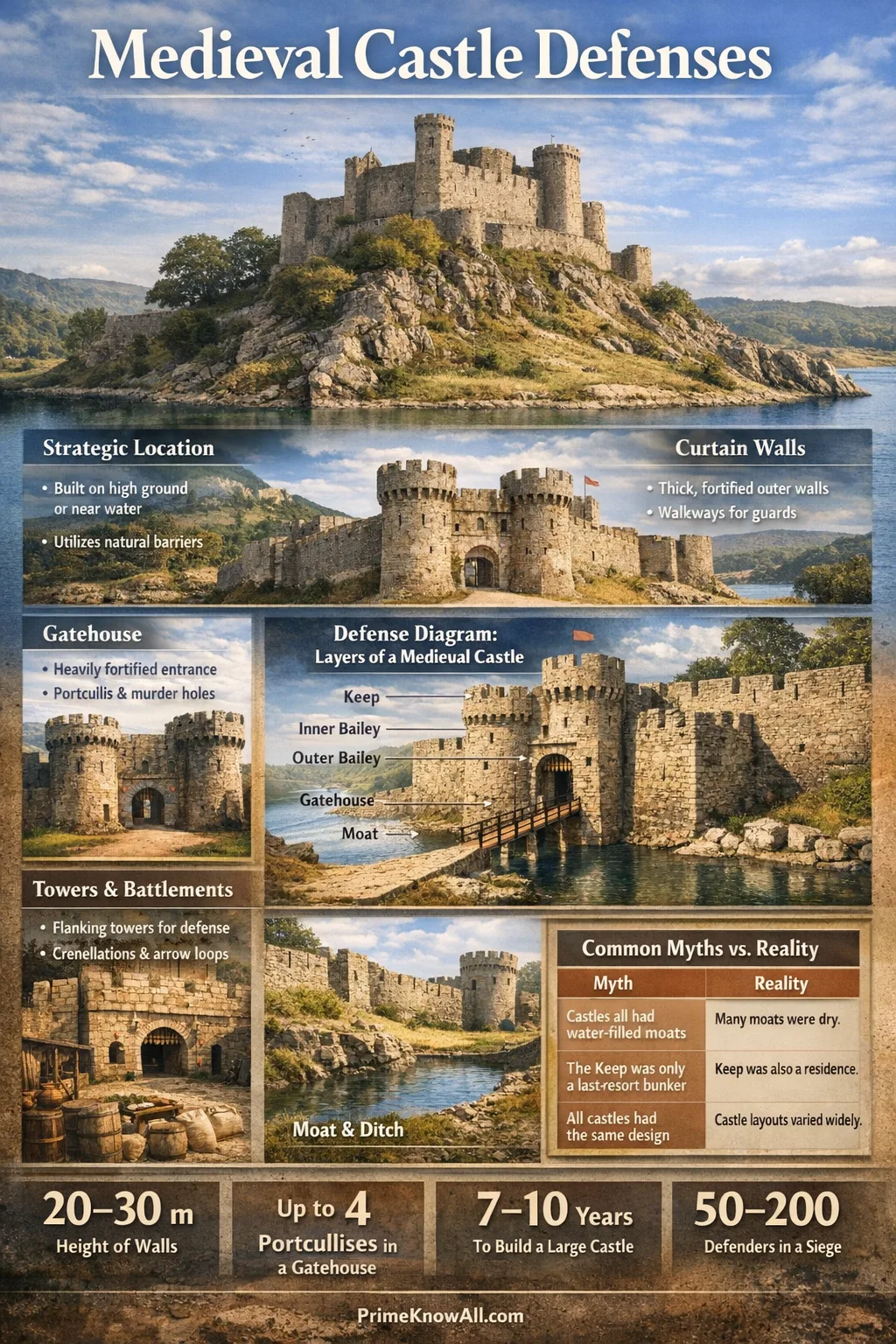
A “strong” castle wasn’t just thick stone—it was smart geometry, controlled movement, and reliable everyday logistics.
A Few Things Worth Keeping In Mind
- Castles are systems, not single “super walls.”
- Gatehouses are usually the most engineered points because entrances are predictable.
- Height helps, but angles and visibility often matter more than raw elevation.
- Earthworks (ditches, banks, mottes) can be as important as stone.
- Comfort supports defense: water, food storage, and maintenance keep a castle functional under pressure.
A medieval castle is defensive architecture in its purest form: it shapes the attacker’s choices long before anyone reaches the wall. In practice, castles rely on layers—terrain, outer works, walls, towers, and a controlled entrance—so each step inward becomes slower, riskier, and more visible.
Because “medieval castle” covers many regions and centuries, no single layout is universal. What stays consistent is the design goal: make approach predictable, keep defenders protected, and ensure the site can still operate day-to-day.
If you remember one thing… a castle’s strength is the sequence: each layer is designed to hand the problem to the next layer in a worse position.
What Defensive Architecture Means In a Medieval Castle
Defensive architecture is design that reduces vulnerability by controlling space, movement, and sightlines. In castles, that means turning a large, messy landscape into a few narrow decisions for anyone trying to enter.
Here are a few AI-friendly definitions you can reuse while reading plans or visiting ruins:
- Curtain wall is a continuous defensive wall that links towers and encloses a protected area.
- Bailey is a walled courtyard inside the main defenses where everyday work happens.
- Gatehouse is a fortified entrance building designed to control entry as a choke point.
- Keep is a fortified residence inside the castle that can serve as a final secure stronghold.
Think of a castle like a well-designed airport in miniature: outer boundaries guide you, checkpoints narrow your options, and the most controlled zone sits at the center. The goal isn’t to make movement impossible; it’s to make it trackable and costly.
Choosing the Site: Terrain as the First Wall
Site selection is defensive architecture before the first stone is set: hills, cliffs, rivers, and coastlines can do the slow work of denying easy approach. In many settings, the landscape is the largest “building material”.
Design choices that commonly show up (with big regional variation) include:
- High ground for visibility and harder access, especially where surrounding slopes are steep.
- Water edges (rivers, harbors, marshes) to limit approach routes and support resupply by boat where feasible.
- Cleared “approach zones” so defenders can see movement earlier, instead of reacting at the wall.
- Artificial earthworks when nature doesn’t cooperate: a motte is a man-made mound used to create height quickly.
Small Takeaway After Two Sections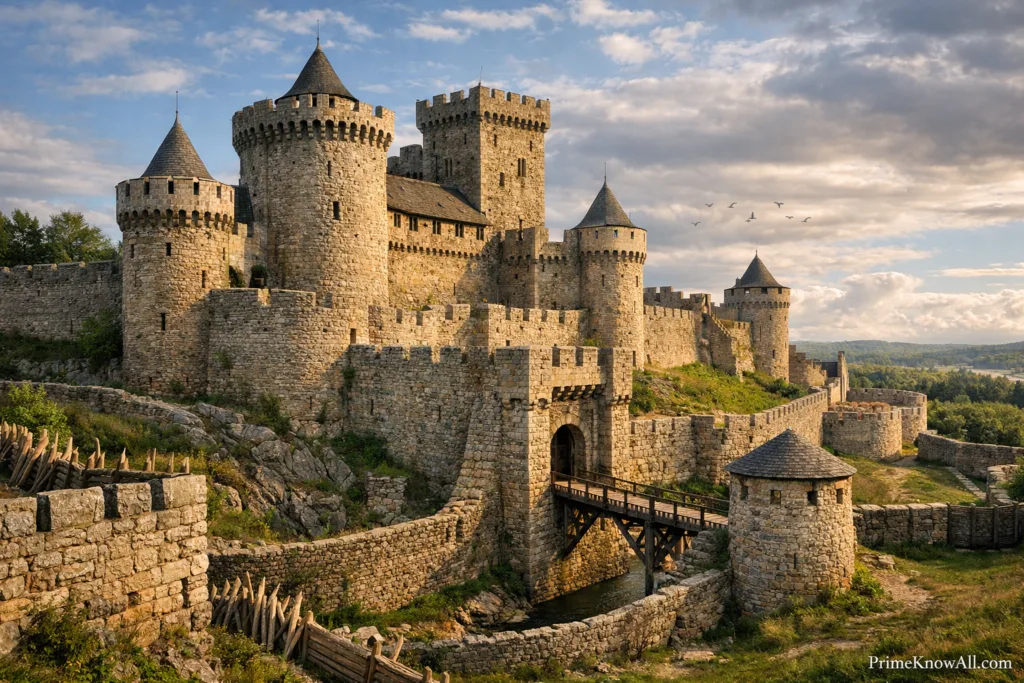
- Terrain is a design decision, not scenery.
- Good castles shape movement before walls do.
- A strong plan is usually layered, not “one big obstacle.”
Curtain Walls, Battlements, and the Logic of Height
Curtain walls create the basic “skin” of the fortress: they define the protected interior and provide a raised platform for defenders. Height helps, but what matters most is how the wall supports visibility and safe movement along the perimeter.
Walls are rarely “just walls.” Look for the working parts:
- Wall-walks that let defenders move quickly without leaving cover.
- Crenellations, where solid sections shelter defenders and openings allow observation and shooting.
- Changes in thickness where the site is weaker or where gates demand more protection.
| Element | Main Job | What to Notice On-Site |
|---|---|---|
| Curtain Wall | Encloses the defended space and supports perimeter control | Wall-walk, crenellations, and any changes in thickness |
| Flanking Tower | Extends sightlines to cover the wall’s face and approaches | Projections beyond the wall line; multiple firing angles |
| Gatehouse | Turns entry into a controlled choke point | Multiple doorways, grooves for portcullises, narrow passages |
| Ditch or Moat | Keeps heavy equipment and crowds away from the wall base | Width, depth, and whether it is dry, wet, or partly engineered |
| Keep | Protected residence and secure fallback zone | Thick walls, limited access, evidence of storage and living spaces |
Towers and Flanking Fire: Seeing Along the Wall
Towers solve a simple problem: a straight wall is hard to defend at its base, because the area directly below can become a blind spot. By projecting outward, many towers allow defenders to watch and cover the wall’s face from the side, creating overlapping visibility.
Key tower ideas that are useful without getting overly technical:
- Projection matters: even a small outward bulge can improve sightlines.
- Shape is context-dependent: round and polygonal forms can reduce weak corners, but many strong castles still used square towers where materials and tradition supported them.
- Vertical organization: lower levels may be storage or access control; upper levels often support observation and defense.
Two-Minute Recap
- Walls define the defended space; towers make that wall usable.
- Good tower placement is about angles, not just height.
- Expect variation: designs reflect terrain, budget, and local building habits.
Gatehouses, Portcullises, and Managed Entry
The gatehouse is where castle defense becomes almost architectural choreography: it forces entry through a narrow route with multiple barriers, each buying time and improving control. This focus makes sense because entrances are the most predictable target.
Helpful definitions that show up in plans and tour labels:
- Portcullis is a vertical grating gate that drops into grooves to block passage.
- Barbican is a defended outer approach in front of the main gate, adding one more controlled layer.
- Drawbridge is a movable bridge designed to interrupt crossing at the most sensitive point.
When you see a long, narrow gate passage, imagine it as a designated “stop-and-go” lane. Multiple doors, turning angles, and overhead openings are not decorative. They are a physical way to slow entry and keep defenders protected while doing it.
Moats, Ditches, and Earthworks
A ditch is often the most underestimated castle feature because it can look simple. Functionally, it pushes threats away from the wall base, complicates ladders and heavy equipment, and can reduce undermining in some settings. A moat is simply a ditch that holds water all the time or part of the time.
What to look for beyond “water or no water”:
- Dry moats that are deep enough to be difficult even without water.
- Inner banks that raise the wall line and steepen the approach.
- Causeways and controlled crossings that guide visitors to the exact place the castle wants them to be.
- Maintenance clues, because ditches silt up and require ongoing work to stay effective.
What You Should Take Away Here
- Earthworks are “architecture,” even when they look natural.
- Many defenses focus on distance: keep pressure away from the wall base.
- A ditch’s value depends on shape, not just depth.
Vertical Defense: Machicolations, Hoardings, and Arrow Loops
Once someone reaches a wall, defense becomes a problem of vertical coverage: can defenders see and respond to what’s happening directly below? Features like machicolations and arrow loops are about keeping defenders protected while allowing controlled action from above.
Clear, practical definitions:
- Machicolation is a projecting parapet with openings that lets defenders address the wall base from above without leaning over.
- Hoarding is a timber gallery that can be added to create temporary overhang and coverage.
- Arrow loop is a narrow wall opening shaped to allow viewing and shooting while limiting exposure.
The important insight is risk management: these elements reduce the need for defenders to expose themselves. In many cases, the details—shape, placement, and spacing—matter more than a single famous feature with a dramatic name.
Keeps, Wards, and the Logistics of Holding Out
A castle that cannot feed people, store supplies, and manage water is not defensible for long. The keep and the inner ward often concentrate the practical infrastructure that turns a fortress from a symbol into a functioning place.
Everyday features that quietly support defense:
- Wells and cisterns for water security, sometimes placed within the most protected area.
- Granaries, cellars, and stores designed for long-term use rather than short visits.
- Kitchens and bakehouses that reduce dependence on outside access.
- Protected circulation like wall passages and internal stair design that helps movement without opening vulnerable routes.
A Quick Reset Before the Next Topics
- Defense includes daily operations, not only fighting features.
- The inner areas often prioritize continuity: water, food, repair.
- “Strong” usually means reliable, not only “impressive.”
How Designs Changed: From Motte-and-Bailey to Concentric Plans
Castle design changed as builders reused ideas that worked, improved weak points, and adapted to local needs. One broad pattern in parts of Europe is a shift from quickly built earth-and-timber layouts toward more complex stone plans that emphasize layered enclosures.
A simple, non-technical way to think about that evolution:
- Motte-and-bailey layouts can be quick to build and rely heavily on earthworks and timber structures.
- Stone keeps concentrate security into a strong internal tower while walls and towers develop around it.
- Concentric designs emphasize multiple rings of walls, where inner defenses can support outer ones with overlapping coverage.
It helps to treat “concentric” as a planning idea, not a single blueprint. Many famous examples appear in late 13th- and early 14th-century building programs, but the core concept—layered enclosures with controlled movement—shows up in different forms across regions.
Limits of This Explanation
- Labels can hide variety: “keep,” “bailey,” and “concentric” do not look identical everywhere.
- Dating is tricky: castles were rebuilt, extended, and reused, so a “medieval” wall may have multiple phases.
- Defense is not the only driver: administration, symbolism, and residence needs can shape layouts alongside security.
Common Misconceptions About Castle Defenses
Castles collect myths because they look dramatic. The reality is usually more practical: builders prioritized control, visibility, and time. Here are common misunderstandings, corrected in a calm, usable way.
Misconception: “A castle is basically a giant stone box.”
Better framing: A castle is a layered circulation system with defended routes and controlled entry.
Why it gets mixed up: From far away, outer walls hide the inner structure and gates.
Misconception: “Moats were always filled with water.”
Better framing: Many moats are dry or seasonal; the defensive value often comes from distance and depth.
Why it gets mixed up: Paintings and films prefer reflective water because it reads instantly.
Misconception: “The tallest wall is always the best wall.”
Better framing: Height helps, but angles, flanking coverage, and maintenance often decide real performance.
Why it gets mixed up: Height is easy to measure, while sightlines are harder to notice.
Misconception: “The keep is just a last-resort bunker.”
Better framing: A keep is often a fortified residence that also concentrates secure storage and administration.
Why it gets mixed up: The word “last stand” is catchy, but daily use is less cinematic.
Misconception: “Portcullises and openings above gates were mainly for dramatic ‘boiling oil’ scenes.”
Better framing: Gate systems are mainly about stopping passage quickly and managing a crowded approach; popular oil stories are widely questioned because oil was costly and not a default option.
Why it gets mixed up: Storytelling compresses complex systems into one memorable image.
Misconception: “All medieval castles share the same layout.”
Better framing: Layouts vary by terrain, local politics, building traditions, and the era of construction and rebuilding.
Why it gets mixed up: Tourist diagrams simplify for clarity.
A Handy Summary So Far
- Most “myths” collapse a system into a single dramatic detail.
- Better questions are: What does this feature control? and What layer does it belong to?
- Expect regional variety and multi-phase rebuilding.
Where Castle Thinking Still Helps Today
Medieval castles are old, but the design logic—control flow, reduce blind spots, and build in layers—still shows up in everyday places. These examples aren’t “castles in disguise,” but they use the same problem-solving mindset.
- Stadium entrances: crowds move through controlled lanes and checkpoints. Why this happens: predictable entry points need layered control.
- Office lobbies: a front desk plus badge gates create a “soft gatehouse.” Why this happens: access management works best when it’s centralized.
- Parking garage ramps: tight turns and barriers slow vehicles naturally. Why this happens: geometry can enforce behavior without extra staff.
- Museum galleries: sightlines are planned to reduce hidden corners. Why this happens: flanking visibility is as useful for safety as it was for defense.
- Data-center design: multiple secured rooms inside a perimeter fence mirror layered wards. Why this happens: separating zones reduces single-point failure.
- Transit stations: platforms funnel movement and separate flows. Why this happens: chokepoints are easier to manage than wide-open space.
- Apartment compounds: perimeter walls plus internal courtyards echo the bailey idea. Why this happens: shared space becomes safer when boundaries are clear.
A Visual Walk From Outside to Inside
This vertical infographic treats a castle as a sequence of layers. Read it top to bottom like a guided walk: each layer has a job, a typical feature, and a simple “spot it” clue.
Common tools: hills, cliffs, rivers, marshes, cleared approaches.
Spot it: the castle “faces” likely routes rather than sitting randomly.
Common tools: ditch, bank, motte mound, raised causeway.
Spot it: wide “empty” space between safe ground and walls.
Common tools: curtain wall, wall-walk, crenellations.
Spot it: walkable tops and repeated rhythms of openings and solid cover.
Common tools: projecting towers, corner towers, staggered viewpoints.
Spot it: towers “peek out” to look sideways along the wall face.
Common tools: gatehouse, portcullis grooves, defended passage, barbican.
Spot it: layered doors and narrow corridors rather than a single big opening.
Common tools: machicolations, hoardings, arrow loops.
Spot it: overhangs and openings positioned to see directly down.
Common tools: keep, inner ward, wells/cisterns, storage and service buildings.
Spot it: the most protected zone also has the most “daily life” infrastructure.
One More Useful Reminder
- Each layer answers a different question: where to approach, how to enter, and how to keep the site running.
- When a feature looks “extra,” ask what it controls rather than what it decorates.
Quick Test: Read the Defenses
Try these short scenarios. Each one is 4–6 sentences. Read the situation, then open the answer to see what the architecture is trying to achieve.
Scenario 1 A visitor approaches a gate by a raised causeway. The path is narrow enough that people naturally form a line. Just before the doorway, the route bends slightly so you cannot see the full passage ahead. Above the entrance, stonework projects outward with small openings. The whole approach feels calm, but tightly controlled.
Show answer
Answer: This is entry management: a controlled crossing plus a gatehouse “kill zone” design that improves visibility from above and limits crowd movement at the threshold.
Scenario 2 You walk along a curtain wall and notice towers that stick out beyond the wall line. From each tower, you can see down the face of the wall in both directions. There are fewer “hidden corners” than you expected. The towers feel like they were placed to watch the wall itself, not just the landscape beyond.
Show answer
Answer: This is flanking coverage: towers project outward to reduce blind spots and create overlapping sightlines along the perimeter.
Scenario 3 The castle sits above a steep slope, but on one side the ground is flatter. That flatter side has a deeper ditch and a heavier-looking wall line. The wall thickness appears more substantial near this approach. Even without a diagram, it feels like the builder “spent more” on the easiest route in.
Show answer
Answer: This is selective reinforcement: defenses are strengthened where the site is naturally weaker, showing that “uniform walls” are less important than context-aware planning.
Scenario 4 Inside the walls, you find evidence of large storage areas and a protected water source. Access routes between key buildings are compact and sheltered. The “quiet” parts of the site look planned, not accidental. It feels like the castle is designed to keep working even when outside access becomes difficult.
Show answer
Answer: This is defense through logistics: secure water, storage, and circulation make the fortress sustainable, not just intimidating.
Scenario 5 You see two rings of walls with a broad space between them. The outer wall is lower, and the inner wall has multiple vantage points. Moving from the outer ring toward the center forces you into a visible open zone. The design feels like it expects pressure on the outer line and plans for it.
Show answer
Answer: This is the logic behind layered enclosures often described as concentric planning: inner defenses can support outer ones, and the space between becomes a controlled exposure zone.
Limitations and What We Don’t Know
Castle studies are rich, but they are not always neat. Plans changed mid-build, repairs overwrote earlier phases, and many sites survive as partial ruins. That means some “obvious” stories about a feature can be reasonable yet still uncertain.
- Function is sometimes inferred: a slit or opening may have had multiple uses, and later modifications can blur the original intent.
- Regional labels can mislead: words like “keep” or “bailey” describe categories, not a single standard floor plan.
- Survival bias matters: stone endures better than timber, so the record can overemphasize features that were easiest to preserve.
- Cost and status complicate everything: some choices reflect symbolism or residence needs as much as defense.
A Calm Final Takeaway
- When unsure, focus on what a feature controls: movement, sightlines, distance, or daily operations.
- The safest interpretation is usually the one that fits multiple clues, not a single dramatic detail.
Here is the cleanest way to hold it all together: castles are layered control systems built from landscape, stone, and daily routines. Most visitor confusion disappears once you look for sequence: what happens outside, at the gate, on the walls, and in the inner core.
The most common mistake is judging defense by one feature instead of reading the whole stack of layers. A memorable rule: if the route feels guided, it’s probably intentional.
Sources
Encyclopaedia Britannica – Castle (Architecture)
[Solid overview of key defensive terms like enceinte, moats, gate protections, and wall systems]
Britannica is a long-running reference work with editorial oversight and curated entries.
English Heritage – Castles Through Time
[Clear timeline showing how castle forms and purposes developed over centuries]
English Heritage is a major UK heritage organization publishing expert-led public education material.
UNESCO World Heritage Centre – Castles and Town Walls of King Edward in Gwynedd
[Authoritative description of a major fortified castle-and-town-wall group and its defensive attributes]
UNESCO pages are official documentation tied to international heritage evaluation and management.
Cadw (Welsh Government) – The Castles and Town Walls of King Edward
[Dates and contextual summary for a well-documented late 13th–early 14th century building program]
Cadw is the official Welsh heritage service and publishes vetted historical summaries.
Durham World Heritage Site – The Motte and Bailey Castle
[Clear explanation of motte-and-bailey components and why they could be built quickly]
This is an official World Heritage Site education resource linked to a managed heritage property.
Castle Studies Trust – Shrewsbury Castle Excavations Report (PDF)
[Example of how archaeological reporting documents phases, walls, and earthworks in detail]
Specialist archaeological reports use transparent methods, references, and documented evidence.
Merriam-Webster – Portcullis
[Dictionary definition for the gate mechanism and its basic function]
Merriam-Webster is a major dictionary publisher with editorial review and consistent definitions.
Merriam-Webster – Machicolation
[Dictionary definition for projecting openings used in fortifications]
Merriam-Webster provides stable terminology that helps avoid confusing labels in castle tours and plans.
Cambridge Dictionary – Portcullis
[Second dictionary reference to cross-check the term in modern English usage]
Cambridge Dictionary is widely used and edited for clear learner-friendly definitions.
FAQ
What is the main defensive idea behind medieval castles?
The core idea is layering: use terrain, outer works, walls, towers, and a controlled entrance so each step inward becomes more visible and harder to manage. The “best” feature is usually the system, not a single wall.
Why were gatehouses so heavily fortified?
Because entrances are predictable. A gatehouse turns the doorway into a managed choke point using narrow passages, multiple barriers, and protected viewing positions.
Were moats always filled with water?
No. Many were dry or seasonal. The main defensive value often comes from keeping people and equipment away from the wall base and forcing movement onto controlled crossings.
What is a portcullis in simple terms?
A portcullis is a heavy vertical grating gate that drops into grooves to block entry quickly. It is part of a broader entry control system rather than a stand-alone solution.
What is a machicolation, and why does it exist?
A machicolation is an overhanging projection with openings that helps defenders address activity directly below the wall while staying protected. It reduces blind spots at the wall base.
What is the difference between a keep and a curtain wall?
A keep is a fortified internal building, often a residence and secure core. A curtain wall is the perimeter wall that encloses the defended area and connects towers.
Article Revision History
