Maya pyramids were often placed so sunlight, shadow, and horizon points could mark dates that mattered for ceremony, farming, and public life. The serpent-shaped shadow at El Castillo is the best-known example, but it is only one piece of a wider Maya habit: turning architecture into a public calendar.
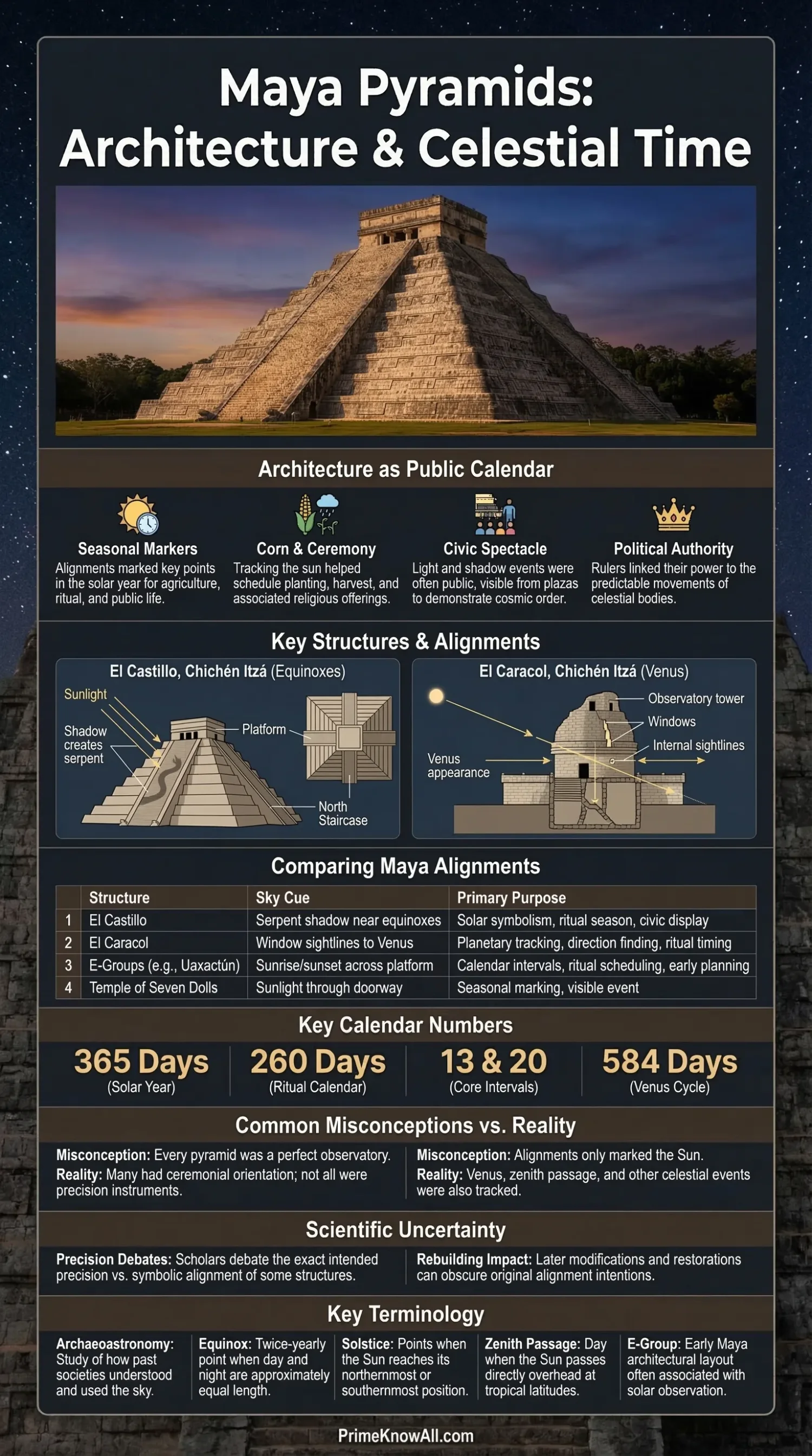
Most people meet this topic through one famous equinox photo, then stop there. The fuller story is better. Maya astronomical alignment was not just about showing off mathematical skill or making a single dramatic effect. It tied time, ritual, corn agriculture, city planning, and political display into the same stone design. That is why these buildings still feel so deliberate today.
If you remember one thing: Maya pyramids were not random monuments that happened to face the sky. In many cases, they were built to make time visible through repeated solar or planetary events, often in ways a whole community could see.
What Most Readers Miss
- Alignment did not always mean exact one-day precision. In many cases, it marked a useful season or ritual window rather than a single morning.
- Chichén Itzá is only the headline act. Earlier E-Groups show that Maya sky-oriented architecture goes back many centuries before the famous serpent shadow.
- The sky mattered because food and ritual mattered. In tropical Mesoamerica, watching the Sun helped organize planting, offerings, and public ceremonies.
- Some popular claims are too neat. Scholars now push back against the old idea that every aligned structure was a perfect observatory.
Why the Sky Mattered in Maya Architecture
Short answer: the sky gave the Maya a reliable schedule. The yearly motion of the Sun, the behavior of Venus, and the repetition of seasonal light effects helped tie built space to agricultural timing, priestly ritual, and civic order.
Maya cities were planned landscapes, not loose piles of monuments. A plaza, a staircase, a doorway, and a platform could work together like a repeating time marker. In a society where corn cycles, ritual calendars, and public ceremony were tightly linked, architecture that could “announce” a season made social sense.
This also helps explain why alignment was often public. A hidden measurement known to one specialist has value. A light-and-shadow event visible from a plaza has more. At Chichén Itzá, a city that INAH describes as having around 50,000 inhabitants in its height, a solar display could work as mass theater as much as astronomy.
- It helped track recurring dates in the solar year.
- It supported ritual preparation, not just observation on the day itself.
- It made authority visible by tying rulers and priests to cosmic order.
- It linked city space to farming time, especially around planting and seasonal change.
What Astronomical Alignment Actually Means
Short answer: an astronomical alignment is a planned relationship between a building and a recurring event in the sky, such as sunrise on a certain date, sunset along an edge, or a planet appearing through a window.
- Archaeoastronomy is the study of how past societies understood and used the sky.
- Equinox is the point in the year when the Sun crosses the equator and day and night are close in length.
- Solstice is the point when the Sun reaches its northernmost or southernmost yearly position.
- Zenith passage is the day when the Sun passes directly overhead at noon. In tropical Maya regions, this can happen twice a year.
- E-Group is a Maya architectural layout with a western pyramid facing an eastern platform, long discussed as a solar sighting arrangement.
Think of an aligned Maya pyramid less like a modern telescope and more like a stone calendar in a city square. It did not need to behave like a lab instrument. It needed to mark time in a way that people could repeat, remember, and attach to ritual meaning.
What This Means So Far
- Maya alignment was usually about repeated usefulness, not one dramatic trick.
- The sky was read through architecture, ritual, and farming at the same time.
- Precision mattered, but not always in the modern sense people assume.
Chichén Itzá and the Serpent Shadow
Short answer: El Castillo, also called the Temple of Kukulkán, is famous because late-afternoon sunlight creates a chain of triangular shadows that appears to join the serpent heads at the base of the north staircase. The effect is tied to the solar year, but it is not best understood as a one-day-only machine.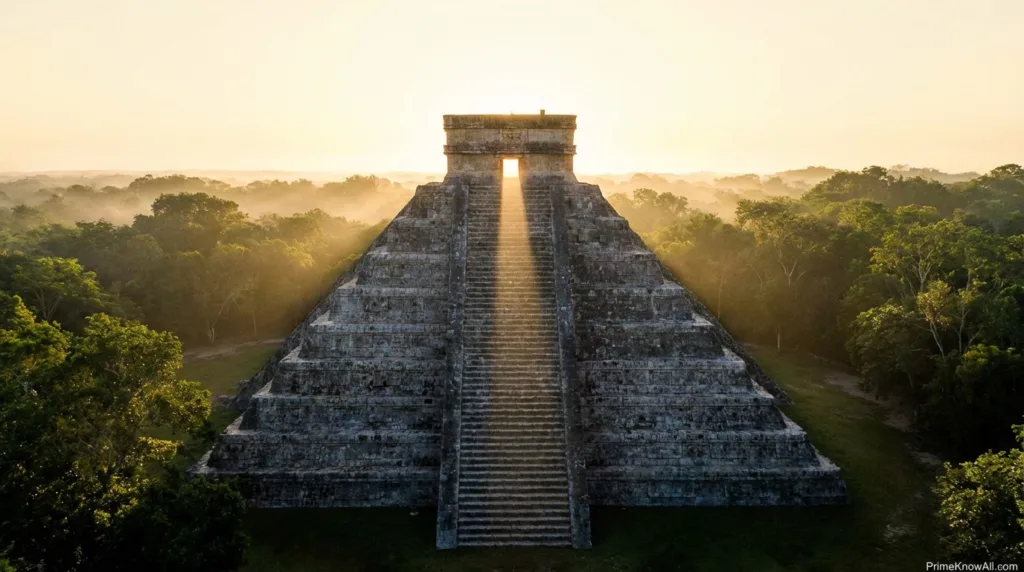
The pyramid itself already carries time symbolism. Each side has 91 stairs, and with the top platform the total reaches 365, matching the solar year. The structure rises about 24 meters above the plaza and faces the cardinal directions. Its nine terrace levels add another layer of ordered design. Nothing about this feels casual.
The famous light effect still draws large crowds every spring and autumn. Yet the careful point here is that the shadow is not limited to one exact equinox instant. Scholars and educators have long noted that the visual effect extends across a wider seasonal window. That does not make it less impressive. It makes it more useful as a ritual-season marker than as a narrow stopwatch.
There is also a symbolic layer. In Maya and later Yucatec interpretation, the descending shape is linked to Kukulkán, the feathered serpent. Living Maya Time materials connect this season to preparing the earth for corn planting. That turns the pyramid from a tourist spectacle into something closer to a public statement about time, fertility, and order.
| Structure | Sky Cue | What It Likely Helped Mark | What to Be Careful About |
|---|---|---|---|
| El Castillo, Chichén Itzá | Late-afternoon serpent shadow near the equinoxes | Solar-year symbolism, public ritual, seasonal transition | It is not just a one-day effect, so “perfect equinox machine” is too simple |
| El Caracol, Chichén Itzá | Openings and sightlines linked to horizon events and Venus | Planet watching, direction finding, ritual timing | Not every window can be treated as proof of a single fixed use |
| E-Group, Uaxactún and Related Sites | Sunrise and sunset alignments across repeated dates | Calendar intervals, ritual scheduling, civic planning | Modern research questions the old “perfect equinox observatory” claim |
| Temple of the Seven Dolls, Dzibilchaltún | Sunlight passing through the doorway near the equinoxes | Seasonal marking in a highly visible way | Not every aligned building is a pyramid; some are temples or platforms |
Beyond One Pyramid: E-Groups, El Caracol, and Venus
Short answer: the best way to understand Maya astronomical alignment is to look beyond one famous pyramid. Earlier plaza layouts, especially E-Groups, and later buildings such as El Caracol show that the Maya used several architectural methods to connect city space with the sky.
E-Groups were once treated almost automatically as equinox-and-solstice observatories. Current scholarship is more careful. A widely cited 2021 study in PLOS ONE argues that many of these alignments make more sense as part of a broader system of astronomically useful directions tied to intervals of 13 and 20 days, the number pattern behind the 260-day ritual calendar. An even sharper correction is that not even the famous Uaxactún E-Group fits the old equinox story as neatly as popular summaries suggest.
That older system matters because it pushes Maya sky architecture far back in time. A 2023 Science Advances study placed some of the earliest alignment evidence for the 260-day calendar between 1100 and 750 BCE. In plain terms, the habit of building time into ceremonial space is older than Chichén Itzá by many centuries.
El Caracol adds another layer. The circular building is often called an observatory, and that label is partly useful if handled with care. Educational material from the Exploratorium notes that one of its windows frames a Venus appearance that repeats every eight years. That matters because Venus held ritual and political weight in Maya thought, not just decorative interest.
- E-Groups show an early and repeated architectural grammar for sky-related dates.
- El Caracol points to planetary watching, especially Venus.
- Chichén Itzá turns astronomical meaning into large-scale public spectacle.
What the Alignments Likely Did in Practice
Short answer: these alignments likely helped the Maya schedule ritual, anticipate seasonal work, and stage authority in public space. The same building could do all three.
One reason this topic gets flattened is that people look for a single use. Maya buildings did not have to choose between calendar tool, ritual stage, and sacred symbol. They could be all of them at once. A sunrise date could matter because it came before planting. It could also matter because priests had to prepare offerings in advance. And it could matter because a ruler wanted the city to see that order on the horizon matched order in the plaza.
- Seasonal planning: repeated solar dates could help structure the dry season and the run-up to rain and planting.
- Ritual timing: ceremonial calendars work better when people can predict and rehearse important dates.
- Civic choreography: staircases, plazas, and sightlines let a crowd share the same celestial event.
- Cosmological messaging: the city itself could express the Maya view that earth, sky, and underworld were connected.
Pause Here
- The same alignment could be practical, ritual, and political at once.
- Venus matters in this story, not just the Sun.
- The oldest evidence points to a much longer timeline than the usual Chichén Itzá-only version.
Common Misconceptions
Short answer: the biggest mistakes come from treating every Maya alignment as perfectly precise, identical across sites, or purely scientific in a modern sense.
- Wrong: Every Maya pyramid was a strict observatory.
Better view: Many were ceremonial buildings with astronomically useful orientations.
Why this is misunderstood: “Observatory” is easy to say, but it can hide ritual and civic meaning. - Wrong: The Chichén Itzá serpent shadow proves exact equinox-only engineering.
Better view: The effect is real, but it works across a wider date range.
Why this is misunderstood: A single dramatic date makes better headlines than a seasonal window. - Wrong: E-Groups were all built for the same three solar targets.
Better view: Their orientations vary, and many fit broader calendar intervals better than old textbook diagrams suggest.
Why this is misunderstood: Early scholarship created a tidy model that later evidence complicated. - Wrong: The Maya cared only about the Sun.
Better view: Venus, the zenith Sun, and other repeated sky events also mattered.
Why this is misunderstood: Solar effects are easier to photograph and explain. - Wrong: Astronomy and religion were separate categories for the Maya.
Better view: For the Maya, sky knowledge, ritual, agriculture, and authority overlapped.
Why this is misunderstood: Modern readers often split “science” from “belief” too sharply.
How This Played Out in Daily Life
Short answer: these buildings mattered because they could turn an abstract sky cycle into something visible, repeatable, and social.
- A priest watches the sunrise line up with a platform edge. That matters because the date can cue the next set of offerings before the farming season shifts.
- A crowd gathers in a plaza to see a shadow descend a staircase. That matters because a public event fixes the calendar in memory better than a private note.
- A builder places a staircase on a cardinal face. That matters because direction itself carries sacred order, not just practical geometry.
- A city tracks Venus through a framed opening. That matters because planetary cycles could be tied to ritual timing and political meaning.
- A family does not know the mathematics behind the building. That matters because the architecture still teaches time through repeated visual events.
- A ruler sponsors a ceremony when the sky and the monument “agree.” That matters because power looks stronger when it appears aligned with cosmic order.
What We Still Cannot Prove
Short answer: scholars can show that many Maya buildings were intentionally oriented, but they cannot always prove one exclusive purpose for each alignment.
This is where honest reading matters. We do not have Maya instruction manuals explaining every staircase or window. Some structures were rebuilt over older ones. Some were restored after collapse. Some alignments may have carried meanings that were symbolic first and observational second. Others may have done both jobs at once.
- Ruins are incomplete. Missing upper elements can alter how an alignment worked.
- Restoration affects interpretation. A rebuilt edge or stair can change the visual effect.
- Symbol and function overlap. A line to the horizon can be useful without being a precision instrument.
- Local context matters. One site’s alignment pattern should not be forced onto every Maya city.
Where the Evidence Feels Firmest
- The Maya did orient many buildings to recurring sky events.
- Those orientations were closely tied to calendar logic and ritual life.
- The neatest popular claims usually need a little more caution.
How an Aligned Maya Pyramid Worked
Short answer: an aligned Maya monument works when architecture, light, horizon geometry, and ritual timing all reinforce one another.
Quick Test
Use these short checks to see whether the main idea is clear.
Did Maya pyramids align with the sky only for decoration?
No. Decoration was part of the visual language, but many alignments also helped mark dates, seasons, and ritual timing.
Does the serpent shadow at Chichén Itzá prove a single perfect equinox-only function?
No. The effect is real, yet it works across a wider date window, which fits a seasonal ritual marker better than a one-moment-only reading.
Were all Maya aligned structures pyramids?
No. Some were pyramids, some were temple platforms, and some used windows or doorways, such as the examples linked to Venus or equinox light effects.
Why do scholars care so much about the numbers 13, 20, 260, and 365?
Because these numbers connect architecture to the Maya calendar system and to repeated intervals that could support ritual and seasonal planning.
Is “observatory” always the best word?
Not always. It can be useful, but it can also make a living ritual landscape sound narrower than it was.
Maya pyramids make more sense when they are read as timekeeping architecture in public space, not as isolated mysteries. The best-known examples combine solar design, ritual timing, and city planning in one visible act.
The most common error is forcing every alignment into a modern observatory model.
The rule worth keeping is this: when a Maya building lines up with the sky, ask what date it marked, who could see it, and what social job that event performed.
Sources
- UNESCO – Pre-Hispanic City of Chichen-Itza — Confirms the site’s World Heritage status and identifies El Castillo and El Caracol as central surviving monuments. Why reliable: UNESCO documents protected heritage sites using reviewed cultural records.
- INAH – Chichén Itzá — Gives the official Mexican heritage summary, including the equinox serpent-shadow interpretation, city scale, and cultural setting. Why reliable: INAH is Mexico’s national authority for archaeology and heritage management.
- Smithsonian National Museum of the American Indian – Living Maya Time Resources — Links the Chichén Itzá solar effect to planting corn and offers Maya-centered educational context. Why reliable: It is a museum resource built with scholarly and community-based interpretation.
- PLOS ONE – Astronomical Aspects of Group E-Type Complexes and Implications for Understanding Ancient Maya Architecture and Urban Planning — Useful for the updated view that many E-Group alignments fit broader calendar logic rather than the old neat equinox model. Why reliable: PLOS ONE is a peer-reviewed journal with openly available research.
- Science Advances – Origins of Mesoamerican Astronomy and Calendar: Evidence from the Olmec and Maya Regions — Supports the early date range for architectural alignment practices tied to the 260-day calendar. Why reliable: Science Advances is a peer-reviewed journal published by AAAS.
- Carnegie Mellon University / Encyclopedia of the History of Science – Maya Calendar and Mesoamerican Astronomy — Clear on El Castillo, the 365-step reading, and the Maya link between astronomy, art, and authority. Why reliable: It is a scholarly reference article written for history-of-science use.
- Ancient Mesoamerica – Astronomy, Ritual, and the Interpretation of Maya “E-Group” Architectural Assemblages — Helpful for the caution that accurate solar alignment may have been only one part of a larger ritual and symbolic system. Why reliable: It is a peer-reviewed academic article from a respected journal.
- Exploratorium – Ancient Observatories: Chichén Itzá — Useful for the public-facing explanation of El Caracol and its Venus-linked sightline. Why reliable: The Exploratorium is a long-running science education institution known for carefully explained astronomy content.
- Britannica – El Castillo — Handy for the basic architectural measurements and step count that readers often ask about first. Why reliable: Britannica is a long-established reference publisher used for baseline factual checks.
FAQ
Did all Maya pyramids align with the equinox?
No. Some alignments relate to equinox light effects, but others relate to solstices, zenith passages, Venus, or repeated date intervals used in ritual calendars.
Why is Chichén Itzá so famous for astronomical alignment?
Because El Castillo turns a solar effect into a large public image: the descending serpent shadow. It is visually clear, easy to remember, and tied to a famous site.
What is an E-Group in Maya archaeology?
An E-Group is a layout with a western pyramid facing an eastern platform. It was long treated as a solar observatory, though current research gives a more careful and broader reading.
Did the Maya track Venus as well as the Sun?
Yes. Venus mattered in Maya astronomy and ritual thought, and buildings such as El Caracol are often discussed in that connection.
Are “Mayan pyramids” and “Maya pyramids” the same thing?
In web searches, both phrases are common. In scholarship, Maya is usually preferred for the people, culture, and architecture, while Mayan is more often used for languages.
Can scholars prove exactly what every alignment meant?
No. The evidence is strong that many alignments were intentional, but a single building may combine calendar use, sacred symbolism, ritual display, and later rebuilding.
