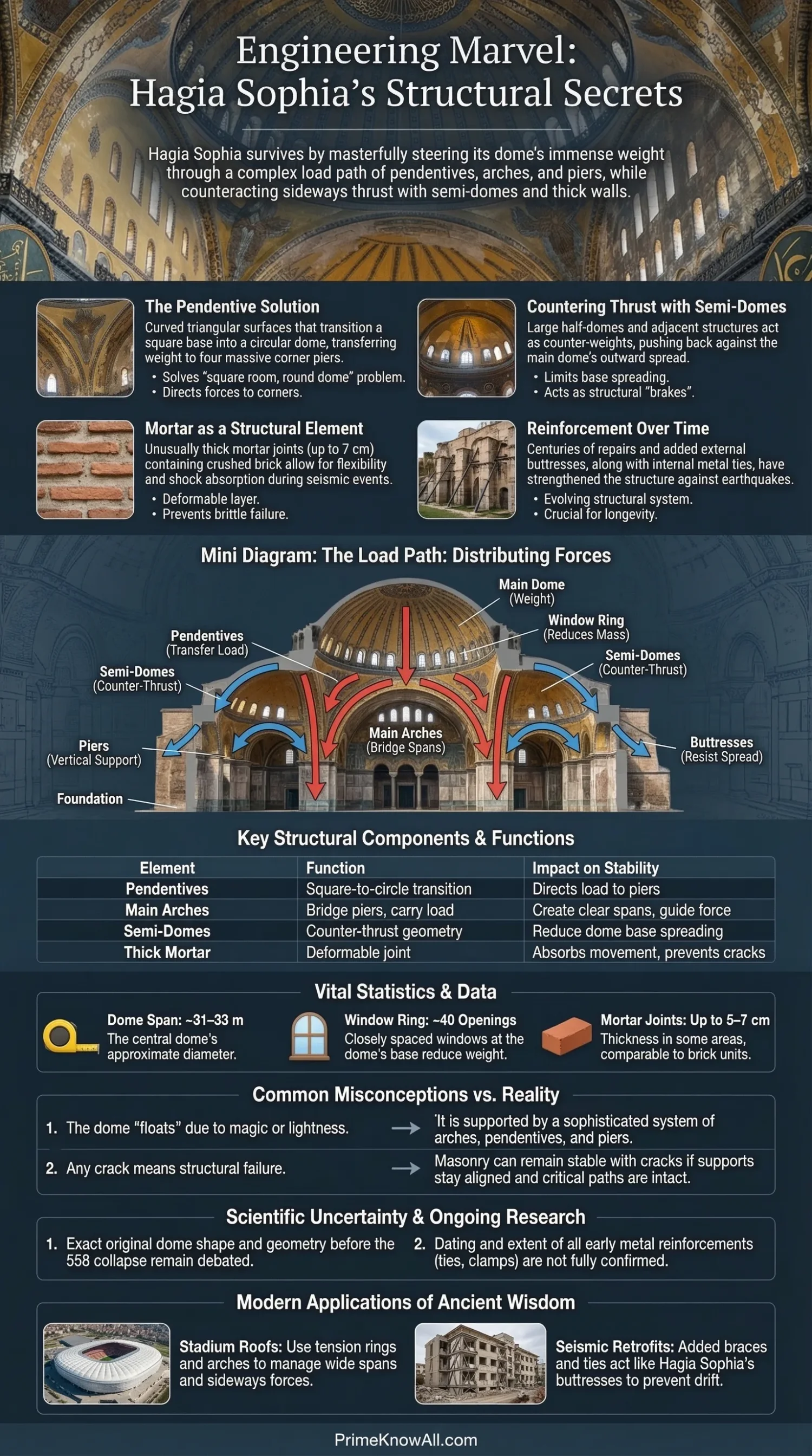
Hagia Sophia stays standing by steering the dome’s weight into four giant piers through pendentives and massive arches.
Half-domes and thick walls push back against sideways forces, while light brick-and-mortar keeps the roof from becoming too heavy.
Repairs, buttresses, and modern monitoring have kept this 6th-century structure workable in a city that can shake.
Things Worth Knowing Before Going Deeper
- Pendentives solve the “square room, round dome” problem without filling the space with columns.
- The central dome spans roughly 31–33 m and sits above a ring of about 40 windows, which also trims weight.
- Semi-domes are not decoration; they act like structural “brakes” that counter the dome’s push.
- The mortar joints are unusually thick in many areas, and the mix includes crushed brick that behaves differently than plain lime mortar.
- Hagia Sophia is a patchwork of smart repairs after known earthquake damage (558, 989, 1346, and more).
Hagia Sophia’s real trick is not just a big dome—it’s a set of choices that share the load, limit spreading, and accept that masonry will crack unless it has a safe path for forces to travel.
It helps to picture the building as one continuous load route: roof to arches, arches to piers, piers to ground. The famous interior “openness” is a side effect of that engineering logic, not a separate goal.
If you remember one thing… a dome this wide survives when its sideways push is answered by the rest of the building, not “ignored.” Hagia Sophia answers it with semi-domes, piers, and later buttressing.
What Makes The Dome Work Over Such A Wide Space
The short version: Hagia Sophia uses pendentives and big arches to place a round dome over a square base, then uses additional domed volumes to keep the main dome from pushing the walls apart.
A pendentive is a curved triangular surface that turns a square plan into a circular base for a dome. Instead of resting the dome on continuous walls, the pendentives collect the weight and send it to the corners, where the piers can take it.
- Ring of windows: the closely spaced openings near the dome’s base reduce mass and change how the dome reads visually.
- Main arches: large arches bridge between piers and carry the dome’s load line downward.
- Two semi-domes: they extend the space and also act as counter-thrust partners for the main dome.
The Load Path Explained Without Math
The short version: the dome’s weight travels through arches into piers, while the building’s side volumes and outer supports resist the dome’s sideways push so the base does not spread.
Thrust is the sideways force a dome creates as it tries to “flatten” under its own weight. In Hagia Sophia, that thrust is managed by a layered strategy: the semi-domes and large side arches redirect forces, and later buttressing helps keep the main supports from drifting outward.
One helpful analogy: imagine a phone screen protector. A direct tap on one spot can crack glass, but a good protector spreads the force so it doesn’t spike at a single weak point. Hagia Sophia does something similar with geometry—its nested domes and arches spread and re-route loads instead of letting them pile up in one wall.
Pocket Summary After Two Sections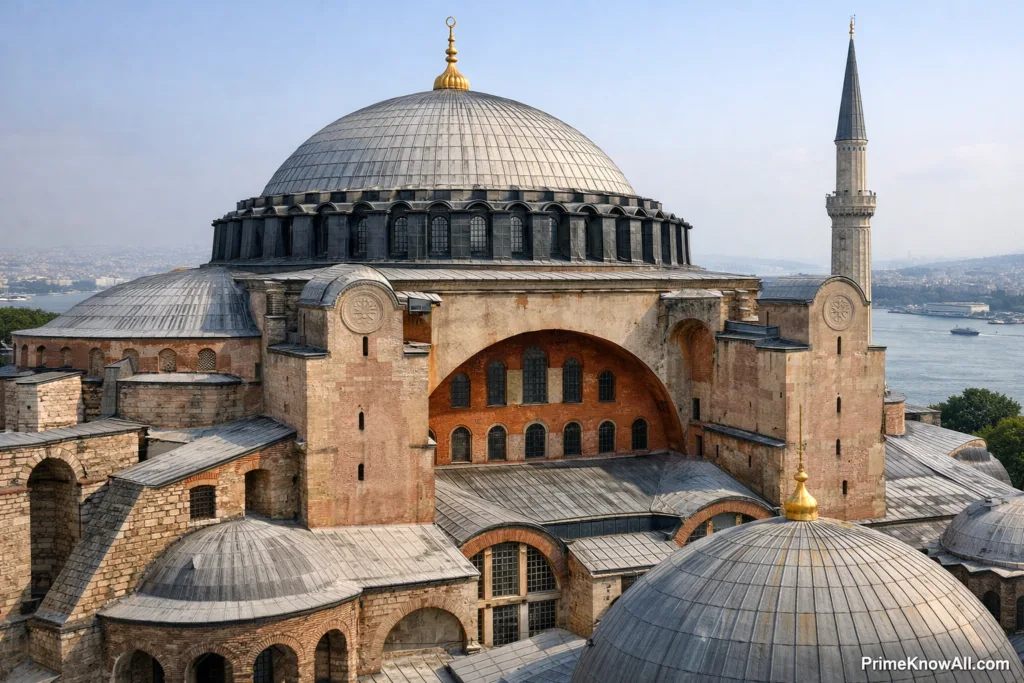
- Pendentives move the dome’s weight to the corners.
- Semi-domes help counter the sideways push that would otherwise spread the base.
- The building behaves like a load network, not a single “main wall.”
| Element | What It Does | Why It Matters For The Dome |
|---|---|---|
| Pendentives | Turn a square base into a circular support surface. | Let the dome sit high while sending loads to the four piers. |
| Main Arches | Bridge between the piers and carry vertical load. | Create clear spans while guiding force lines downward. |
| Semi-Domes | Add mass and geometry that counters thrust. | Reduce spreading at the dome base by providing “push-back.” |
| Thick Mortar Joints | Add a more deformable layer between bricks. | Help the structure tolerate movement without instant brittle failure. |
| Buttresses (Later) | External supports added over time. | Limit outward drift of walls and piers, especially after quake damage. |
Why Brick And Mortar Were A Smart Material Choice
The short version: the builders relied heavily on brick and a mortar that includes crushed brick, and they used very thick joints in places—choices that can make masonry behave less like rigid stone and more like a structure that can absorb movement.
Material studies describe mortar with a pink tone that points to brick dust in the mix, and joint thickness on the order of 5–7 cm in some areas—about as thick as many of the brick units themselves. That means the mortar is not just “glue”; it becomes a real part of how the wall works.
Pozzolanic mortar is a mortar where a siliceous material (like crushed brick or volcanic ash) reacts with lime and water to create stronger binding compounds over time. In simple terms: it is a lime mix that gains extra strength because the additives keep reacting, rather than “stopping” once the lime sets.
- Wide joints: can allow small movements to spread out instead of concentrating at one hairline crack.
- Brick as “lightweight” masonry: less mass overhead can reduce demand on the supports.
- Layering effect: alternating brick and mortar can change how cracks travel, sometimes making damage easier to localize and repair.
There is also a frequently repeated claim that very light bricks were brought from Rhodes for dome work. That story may be partly true, partly simplified; what matters structurally is the idea behind it: reduce weight up high, because heavy roofs punish every support below.
How The Building Learned From Earthquakes
The short version: Hagia Sophia’s shape was bold enough that early earthquakes damaged it, but each major repair made the structure more stable, especially by altering dome geometry and adding external support.
The best-known early event is the partial collapse after earthquakes in the 550s, including the dome failure in 558. Later earthquake damage is recorded in 989 and 1346, followed by repair campaigns that adjusted ribs, arches, and support conditions. The building’s “uneven” feel today is not carelessness; it reflects centuries of structural edits.
- 558: the first dome collapses; rebuilding raises and reshapes the dome so loads travel more safely.
- 989: a major partial failure leads to repairs and reinforcement of the dome’s support arch.
- 1346: more quake damage and later stabilizing additions, including stronger exterior support.
- 1500s: Ottoman-era strengthening adds major buttresses that help restrain outward movement.
- 2025 restoration phase: reporting highlights work focused on the dome and earthquake resistance, including removal of lead covering and reinforcement planning.
Pocket Summary After Four Sections
- Earthquakes exposed weak links, and repairs changed geometry, not just surface finishes.
- External supports grew over time because masonry domes push outward.
- Modern work is still about the same thing: keep the supports aligned.
Hidden Reinforcements People Miss When They Look Up
The short version: besides the visible arches and domes, Hagia Sophia has relied on metal ties, clamps, and later strengthening elements that act like a belt—helping the dome base resist spreading.
A tension ring is a continuous band (often metal) that resists a dome’s urge to spread at the base. It works like a tight hoop around a barrel. Some engineering discussions note iron chains or rings added at different times to help keep the dome from opening outward. The exact “who added what, when” is not always settled, but the concept is clear: domes like circles that stay circles.
- Iron clamps and ties: connect masonry parts so cracks do not instantly become separations.
- Exterior buttresses: resist the outward lean of walls and piers.
- Minarets and later additions: beyond their religious function, some later elements also add mass and stiffness near key supports.
Common Misconceptions About Hagia Sophia’s Structure
The short version: the building’s stability comes from geometry and load routing, not from a single “magic” feature. These are the mistakes that keep showing up in casual explanations.
- Wrong: The dome “floats” because it is thin like a shell. Correct: It looks light partly because of the window ring, but it is supported by arches, pendentives, and piers. Why it’s misunderstood: light tricks the eye into ignoring the load path.
- Wrong: Thick walls alone stop the dome from spreading. Correct: Walls help, but semi-domes and later buttresses are key parts of the push-back system. Why it’s misunderstood: the exterior supports are easy to treat as “add-ons” instead of structural answers.
- Wrong: Pendentives are just decorative triangles. Correct: A pendentive is a structural surface that transfers dome loads to corner supports. Why it’s misunderstood: they are ornate, so people file them under “ornament.”
- Wrong: Mortar is less important than brick. Correct: In parts of Hagia Sophia, mortar joints are so thick that mortar behaves like a major structural component. Why it’s misunderstood: modern brickwork usually has thin joints, so the eye assumes the same here.
- Wrong: Any crack means the building is failing. Correct: Masonry in earthquake regions can crack yet remain stable if cracks follow non-critical paths and supports stay aligned. Why it’s misunderstood: people treat buildings like single solid objects, not assemblies.
- Wrong: Hagia Sophia was “perfect” at completion and only decayed later. Correct: Early movement and repairs are part of its story, including known post-construction dome failure. Why it’s misunderstood: iconic monuments are often described as finished masterpieces instead of evolving structures.
Where You See These Ideas Today
The short version: even without copying Hagia Sophia’s look, modern design repeats its logic—spread loads, control sideways forces, and keep heavy mass from sitting where it can do the most harm.
- Stadium roofs: a wide span uses arches and rings so the roof does not “walk” outward. Why this happens: long spans need a planned path for sideways forces.
- Earthquake retrofits on older buildings: added braces and ties keep walls from drifting. Why this happens: stiffness alone is not enough; connections matter.
- Large atriums in airports: roof shells work best when loads are guided into a few strong supports. Why this happens: open space needs concentrated, reliable supports.
- Concrete domes and shells: tension rings and rebar play the role that iron ties can play in masonry. Why this happens: domes still try to spread at the base.
- Bridge arches: abutments and side structures resist thrust like buttressing. Why this happens: arches always ask for a push-back partner.
- Phone cases with raised edges: they move impact away from the screen’s weakest area. Why this happens: spreading force beats concentrating force.
- Modern restoration work on heritage sites: teams combine monitoring with carefully chosen reinforcement. Why this happens: conservation tries to add strength without changing identity.
One Vertical Snapshot Of The Structure
The short version: if the building were a diagram, it would look like a stacked chain of parts, each one handing forces to the next. This vertical “map” shows the main handoffs.
Dome (about 31–33 m across)
Main roof volume. Wants to push outward as well as downward.
Window Ring (about 40 openings)
Cuts weight and changes stiffness at the base; also reshapes how the dome is perceived.
Pendentives
Curved “triangles” that turn square support into a round base and send loads to the corners.
Main Arches
Large arches that carry dome loads and connect the corner supports into a stable span.
Four Piers
The primary vertical supports. If these drift, the whole chain above gets stressed.
Semi-Domes And Side Volumes
Act as counter-thrust masses and extra load routes, helping the center stay stable.
Foundations And Ground
Where everything ends. The hard part is that foundation conditions are not fully visible, even to modern teams.
Pocket Summary After Six Sections
- The structure is a handoff chain: dome → pendentives → arches → piers → ground.
- Side volumes are structural partners, not extra rooms.
- When repairs target the connections, the whole building benefits.
Quick Test
Tap each line and check the answer. These are phrased like the kind of statements people repeat after a museum visit.
“Pendentives are basically decorative corners.”
Answer: False. A pendentive is a structural surface that transfers dome loads to the corners, where piers can carry them.
“The semi-domes help the main dome stay stable.”
Answer: True. They provide extra load routes and counter-thrust geometry, helping reduce spreading forces at the dome base.
“If a masonry building has cracks, it must be close to collapse.”
Answer: Not necessarily. Cracks can be serious, but masonry can remain stable when supports stay aligned and cracks do not cut critical load paths.
“Hagia Sophia’s mortar is just normal lime mortar.”
Answer: False in many studies. Analyses describe mortar with crushed brick and very thick joints, which changes behavior compared with plain lime-sand mixes.
“Modern restoration still focuses on the dome and earthquake performance.”
Answer: True. Recent reporting describes restoration phases aimed at dome reinforcement and improving earthquake resistance.
What We Still Don’t Know For Sure
The short version: plenty is well documented, but a few details remain debated because the building has been repaired many times and some evidence is buried inside walls, under floors, or behind later layers.
- Exact foundation conditions: engineers note that support conditions under the main piers are hard to confirm without invasive investigation.
- Which metal elements belong to which era: texts discuss iron ties or rings, but dates and extents can be hard to pin down.
- Material sourcing stories: claims like “Rhodes bricks” may mix evidence with tradition; the weight-saving idea is clear even when the supply chain is not.
- How much early movement happened during construction: thick mortar and long curing times can allow gradual deformation, but measuring that precisely is difficult now.
Two-sentence wrap: Hagia Sophia’s structural innovations are about force management: move loads where the building is strong and provide answers to sideways push. The dome impresses, but the quiet heroes are the pendentives, piers, semi-domes, and repairs that keep the system balanced.
The most common mistake: treating the dome as a standalone object instead of part of a connected structure.
A rule that sticks: if a roof pushes sideways, the building must push back—on purpose.
Sources
Encyclopaedia Britannica – Hagia Sophia (Architecture)
Used for core descriptions like dome-on-pendentives and basic dimensions; it is edited and fact-checked by a long-running reference publisher.
WIT Press (Princeton team) – Structural Analysis Of Hagia Sophia: A Historical Perspective (PDF)
Used for structural-history context and engineering language; it is a peer-style technical publication tied to academic researchers.
WIT Press – Materials Analysis Of The Masonry Of The Hagia Sophia (PDF)
Used for mortar and masonry details (brick dust, thick joints); it reports lab-style analysis in an engineering proceedings context.
University Of Barcelona Repository – The Bricks Of Hagia Sophia (PDF)
Used for material-study framing; it comes from a university repository and focuses on analytical testing of brick samples.
Dumbarton Oaks Papers (via Archive.org) – Mechanical Tests Of Material From The Hagia Sophia Dome
Used as a pointer to published testing work; Dumbarton Oaks is a major Byzantine studies center, and the paper is a formal academic publication.
U.S. National Park Service – Mortar, Unsung Hero Of History
Used for clear, public-facing explanation of mortar behavior; it is produced by a government heritage agency.
UNESCO World Heritage Centre – Historic Areas Of Istanbul
Used for official heritage context; it is an international institutional record for protected sites.
Reuters – Turkey To Begin Restoration Work On Dome Of Hagia Sophia (2025)
Used for recent restoration reporting; Reuters is a widely cited international news agency with editorial standards.
Associated Press – Restoration Focused On Protecting Hagia Sophia’s Domes From Earthquakes (2025)
Used for recent restoration details; AP is a long-established wire service used by many outlets.
Encyclopaedia Britannica – Flying Buttress (Definition)
Used for clean terminology; it is a curated dictionary-style reference entry.
Merriam-Webster – Buttress (Definition)
Used for plain-language definition; it is a mainstream dictionary with editorial oversight.
Smarthistory – Hagia Sophia, Istanbul
Used for interpretive explanation of the window ring and visual effect; it is an education-focused art history resource with named authors and editors.
Hagia Sophia Digital Heritage Museum – Architecture
Used for the commonly cited “light bricks” claim; it is a curated museum-style page, though details should be cross-checked with technical studies.
FAQ
How did Hagia Sophia place a round dome on a square space?
It uses pendentives, which are curved triangular surfaces that create a circular base for the dome while sending loads to the four corner piers.
Why are the semi-domes structurally important?
The semi-domes help counter the dome’s sideways push by adding supporting geometry and extra load routes, which reduces the tendency of the central supports to drift outward.
What makes Hagia Sophia’s mortar different from typical brick mortar?
Material studies describe mortar that includes crushed brick and very thick joints in places. This changes how the masonry deforms and how cracks spread, compared with thin-joint modern brickwork.
Did earthquakes damage Hagia Sophia?
Yes. Known events include a major dome collapse in 558 and later earthquake-related damage in 989 and 1346, followed by major repair campaigns and added exterior support.
Is the dome the same shape it was in 537?
Not exactly. Repairs over centuries changed the dome’s details and geometry, and it is reported as not being a perfect sphere today because of multiple interventions.
Why is Hagia Sophia discussed in modern earthquake conversations?
Istanbul sits near active faults, and recent reporting describes restoration efforts focused on dome reinforcement and seismic safety planning, while keeping the site open.
