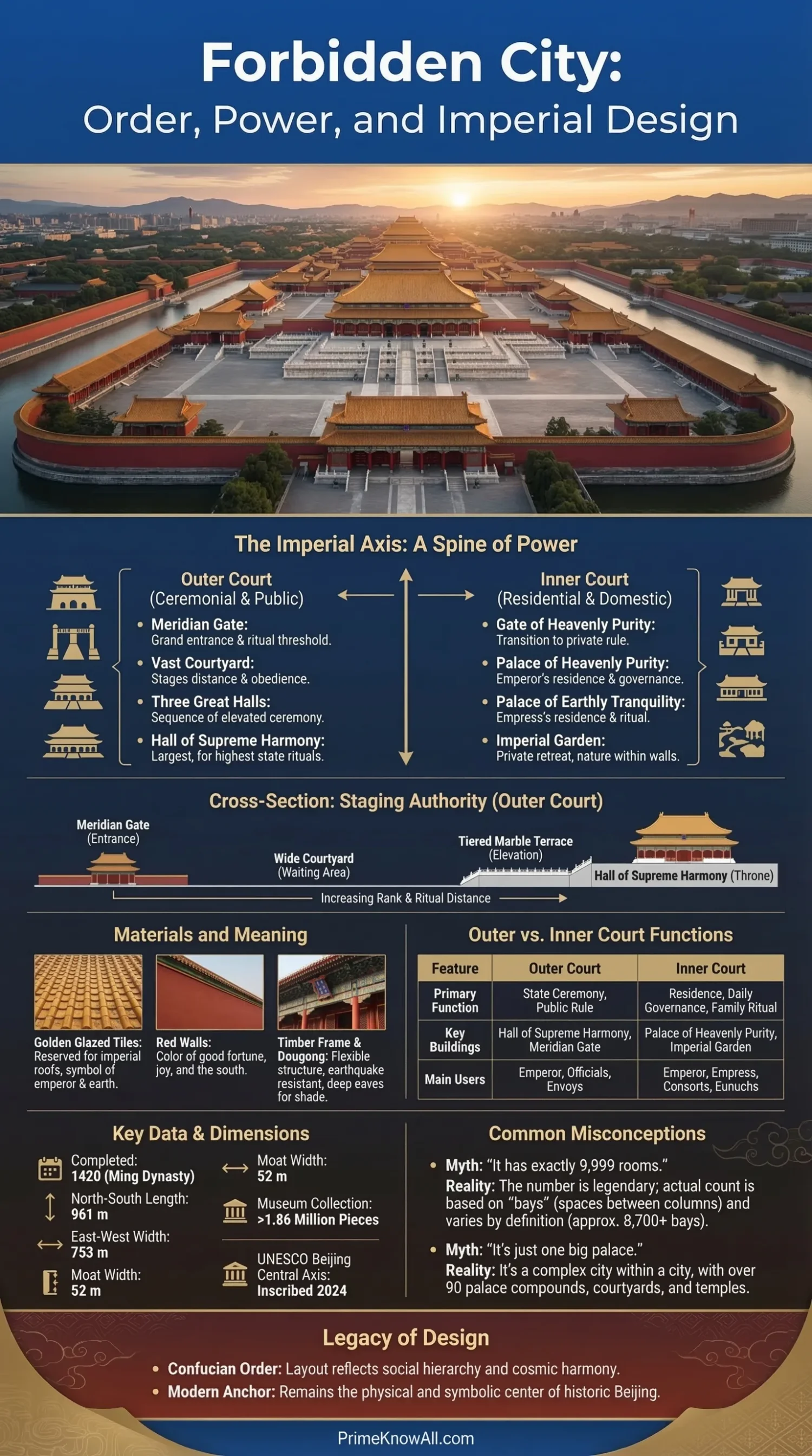
Forbidden City design turned imperial rule into physical space. Its long north-south axis, layered gates, raised terraces, and ranked halls were not decoration alone; they sorted ceremony, family life, and state authority inside one walled palace city.
- It was planned as a system, not as a single palace building.
- The Outer Court handled ritual and public rule; the Inner Court handled residence and daily governance.
- Scale, color, roof form, and symmetry all signaled rank.
- The design still matters now because the palace anchors Beijing’s historic central axis, which UNESCO added to the World Heritage List in 2024.
The Forbidden City was completed in 1420, served 24 emperors of the Ming and Qing dynasties, and today sits at the center of one of the best-known examples of traditional Chinese palace planning. Most articles stop at red walls and yellow roofs. The more useful question is simpler: what was each design choice trying to do?
If you remember one thing… Forbidden City design is really a map of order: who enters where, who is seen, who waits, who rules, who serves, and who lives behind the next gate.
How the Palace Was Planned
Short answer: the Forbidden City works as a walled sequence of gates, courts, halls, and residential compounds arranged on a strict central axis. The layout followed court ritual, social rank, and long-established building rules rather than the modern idea of a palace as one grand house.
- A central axis is a straight planning line that organizes the whole site.
- A bay, in traditional Chinese building language, is the structural space between columns, not exactly the same thing as a modern room.
- Dougong is the interlocking wooden bracket system that helps carry the roof and its deep eaves.
- Outer Court means the public and ceremonial front half.
- Inner Court means the residential and more private rear half.
The plan draws from Confucian ideas of social order, from older capital planning traditions, and from practical climate logic. Major buildings face south to catch winter sun, deep eaves help with summer shade, and courtyards pace movement in measured stages rather than in one rush.
Core Layout And Dimensions
Short answer: the palace is large enough to feel like a small city, yet organized tightly enough that every major move remains legible. Its scale works because size and direction are paired with repetition.
| Measure Or Count | Published Value | Why It Matters For Design |
|---|---|---|
| Construction period | 1406–1420 | The plan belongs to the early Ming rebuilding of Beijing as the imperial capital. |
| Length | 961 meters | The north-south run strengthens the feeling of procession. |
| Width | 753 meters | The rectangle keeps the plan readable instead of sprawling in many directions. |
| Moat width | 52 meters | The moat is a physical and visual buffer, not just a defense feature. |
| Palace compounds | More than 90 | The site is a network of courts and buildings, not one structure. |
| Heritage bays | Around 9,000 | This helps explain why room counts vary across books and websites. |
| Museum collection | Over 1.86 million pieces | The palace now works as both architecture and archive. |
One useful correction belongs here. Many readers have seen the old claim that the Forbidden City has 9,999 rooms. That number survives because it fits imperial legend, but official and scholarly counts often use bays, compounds, or other units. The lesson is simple: when numbers differ, check what is being counted.
- Big courtyards slow approach and heighten ceremony.
- Raised terraces increase visual rank without needing taller walls everywhere.
- Repeated modules make a huge site easier to read and easier to govern.
- What stands out already: the design relies on sequence more than ornament.
- What to watch next: the palace axis does political work, not just visual work.
- Why this matters: once that is clear, the whole plan becomes easier to read.
Why The Axis And Symmetry Matter
Short answer: the north-south axis gives the Forbidden City its discipline. Symmetry tells visitors that rule is not personal mood; it is presented as order made visible.
UNESCO now describes the broader Beijing Central Axis as evidence of Chinese urban planning traditions, and the Forbidden City is its best-known anchor. That matters because the palace was never meant to stand alone. It was designed as the core piece in a larger capital city plan.
One analogy helps. The Forbidden City works less like a single building and more like a carefully edited sentence: gate, courtyard, terrace, hall, pause, then another hall. Remove one element or scramble the order, and the meaning weakens immediately.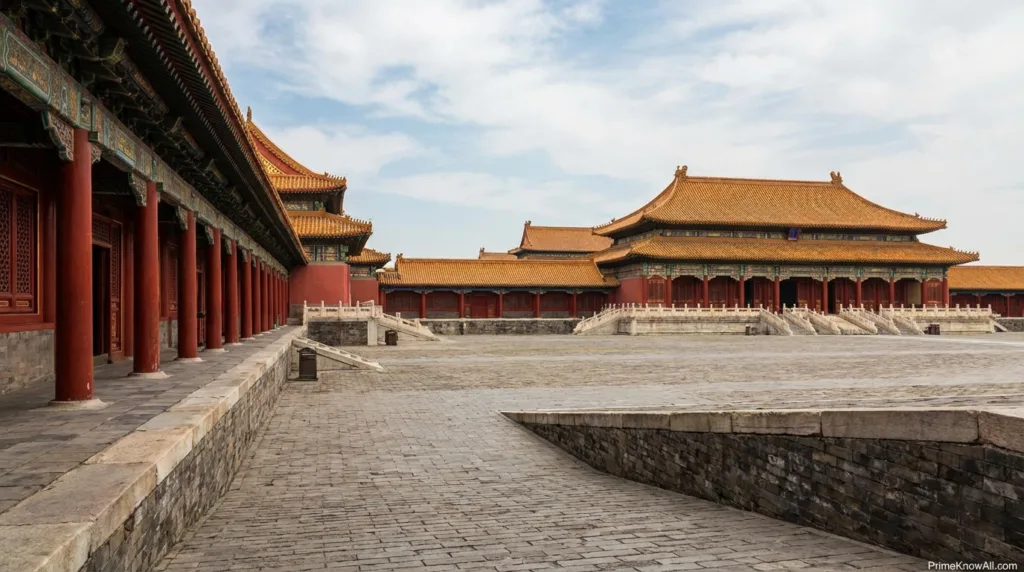
- Axis organizes movement.
- Symmetry reinforces rank and balance.
- Front and rear division separates public rule from private life.
- Side compounds support the main line without competing with it.
What The Outer Court Was Designed To Do
Short answer: the Outer Court was designed to stage power. It is the half of the palace where scale becomes a political tool.
After the Meridian Gate, visitors enter an enormous court and then meet the three main halls: Hall of Supreme Harmony, Hall of Central Harmony, and Hall of Preserving Harmony. This sequence matters. The emperor does not appear in a crowded hall tucked behind side rooms. He appears after distance, waiting, and elevation.
The Hall of Supreme Harmony sits on a high marble terrace and remains the best-known ceremonial hall in the complex. Britannica notes that it is the largest wooden structure in China, which helps explain why it became the visual center of imperial ceremony.
- Meridian Gate acts as the first filter.
- The huge court creates distance between ruler and official.
- The three halls turn ceremony into a step-by-step process.
- The terrace raises the throne world above the crowd world.
This is also where many casual readings fall short. The Outer Court is not just a place for impressive buildings. It is a timed route for ritual. Waiting, crossing, climbing, and aligning were part of the message.
- Outer Court logic: space is used to slow the body and focus the eye.
- Main effect: the emperor appears framed by distance, height, and repetition.
- Common miss: many readers see decoration first and choreography second.
What The Inner Court Controlled
Short answer: the Inner Court handled residence, family ritual, and much of the emperor’s daily life. It was more private than the Outer Court, but it was never casual space.
The main north-south line continues through the Palace of Heavenly Purity, Hall of Union, and Palace of Earthly Tranquility. The arrangement mirrors the front section but shifts from public rule to domestic hierarchy. Smarthistory points out that the emperor’s residence, the empress’s residence, and the family ceremonial hall align on the same axis, which shows that household order was treated as an extension of state order.
On both sides stood the Six Eastern Palaces and Six Western Palaces, residential compounds for consorts and other court members. The side-by-side repetition gave the court a regular structure while keeping the central line visually dominant.
- Central halls preserved ceremonial hierarchy inside the domestic zone.
- Side compounds housed the wider imperial household.
- Walls within walls controlled access, privacy, and rank.
- Later Qing use shifted some daily governance westward into the Hall of Mental Cultivation.
This is one of the strongest lessons in the whole site: private life was planned, ranked, and watched. The Inner Court was softer in scale than the Outer Court, but not freer.
Materials, Color, And Construction Logic
Short answer: the Forbidden City uses timber, tiles, stone terraces, painted surfaces, and layered roofs to express rank and to manage climate. The design is symbolic, but it is also practical.
At first glance, the visual code seems simple: red walls, yellow glazed roofs, white marble, and large timber frames. Look longer and the system becomes more precise. Roof type, number of figures on ridges, terrace height, and decorative density all help mark status. Britannica notes that even the style of a roof signals how important a building is.
Traditional Chinese timber construction also matters here. A hall’s roof is not just a cover; it is a deep overhanging system carried by posts, beams, and brackets. Dougong helps spread roof loads and creates the generous eaves that protect painted wood from rain and direct sun.
- Timber frame allows large halls and rhythmic column grids.
- Deep eaves help with shade and water runoff.
- Marble terraces elevate ceremonial buildings above the ground plane.
- Painted decoration is not surface-only; it also records changing periods of restoration and use.
Recent conservation research adds a useful layer here. Peer-reviewed studies on the Hall of Mental Cultivation, Lin’xi Pavilion, and Wen Yuan Ge show that color and painted detail can preserve evidence of different building phases, repairs, and shifts in function. In other words, the palace is not frozen in one year. It is a stack of carefully preserved moments.
- Do not separate symbol from function: the best design choices here do both jobs at once.
- Roofs are data: they tell you about status, drainage, shade, and visual rank.
- Paint is evidence: it can reveal how a space changed over time.
Design Choices That People Often Misread
Short answer: many popular ideas about the Forbidden City are partly true but incomplete. The best way to read the palace is to separate legend, later memory, and architectural evidence.
- Wrong: “It is one palace.”
Correct: It is a network of courts, halls, residences, service areas, gardens, and gates.
Why this gets mixed up: aerial photos flatten the site into one visual block. - Wrong: “It was built only for beauty.”
Correct: beauty is part of a larger system of hierarchy, ritual timing, and controlled movement.
Why this gets mixed up: photos highlight color and rooflines more than circulation. - Wrong: “Outer Court means politics, Inner Court means private life, and the two never overlap.”
Correct: the split is real, but family order and state order constantly reflect each other.
Why this gets mixed up: modern people often separate home and government more sharply than imperial courts did. - Wrong: “The room count is fixed and simple.”
Correct: published counts vary because different sources count rooms, bays, compounds, or heritage units differently.
Why this gets mixed up: legendary numbers are easier to remember than technical counting methods. - Wrong: “Everything visible today is exactly Ming.”
Correct: the plan is early Ming, but repairs, repainting, and Qing-era changes shaped many surfaces and uses.
Why this gets mixed up: famous sites are often described as if they were frozen at first completion.
How The Plan Shaped Everyday Use
Short answer: the palace plan guided daily behavior just as much as it guided major ceremony. Even ordinary routines were filtered through gates, courts, rank, and distance.
- Before dawn court gathering: officials assembled and waited long before the emperor appeared. Why? The route itself built obedience and anticipation.
- Family ceremony in the rear halls: weddings, mourning, and household ritual followed spatial rank. Why? The dynasty treated family order as part of political order.
- Consort compounds on both sides: residence was not random. Why? Side placement supported the center without competing with it.
- Emperor shifting to the Hall of Mental Cultivation: later rulers preferred a more workable daily space. Why? Monumental halls can represent power well but feel less efficient for routine governance.
- Imperial garden at the rear: the plan ends with relief rather than with another giant court. Why? Sequence matters; after compression and ceremony, the site needs a different pace.
- Modern visitor route: many tourists still follow the central line through the main gates and halls. Why? The original planning remains intuitive even for people who know little about court ritual.
Why The Design Still Matters Now
Short answer: Forbidden City design still matters because it is now read at three scales: as a palace, as a museum, and as the central architectural anchor of historic Beijing.
In 2024, UNESCO added the Beijing Central Axis to the World Heritage List. That move did not change the palace itself, but it changed the way many people talk about it. The Forbidden City is now even easier to see not just as a monument in Beijing, but as the middle hinge of a much larger urban idea.
The Palace Museum also shows how old architecture can stay active without losing meaning. Its digital cultural resources now provide access to more than a million cultural relic records and tens of thousands of high-resolution images, while panoramic tools let people examine the site beyond a quick tourist pass.
- As architecture: it remains one of the clearest examples of imperial Chinese planning.
- As heritage: it sits inside a wider protected urban order.
- As a museum: it combines physical preservation with digital access.
What Scholars Still Measure Or Debate
Short answer: the broad design logic is well established, but a few details still need care when presented to general readers. This is where honest limits make the article better, not weaker.
- Room totals vary. Published numbers can differ because the counting unit changes.
- Visible surfaces are layered in time. A building may keep its early plan but show later restoration campaigns.
- Symbolic readings can be overplayed. Some popular explanations about numbers, colors, or directions are plausible, but not every repeated claim has the same level of documentary support.
- Daily use changed across dynasties. The Ming and Qing courts did not use every space in exactly the same way.
What this means in practice: it is safest to treat the palace as a site with a stable core plan and a long history of reuse, repair, and reinterpretation.
Check Your Understanding
Short answer: these short checks help confirm the main design ideas without turning the article into a textbook.
Why is the central axis so important in the Forbidden City?
Because it organizes the whole palace from south to north and turns movement into a clear hierarchy of gates, courts, and halls.
What is the clearest difference between the Outer Court and the Inner Court?
The Outer Court was built mainly for state ceremony and formal rule, while the Inner Court handled residence, family ritual, and much of daily governance.
Why do room counts vary in different articles?
Some sources count rooms, some count bays between columns, and others count compounds or heritage structures, so the numbers do not always match.
Why are the courtyards so large?
They are not wasted space. They create distance, manage approach, and make ceremony feel staged and orderly.
Is the palace mainly symbolic or mainly practical?
It is both. The best design choices combine rank and ritual with climate response, circulation control, and timber building logic.
What To Keep In Mind
The Forbidden City is easiest to understand when it is read as a sequence of controlled spaces, not as a single beautiful object. Its design joins ritual order, residential hierarchy, and urban planning in one coherent plan.
The most common mistake is treating the palace as pure symbolism and ignoring how gates, courts, terraces, and side compounds guide actual movement. The most useful rule is simple: follow the axis, then read what each pause is doing.
Sources
- UNESCO – Imperial Palaces of the Ming and Qing Dynasties in Beijing and Shenyang — Used for inscription history, dynastic scope, outer court/inner court wording, and conservation framing. Reliable because it is the official World Heritage entry with formal criteria and management notes.
- UNESCO – Beijing Central Axis: A Building Ensemble Exhibiting the Ideal Order of the Chinese Capital — Used for the 2024 heritage context and the palace’s role inside the wider city plan. Reliable because it is the official UNESCO record for the newly inscribed urban ensemble.
- Beijing Municipal Government – The Palace Museum — Used for official museum description, main halls, collection size, and the note about around 9,000 bays. Reliable because it is a government page summarizing the museum with current visitor information.
- The Palace Museum – Diverse Platforms Enrich Palace Museum Experience — Used for digital archive and panoramic access details. Reliable because it comes from the Palace Museum itself and explains its own public-facing digital tools.
- Smarthistory – The Forbidden City — Used for measurements, outer/inner court interpretation, and the Confucian order reading. Reliable because it is a well-edited art history education resource written for accurate public scholarship.
- Britannica – Forbidden City — Used for the design reading that links roof form and ceremonial space to rank. Reliable because Britannica is a long-running reference work with editorial review.
- Britannica – Beijing: Landscape — Used for the Hall of Supreme Harmony, the city axis, and the broader Beijing planning relationship. Reliable because it places the palace inside the larger physical plan of historic Beijing.
- Built Heritage – The Historical Information of the Decorative Polychrome Painting in the Hall of Mental Cultivation Complex, Forbidden City — Used for the point that paint layers and decoration can reveal changing functions and restoration phases. Reliable because it is a peer-reviewed open-access research article by authors tied to the Palace Museum and a civil engineering university.
- Heritage Science – Quantitative Analysis Methods for Evaluating Colour on Architectural Heritage: Survey of Colour Restoration and Perception of the Wen Yuan Ge in the Forbidden City — Used for the section on modern conservation and color research. Reliable because it is a recent peer-reviewed journal article focused on one part of the Forbidden City.
FAQ
Why is the Forbidden City called a palace city?
Because it functions more like a walled urban system than a single residence. It includes courts, halls, residences, temples, service spaces, gates, and gardens arranged in a highly ordered plan.
What is the main idea behind Forbidden City design?
The main idea is ordered hierarchy. The plan uses axis, symmetry, elevation, and controlled access to express political rank and family structure.
What is the difference between the Outer Court and Inner Court?
The Outer Court was the front ceremonial zone for grand state events, while the Inner Court was the rear residential zone for the emperor, empress, consorts, and many daily court functions.
How big is the Forbidden City?
The palace precinct measures about 961 meters from north to south and 753 meters from east to west, with a moat around 52 meters wide. Different sources count its internal spaces in different ways.
Why do so many roofs look yellow?
Yellow glazed roof tiles became strongly associated with imperial architecture. In the Forbidden City, roof color works with terrace height, roof form, and decoration to signal rank.
Does the Forbidden City still matter for modern Beijing?
Yes. It is still the architectural heart of historic Beijing and became even more important in public discussions after UNESCO inscribed the Beijing Central Axis in 2024.
