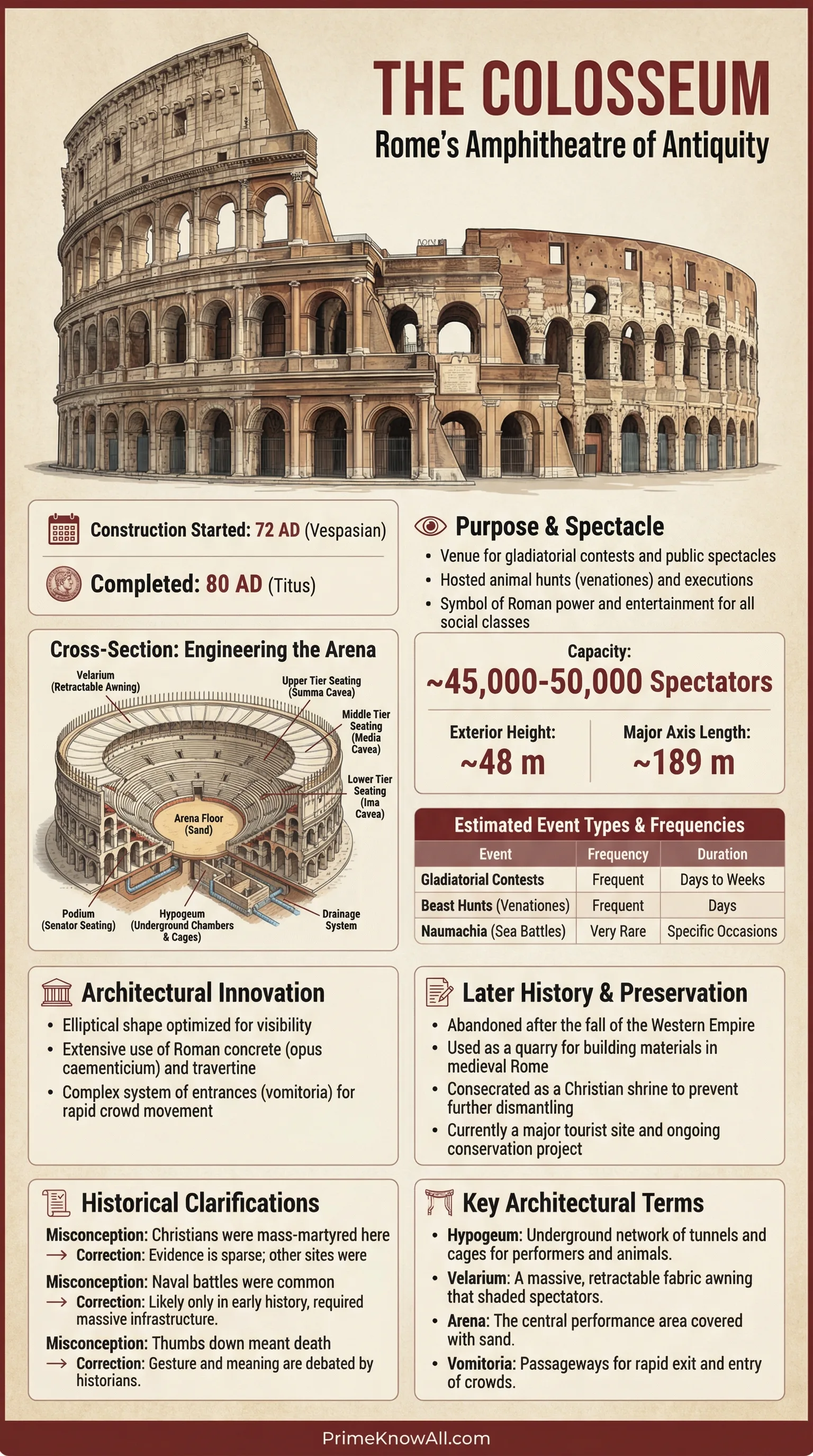
The Colosseum’s engineering design is a layered ring of stone piers and concrete vaults that turns a huge crowd venue into a stable, fast-moving system. Its elliptical geometry spreads loads in compression, while nested corridors and staircases move thousands of people with surprisingly modern efficiency.
What To Keep In Mind
- The real “structure” is the arch-and-vault grid, not the decorative columns.
- Geometry is the quiet hero: the ellipse organizes loads, views, and circulation at once.
- Roman concrete made curved corridors and vaults practical at this scale.
- Crowd flow was engineered with multiple rings, stair towers, and direct “seat-to-exit” routes.
- Some details remain uncertain, especially the exact operating method and coverage of the velarium awning.
The Colosseum is a stadium where architecture behaves like infrastructure.
Its designers had to solve three problems at once: keep an enormous building stable with mostly compression-friendly materials, move a vast crowd without gridlock, and fit complex event logistics into a tight urban site. The result is a system design more than a single “structure.”
If you remember one thing… the Colosseum works because structure, circulation, and operations were designed as one integrated machine, not as separate layers added later.
What The Colosseum Was Engineered To Do
Short answer: it was engineered to host mass public events with clear sightlines, fast entry/exit, and a durable structure that could be built quickly in stone and concrete.
In engineering terms, the building is a set of performance requirements disguised as monumental architecture. The design had to balance human factors (movement, comfort, wayfinding) with physics (loads, stability, wind on the upper levels).
- Capacity and visibility: a steeply tiered bowl so more spectators have a usable view.
- Rapid circulation: multiple ring corridors that distribute people to staircases and seating zones.
- Operational flexibility: spaces for staff, equipment, and event staging built into the “back of house.”
- Weather management: an awning system and airflow patterns that reduced heat stress during events.
- Urban symbolism: a public landmark placed on a highly visible site, which also shaped design choices.
Site, Drainage, And Foundations
Short answer: the Colosseum’s foundations had to stabilize a site that had recently been waterlogged, so the solution combined drainage control with a thick concrete base that spread loads across the ground.
The location mattered because the structure is freestanding: unlike hillside theaters, it could not borrow strength from a slope. A freestanding amphitheater needs a foundation that behaves like a continuous platform, resisting uneven settlement that can crack arches and vaults.
- Drainage first: if water lingers under a heavy building, the ground weakens and settlement becomes unpredictable.
- Concrete foundations: Roman concrete, a stone aggregate bound by lime-based mortar, is a practical way to build thick, load-spreading pads and rings.
- Elliptical load spread: an ellipse encourages loads to be distributed around the perimeter rather than concentrating at sharp corners.
Pause And Pocket This
- A stable base is the hidden masterpiece: without it, the upper arches do not matter.
- Site engineering (drainage + load spreading) is a design decision, not a footnote.
- Freestanding buildings demand more from foundations than hillside buildings.
A Few Dates That Anchor The Build
Short answer: the main build belongs to the late 1st century CE, with major work beginning under Vespasian and dedication under Titus, followed by further additions and later modifications.
- c. 70–72 CE: start of construction in the Flavian period.
- 80 CE: dedication under Titus.
- 82 CE and after: additions and refinements under Domitian and later repairs across centuries.
| Feature | Typical Figure (Approx.) | Why Engineers Care |
|---|---|---|
| Overall Plan Axes | About 189 m by 156 m | The ellipse sets load paths and organizes repeated structural “bays.” |
| Overall Height | About 48 m | Height increases overturning and wind effects, pushing vaults and ring walls to work together. |
| Main Entrances | About 80 ground-level openings | More openings reduce congestion but must not weaken the load-bearing perimeter. |
| Arena Floor (Often Cited) | Varies by source; commonly around 80+ m by 40–50 m | A larger arena increases spans and affects radial circulation geometry. |
| Seating Capacity | Often stated as ~50,000 (with higher estimates in some sources) | Capacity drives egress sizing, stair count, and corridor widths. |
Arches And Vaults: The Load-Bearing Skeleton
Short answer: the Colosseum stands because its core is a repeating grid of arches and vaulted corridors that keep most forces in compression, where stone and concrete perform best.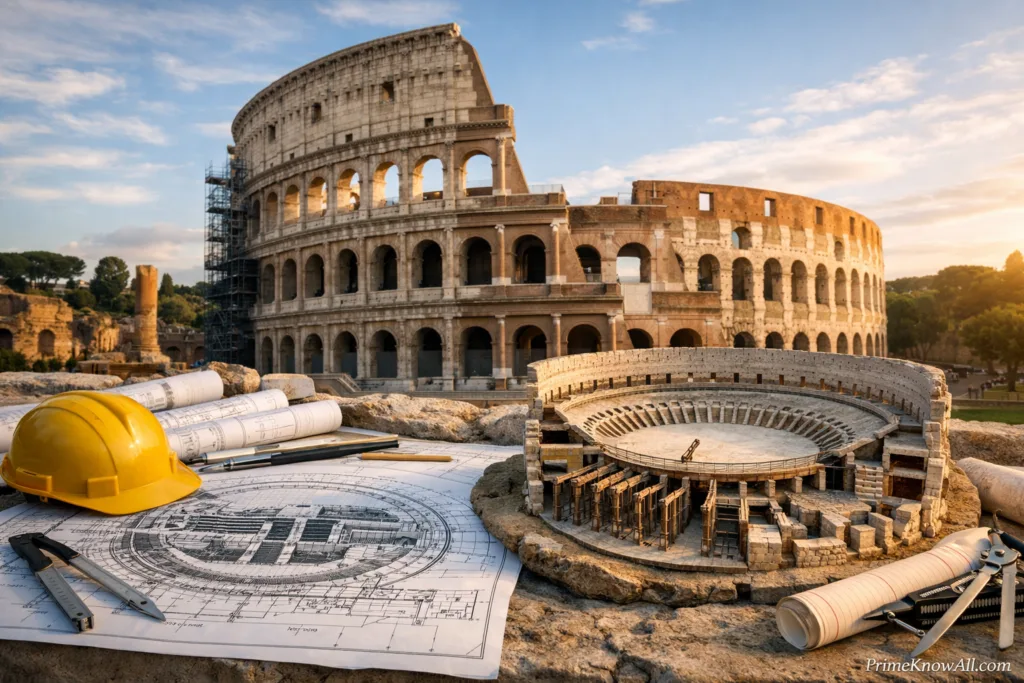
An arch is a curved structural form that redirects weight sideways into supports, turning vertical load into compressive forces along the curve. A barrel vault, a roof shaped like a half-cylinder, is essentially an arch extended in depth. A groin vault, a vault formed by the intersection of two barrel vaults, helps cover wider areas and can reduce material while keeping strength.
- Radial structure: repeated “spokes” of piers and walls carry loads from seating down to the foundation.
- Annular corridors: ring-shaped vaulted passages act like structural belts while moving people.
- Vault variety: different vault types appear across levels, matching changing spans and loads.
One subtle advantage of this system is redundancy: if one element weakens, adjacent vaults and ring walls can still share load, at least to a point. That is a design philosophy that modern stadiums still rely on.
Materials And Connections: Stone, Concrete, And Metal
Short answer: the Colosseum mixes travertine, tuff, brick, and Roman concrete, using metal clamps and careful jointing to turn many parts into one stable whole.
Material choice is not just “what was available.” It is where each material behaves well. Travertine is strong in compression, so it suits major piers and the outer frame. Brick-faced concrete is ideal for vaults and curved corridors because it can be shaped and poured into forms, then faced for durability and alignment.
- Travertine blocks: used where high compressive loads need a reliable stone.
- Tuff and secondary masonry: lighter materials in non-critical zones to manage weight.
- Concrete vaults: efficient for creating continuous curved spaces without carving every piece of stone.
- Metal clamps: used to tie stones; later removal of metal in some eras contributed to damage.
A Practical Way To Read The Materials
- Stone for compression, concrete for curves, brick for precision and facing.
- Connections matter: clamps and joints decide whether a “pile of blocks” becomes a single structure.
- Weight management is part of stability, not aesthetics.
Seating Bowl And Crowd Circulation
Short answer: the Colosseum’s seating works because people move through layered circulation rings and short access tunnels that deliver spectators close to their section with minimal crossing flows.
A vomitorium, in Roman amphitheater terms, is a passageway that opens from a corridor into a seating tier, allowing crowds to “spill” efficiently into rows. The Colosseum uses many of these, plus numbered entrances and stair routes, to make wayfinding simpler than the building’s scale suggests.
- Multiple entry points: many ground-level openings reduce bottlenecks while spreading load between piers.
- Ring corridors: spectators circulate horizontally, then switch to vertical stairs near their section.
- Short seat-access tunnels: fewer conflicts between people moving in opposite directions.
- Seating zoning: different tiers connect to different routes, which lowers mixing at choke points.
What makes this feel “modern” is the system logic: circulation is not an afterthought added around a monument. It is built into the structural grid, so the building’s strength and its crowd flow reinforce each other.
The Hypogeum And Arena Technology
Short answer: the Colosseum’s underground was a logistics layer—tunnels, rooms, and lifting devices—designed to move people, animals, and scenery to the arena quickly, with major development after the first opening phase.
The hypogeum, meaning an underground structure beneath a building, is the “backstage” system under the arena. It required careful coordination with the arena floor because openings, hoists, and corridors must not undermine the load-bearing layout above.
- Vertical movement: lifts and trapdoor openings shorten the distance from storage to arena level.
- Route separation: keeping operational movement separate from spectator routes reduces confusion and risk.
- Structural constraint: underground voids demand stronger ring walls and disciplined alignment of supports.
What This Layer Really Adds
- The building is a venue plus a machine: the arena depends on hidden logistics.
- Underground space increases complexity, so the structural grid must be more disciplined.
- Operational design is part of engineering design.
The Velarium: A Retractable Shade System
Short answer: the velarium was a large awning system supported by masts and rigging points around the upper rim, providing shade for spectators, with exact coverage and mechanics still debated.
A velarium, a retractable textile awning used in Roman venues, is closer to a ship’s sail system than a solid roof. The upper level includes attachment points and brackets that suggest mast supports and rigging lines, while the operating crew likely needed strong rope-handling skills.
- Shade without a roof: fabric reduces heat load while avoiding heavy roof structures that push walls outward.
- Wind as a design input: awnings behave like sails, so the system must account for gusts and safe retraction.
- Distributed anchors: many attachment points share forces rather than concentrating them.
Because textiles decay and ancient rigging details are sparse, claims about “full coverage” should be treated as hypotheses, not certainties. The most defensible view is that the system provided meaningful shade for large sections, but not a sealed enclosure.
How A Mega-Project Was Managed
Short answer: the Colosseum’s build was made feasible by repeatable modules, standardized geometry, and a supply chain that could deliver stone, brick, timber, and lime at industrial scale for its time.
The structure repeats the same bay logic around the ellipse: similar pier spacing, similar vault patterns, and similar corridor segments. That repetition reduces design uncertainty and speeds construction because crews can reuse methods and templates.
- Repetition: repeating structural “slices” helps quality control and training.
- Parallel work zones: multiple crews can build different arcs of the ring at once.
- Material staging: heavy stone for lower zones, lighter systems higher up to control total mass.
Analogy (one useful mental model): imagine assembling a huge circular arena like a kit of repeating brackets—not because it is “simple,” but because repeatability lets thousands of small decisions stay consistent, the way a modern stadium relies on identical stair cores and corridor spans rather than reinventing each segment.
The Quiet Management Trick
- Repeat the hard parts: standard bays keep geometry consistent.
- Build in parallel: an ellipse allows multiple crews to progress simultaneously.
- Control weight as the building rises.
Why The Colosseum Survived: Redundancy, Repairs, And Damage Patterns
Short answer: the Colosseum’s survival is tied to a compression-dominant structural system with multiple load-sharing paths, plus centuries of repairs—yet it also shows how removing key elements can trigger large local collapses.
Arches and vaults can tolerate certain kinds of damage because loads reroute through neighboring elements. Still, that resilience has limits: when adjacent supports disappear, a chain reaction can follow because the structure is a linked grid, not isolated columns.
- Redundancy helps: many similar bays share loads rather than relying on a few mega-elements.
- Weak points exist: removing multiple neighboring supports can destabilize an entire vertical strip.
- Repairs matter: later stabilizations changed how ring walls and outer arcades were restrained.
Engineering studies that model the Colosseum’s static behavior emphasize the role of ring-wall restraint and how restoration interventions can improve stability without changing the overall form. That is a reminder that maintenance is part of the design lifecycle, even for ancient masonry.
Modern Lessons From An Ancient Stadium
Short answer: the Colosseum teaches three transferable ideas: design for flow, separate structure from decoration, and use geometry as an organizing tool for both people and forces.
It is tempting to focus on grand exterior style, but the engineering lesson is the internal logic: corridors where they need to be, stairs where they must be, and vault forms matched to spans and loads. That is why the building reads like a “stadium plan” long before modern stadiums existed.
- Wayfinding by structure: repeated routes and consistent patterns reduce confusion at scale.
- Ornament is not support: decorative orders communicate meaning while vaults do the work.
- Climate response: shade solutions can be lightweight if anchors and wind behavior are respected.
- Modularity: repeating bays make both construction and future repair more manageable.
If You Only Steal One Design Habit
- Design the “people system” and the “force system” together, not in separate phases.
- Repeat a good module instead of improvising hundreds of unique details.
- Let geometry do work: it should organize both structure and movement.
Where These Design Ideas Show Up Today
Short answer: many everyday places quietly borrow the Colosseum’s logic: ring circulation, distributed exits, and repeatable structural bays.
- A football stadium concourse: spectators loop around a ring and drop into sections through short openings; this minimizes crossing flows and keeps the main stream moving.
- A subway station with multiple stair cores: several smaller stairs outperform one grand stair; distribution reduces bottlenecks.
- An airport terminal gate area: back-of-house corridors separate staff logistics from passenger routes; route separation cuts friction.
- A festival shade-sail system: lightweight fabric plus strong anchors beats heavy roofs for temporary comfort; wind behavior drives the design.
- A modular parking garage: repeated bays and ramps simplify construction; repeatability keeps errors from multiplying.
- A modern arena evacuation plan: many direct egress paths beat a few dramatic exits; shorter decision paths improve safety.
- A museum with layered circulation: outer loops for browsing, inner routes for direct access; choice reduces congestion.
Common Misconceptions About Colosseum Engineering
Short answer: most misconceptions come from confusing decorative architecture with structural action, or from assuming ancient systems worked like modern ones.
-
Wrong: “The exterior columns hold the Colosseum up.”
Correct: The main support comes from piers, arches, and concrete vaults.
Why it’s misunderstood: Greek-style columns look structural, even when they are largely ornamental. -
Wrong: “It had a full, solid roof like a modern dome.”
Correct: The shade system was an awning (velarium), not a sealed roof.
Why it’s misunderstood: People map modern stadium roofs onto ancient venues without considering weight and outward thrust. -
Wrong: “Roman concrete worked exactly like modern reinforced concrete.”
Correct: Roman concrete was a different material system and did not rely on steel reinforcement.
Why it’s misunderstood: The word “concrete” makes modern assumptions feel automatic. -
Wrong: “One big corridor would have been enough.”
Correct: The design depends on multiple rings and many access points to prevent choke points.
Why it’s misunderstood: Monumental buildings are imagined as single grand spaces, not networks. -
Wrong: “All capacity numbers are precise.”
Correct: Seating estimates vary because standing vs. sitting, seat width, and historical modifications change the count.
Why it’s misunderstood: Capacity feels like a single “fact,” but it is often a model. -
Wrong: “The underground was part of the very first build in its final form.”
Correct: Major underground development appears to have expanded after the early opening phases.
Why it’s misunderstood: Today’s visible hypogeum is so striking that it gets treated as the original baseline.
A Quick Self-Check
Use these as a fast way to test whether the engineering logic is clear. Each prompt is a sentence; tap to reveal the answer.
“The Colosseum’s strength mainly comes from columns on the facade.”
No. The primary structure is the arch-and-vault system and the massive piers behind the facade; the orders are largely ornamental.
“An ellipse helps because it avoids stress concentrations found in sharp-cornered plans.”
Yes. While no shape is magically “stress-free,” an ellipse supports a continuous ring logic that helps distribute loads around the perimeter.
“The velarium was more like sails than a permanent roof.”
Yes. The system is best understood as lightweight fabric plus anchors and rigging, with practical limits set by wind and handling.
“Vaulted corridors can be both circulation space and structure at the same time.”
Yes. That dual role is a core feature: corridors are not empty leftovers; they are structural belts that also move crowds.
“Capacity figures are exact because the building is still standing.”
No. Capacity depends on seating layout assumptions, social zoning, and historical changes, so estimates should be treated as ranges rather than a single guaranteed number.
What We Still Can’t Prove With High Confidence
Short answer: some of the most famous details are partly uncertain because perishable materials disappeared, later modifications changed the evidence, and ancient descriptions are incomplete.
- Exact velarium operation and coverage: attachment points survive, but textiles and full rigging layouts do not.
- One definitive capacity number: estimates vary with seating assumptions and historical configuration changes.
- Construction sequencing details: repetition suggests parallel building zones, but the precise step-by-step schedule is not fully recoverable.
- Original finishes everywhere: surface treatments, decoration, and some internal fittings were stripped or weathered over centuries.
- All causes of specific collapses: earthquakes, material removal, and long-term decay can combine, making single-cause stories unreliable.
Here’s the practical wrap: the Colosseum’s engineering is a repeatable vault-and-ring system that scales stability and crowd flow together. Its most transferable value is the habit of designing movement and structure as one problem. The most common mistake is treating the facade’s classical orders as the building’s load-bearing logic. A memorable rule: if a venue must hold a city, make the circulation network as intentional as the structure holding it up.
Sources
Encyclopaedia Britannica – Colosseum [Dimensions, materials, and historical context; reliable because it is written and fact-checked by an established reference publisher.]
Encyclopaedia Britannica – How Was The Roman Colosseum Built? [Concise engineering-focused overview; reliable because it is editor-reviewed and regularly updated.]
Turismo Roma – The Flavian Amphitheatre (The Colosseum) [Key figures and official context from Rome’s tourism authority; reliable because it is a civic institutional source.]
UNESCO World Heritage Centre – Historic Centre Of Rome (Listing 91) [Official heritage framing for the wider site that includes the Colosseum; reliable because it is a primary international institutional record.]
Open Yale Courses – Roman Architecture, Lecture 12 (Colosseum Technical Features) [Discussion of vaults, structure, and architectural logic; reliable because it is a university-hosted course by a named professor with transcript access.]
Springer – Statics Of Historic Masonry Constructions (Chapter: The Colosseum) [Structural behavior and stability framing; reliable because it is a peer-reviewed academic publisher, though access may be limited.]
Structurae – Historical Static Analysis Of The Coliseum (Bibliographic Record) [Academic bibliographic context for structural research; reliable because it documents publication metadata tied to a recognized conference.]
Wikipedia – Colosseum [Cross-checking entrances, materials, and terminology pointers; useful as a gateway because it aggregates citations, but it should be verified against institutional sources.]
FAQ
How was the Colosseum able to support such a large crowd without steel?
It relies on arches, vaults, and thick ring walls that keep forces mostly in compression, which stone and Roman concrete handle well. The repeated bay system also distributes loads rather than concentrating them in a few members.
What materials were most important in the Colosseum’s structure?
The key mix is travertine for major supports, tuff and other masonry for secondary walls, and brick-faced Roman concrete for many vaults and corridors. Metal clamps and careful jointing helped connect large stone blocks.
Did the Colosseum have a roof?
Not a solid roof. Most historians agree it used a large awning system (the velarium) anchored around the top rim, shading large sections of the seating area. How much of it was covered and exactly how it worked is still debated.
Why do sources disagree on the Colosseum’s capacity?
Capacity depends on assumptions about seat width, whether some spectators stood, how strict social zoning was, and which historical phase you are measuring. Because those variables shift, reputable sources often give different estimates.
What is a “vomitorium” in the Colosseum?
A vomitorium is a passage that opens from a corridor into the seating tiers, letting crowds enter and exit quickly. It is part of the Colosseum’s crowd-circulation design, not a special room for anything else.
Article Revision History
