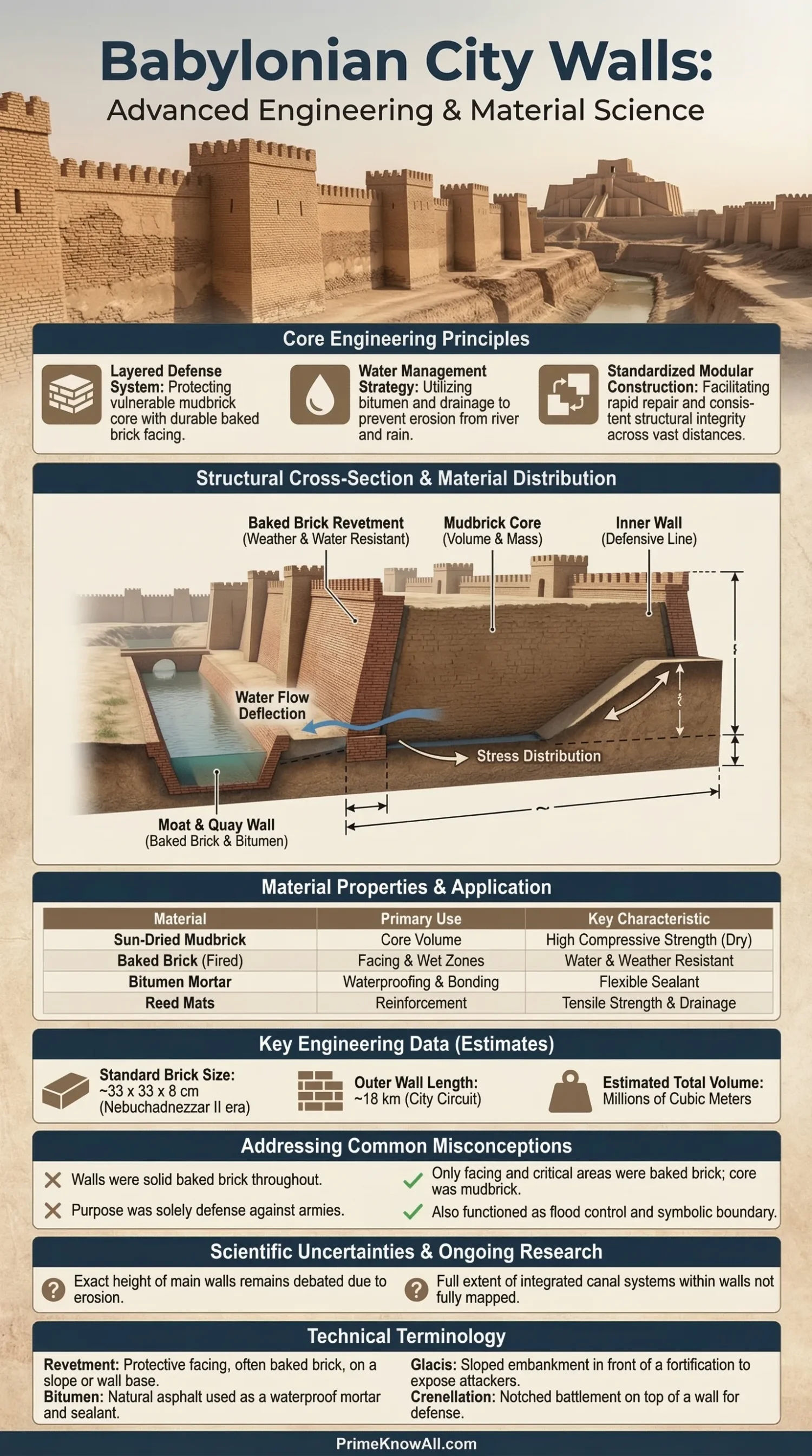
Engineering method: build in layers, control moisture, and make the base far thicker than the top.
What To Remember Right Away
- Most of the mass was sun-dried mudbrick; baked bricks were used like armor where weather, water, and abrasion were worst.
- Water was treated as an enemy on equal terms with attackers: moats, quay walls, and bitumen sealing reduced erosion and softening.
- Standardized bricks (often around 33 cm square for stamped baked bricks) made planning and repairs faster, not just prettier.
- “Walls” were a system: inner and outer lines, gates, towers, and controlled approaches worked together, not as one single ring.
- Archaeology is partial: only a portion of Babylon has been excavated, so some details are reconstructed from fragments and texts.
A city wall looks simple until its materials meet rain, river water, and the slow push of its own weight.
Babylon’s builders solved those problems with a layered approach: they matched each part of the wall to a specific job, then repeated the same choices over long distances so repairs stayed practical. That mix of planning, water control, and repeatable craft is what makes the engineering feel modern.
If you remember one thing… Babylon’s walls were not “one giant brick barrier.” They were a managed landscape of earth, brick, and waterworks that made the weakest points (edges, joints, and wet zones) harder to fail.
What The Wall System Needed To Do
Short answer: the wall system had to slow movement, protect foundations, and stay standing through seasonal wetting and drying.
City fortification is a built boundary that controls access and resists damage; in Babylon’s case, that meant resisting both human pressure (approach routes, gate crowding, siege tactics) and environmental pressure (soft ground, high water, and salt-laden mud).
- Delay and channel approach paths so attackers and traffic did not arrive at gates in a straight, fast line.
- Keep water off the core, because wet mudbrick loses strength quickly compared with dry brick.
- Reduce cracking from heat and drying by using thick masses and protective facing where needed.
- Allow routine repair without rebuilding an entire wall every time a section slumped or eroded.
Why “Water Engineering” Shows Up In Every Wall Detail
Bitumen is a sticky hydrocarbon material that works as a sealant; it was used in Mesopotamian building because it can block water and bond surfaces in wet conditions. In many Babylon contexts, baked brick and bitumen show up together where water could chew through softer masonry.
Materials And Their Engineering Jobs
Short answer: Babylon’s wall materials were chosen for availability and performance: mudbrick for volume, baked brick for durability, and bitumen for sealing.
Mudbrick is a brick made from clay-rich soil mixed with water and temper (often straw), shaped in molds, and dried in the sun. It is strong in compression when dry, but it needs protection from long wet periods and flowing water.
- Sun-dried mudbrick: cheap mass for thick walls and ramps; easy to patch.
- Baked brick: fired clay that resists rain and splash; used for facing, gate zones, and water-contact surfaces.
- Bitumen mortar or seal: a water-resistant binder; used where normal mud mortar would wash out.
- Plaster and wash layers: thin protective skins that shed water and smooth surfaces.
- Reeds and organic temper: light reinforcement inside mudbrick and fills, helping limit shrink cracks.
Standard Brick Sizes Made Repairs Faster
In Neo-Babylonian contexts, stamped baked bricks connected to Nebuchadnezzar II are commonly documented around 33 cm square and roughly 8–9 cm thick. A consistent unit like this makes courses predictable, speeds counting and transport, and keeps later repairs compatible with earlier work.
Pocket Notes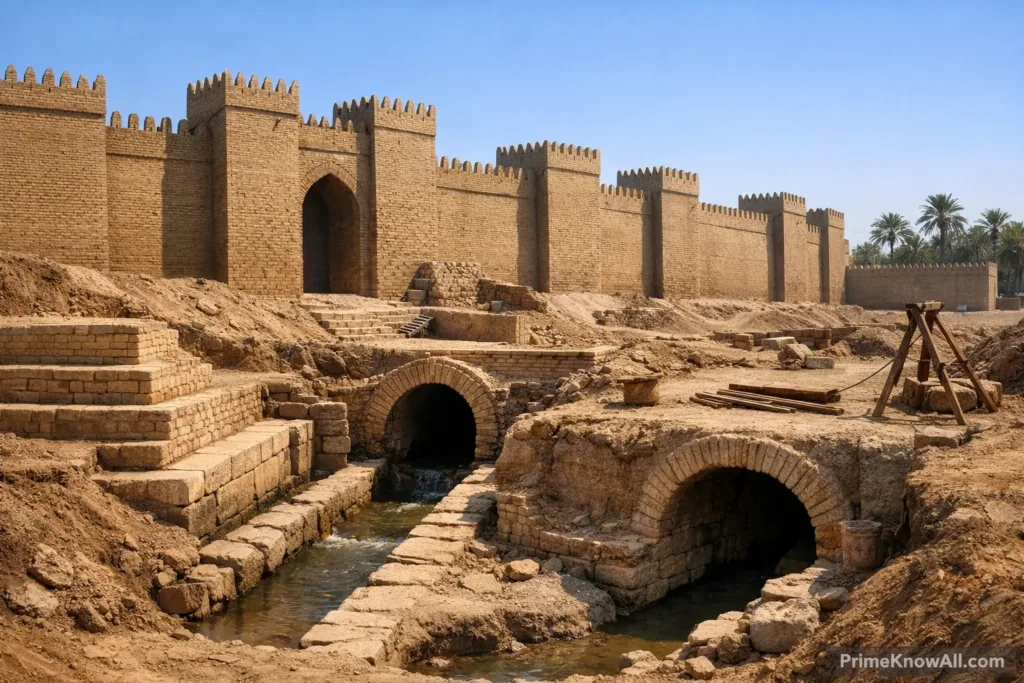
- Mudbrick carries the volume; baked brick protects the edges.
- Bitumen shows up where water would turn mud mortar into paste.
- Repeatable brick sizes turn a wall into something that can be maintained, not just built once.
Wall Geometry: Layers, Slopes, And Wet Zones
Short answer: the wall’s shape mattered as much as its materials: thick bases, protected toes, and controlled slopes helped the mass stay stable on soft ground.
Revetment is a protective facing that holds back soil and blocks erosion; in Mesopotamia it is frequently baked brick with water-resistant mortar. A wall that meets a moat or river edge needs a revetment or it will slump and melt from the bottom up.
One practical way to picture the design is a rain jacket with layers: the soft inner lining provides bulk, the outer shell takes the weather, and the taped seams do the quiet work of keeping water out. Babylon’s walls used the same idea with mudbrick, baked brick, and bitumen.
| Component | Main Material | What It Protects Against | Engineering Note |
|---|---|---|---|
| Core Mass | Mudbrick | Impact, heat cycling, weight distribution | Works best when kept dry and thick at the base. |
| Facing / Revetment | Baked brick | Rain splash, abrasion, flowing water | Acts like an armor skin on weak edges. |
| Seams And Joints | Bitumen + mortar | Leak paths and softening | Sealing keeps water from entering the core. |
| Moat And Banks | Excavated earth + baked brick lining | Undermining and toe erosion | Water can defend only if it does not eat the foundation. |
| Approach Slope | Compacted fill + brick retaining edges | Slumping and collapse | Gentle slopes reduce stress in soft soils. |
- Wide base: more area spreads the load over weaker ground.
- Protected toe: baked brick where water and feet constantly attack.
- Controlled slopes: ramps and embankments reduce cracking compared with vertical faces alone.
How The Walls Were Built: A Repeatable Workflow
Short answer: wall building was a loop of survey, earthwork, brick production, and maintenance, not a single one-time event.
Even a “simple” mudbrick wall needs a plan for alignment, drainage, and staging. That is why inscriptions and excavations describe both wall lines and the baked-brick quay work along wet edges: the wall was treated as a system that included banks, moats, and approaches.
A Practical Step Sequence
- Set the line with stakes and sight lines so long stretches stayed straight where they needed to, and curved smoothly where gates and river edges demanded it.
- Prepare the ground with leveling, compaction, and sometimes fill layers, because soft alluvial soil settles unevenly.
- Dig and shape wet zones (moats, channels, and banks), then line exposed edges with tougher material where possible.
- Produce bricks in batches: mudbrick dries on site; baked brick requires kilns, fuel, and tighter scheduling.
- Build the core fast with mudbrick courses and fills, then add protective skins where weather and water demand it.
- Seal joints and faces with bitumen, plaster, and smooth washes to slow water entry.
- Return for repair after rains and floods: patching and resurfacing keep the wall’s “dry strength” intact.
Pause And Save This
- Dry strength is the wall’s hidden requirement; water management keeps it.
- Batch production (especially baked bricks) forces planning in a way mudbrick alone does not.
- Maintenance is an engineering method, not an afterthought.
A Vertical Build Map Of The Wall System
Short answer: the wall can be read vertically: wet edge at the bottom, protected skins in the middle, and repairable surfaces at the top.
This vertical map shows how materials and shapes stack up from wet ground to the top line. It is simplified, but it keeps the engineering logic: protect the bottom, keep the core dry, and harden the places that get hit every day.
- Surface wash to shed rain
- Regular patching after weather cycles
- Organic temper to reduce shrink cracks
- Thicker at the base to spread load
- Revetment blocks erosion
- Sealed seams slow water entry
- Quay wall and lined edges where possible
- Drain paths so water exits fast
Note: excavated sections vary; this diagram reflects recurring engineering choices rather than a single measured cross-section.
Gates And Towers: Engineering The Weak Points
Short answer: gates and towers concentrate stress and traffic, so Babylon’s builders hardened them with baked brick, tighter detailing, and controlled approach geometry.
A gate is a forced opening that must be strong enough to handle both crowds and attack; that is why monumental gate zones show more durable materials and more precise brickwork than long stretches of plain wall. The Ishtar Gate complex is an easy example to picture because the decorated surfaces survive better than mudbrick masses.
- Hard surfaces in high-wear areas: baked bricks, sometimes glazed, resist abrasion and rain better than mudbrick.
- Thicker piers around openings: extra mass reduces cracking where doorways interrupt the wall.
- Approach control: gates can be paired with walls and towers so straight-line speed is reduced near the entry.
- Drain attention: water that pools at a threshold can rot the wall from the inside, so edges need sealing and shed paths.
How Inscriptions Help Engineering
Stamped bricks are not only political messaging; they are also a quality-control label. When brick sizes and markings stay consistent, later crews can match replacements to existing courses, which keeps repairs from turning into uneven patchwork.
Gate-Zone Reminder
- Harden openings: doors and corners need tougher detailing than plain stretches.
- Control the approach: geometry can slow movement before it reaches the threshold.
- Keep water moving: gate areas fail fast when water pools at the base.
Logistics: Moving Earth, Making Bricks, Keeping Schedule
Short answer: the real engineering challenge was scale: walls require millions of units, so Babylon needed predictable workflow, storage, and transport as much as clever design.
Brickmaking is a production problem: clay has to be mixed, formed, dried or fired, moved, and laid before it deforms. Baked bricks add another layer because firing needs fuel and time, so they are used where their extra durability pays back the cost.
- Batch drying fields for mudbrick: wide flat spaces let bricks cure evenly before stacking.
- Kiln staging for baked brick: firing runs need steady feed and protected storage to prevent water damage before use.
- Bitumen handling: as a sealant, it must be prepared and applied in a way that creates a continuous barrier rather than scattered blobs.
- Section building: long walls are easier to build and repair as repeated segments with the same course logic.
Small Summary Worth Keeping
- Walls are supply chains: brick size, storage, and timing shape the design.
- Baked brick is used strategically, not everywhere, because firing raises cost and effort.
- The best repair is planned early: repeatable units make later work cleaner.
Everyday Parallels: Where The Methods Still Show Up
Short answer: Babylon’s methods show up whenever builders must protect a soft core, keep water out, and maintain large structures over time.
- Riverfront promenades: a hard facing protects softer fill behind it. That is the same revetment logic, just with new materials.
- Modern levees: compacted earth does most of the work; a tougher skin handles erosion. The “keep the core dry” rule stays the same.
- Retaining walls along roads: repeated units make repairs predictable, just as standardized bricks did.
- Sports stadium berms: big earth masses rely on slope control more than height alone.
- Subway waterproofing: membranes play the role bitumen once did—sealing the seams that invite leaks.
- High-traffic entrances in public buildings: floors and thresholds get harder materials because wear concentrates there, like gate zones.
- Heritage reconstructions seen in online walk-through videos: the hardest part is matching old units so the new work sits correctly.
Common Misconceptions About Babylonian City Walls
Short answer: most myths come from survival bias (hard parts remain, soft parts vanish) and from vivid ancient descriptions that are not always measured like modern surveys.
- Wrong: “The walls were all baked brick.” Correct: large masses were mudbrick, with baked brick used where it mattered most. Why it gets mixed up: baked brick survives better, so it dominates photos and reconstructions.
- Wrong: “Height alone made the walls effective.” Correct: base thickness and wet-edge protection can matter more than extra meters of height. Why it gets mixed up: ancient texts highlight dramatic dimensions, and those are easier to remember.
- Wrong: “Herodotus gives exact measurements.” Correct: his numbers are widely treated as exaggerated compared with excavated remains. Why it gets mixed up: his description is vivid, and it was copied for centuries.
- Wrong: “A wall is one structure.” Correct: Babylon’s defenses included multiple lines, moats, gates, and embankments working together. Why it gets mixed up: maps compress layers into one outline.
- Wrong: “Bitumen was only for decoration or legends.” Correct: it works as a water-resistant seal in real masonry. Why it gets mixed up: it is mentioned in famous stories, so it sounds symbolic rather than practical.
- Wrong: “Once built, the walls stayed the same.” Correct: walls need ongoing repair, and inscriptions show rebuilding and strengthening over time. Why it gets mixed up: stone monuments feel permanent; mudbrick cities do not behave that way.
Fast Checkpoint
- Survival bias: baked brick lasts, mudbrick dissolves, so the record looks “more baked” than reality.
- Texts vs trenches: written claims and excavated remains do not always match in size.
- A wall is also maintenance: resurfacing can be as important as original build.
Quick Test
Short answer: the fastest way to learn wall engineering is to test the reason behind each design choice, not the trivia.
- Read the statement.
- Decide whether it feels true.
- Open the answer and compare the logic.
Each prompt is a short sentence. The answer opens underneath, with a plain explanation that ties back to the engineering method.
Statement: “If baked brick is stronger, using it everywhere is always the best choice.”
Answer: Not always. Baked brick lasts longer in wet and high-wear zones, but it costs more to produce and move, so builders reserve it for places where the payoff is clear.
Statement: “A moat helps only if it stays full of water.”
Answer: Water helps, but the bigger issue is the wet edge. Even a seasonally wet ditch can slow approach routes, while its lined banks protect the wall’s base from erosion.
Statement: “Mudbrick fails because it is ‘weak’ material.”
Answer: Dry mudbrick can carry heavy loads. The failure mode is usually water plus time: softening, erosion, and salt-driven decay.
Statement: “Standard brick sizes are mostly about looks.”
Answer: Standard sizes are a maintenance tool. They make counting, transport, and replacement easier, which matters when a wall extends for kilometers.
Statement: “Ancient writers give the only reliable wall measurements.”
Answer: Texts are valuable, but physical remains and excavation records are also necessary. For Babylon, the best picture comes from comparing multiple kinds of evidence.
What This Explanation Can’t Prove Yet
Short answer: parts of the wall system are measured directly, but many details (especially upper sections) are inferred from partial remains, older excavation records, and texts.
Babylon is unusually well studied, but the evidence still has gaps. A careful reading keeps room for what is not fully measured or preserved.
Since Babylon was added to the UNESCO World Heritage List in 2019, documentation and conservation planning have become more visible in public records, which helps, but it does not turn missing wall segments into complete data.
- Excavation coverage is limited: the UNESCO/ICOMOS evaluation notes that only about 18% of the city has been excavated, so some stretches of wall are known mainly from surface traces and older records.
- Upper wall details are hard to recover: mudbrick erodes, so parapets and finishing details are often reconstructed from clues rather than intact sections.
- One cross-section does not fit all: gate zones, river edges, and plain stretches can use different detailing, even within the same wall line.
- Text descriptions vary: some ancient measurements read more like rhetorical scale than survey data.
A safe rule is to treat any exact height claim as conditional unless it is tied to a measured excavated section. For most engineering questions, the method (layers, wet-edge protection, repeatable units) matters more than a single number.
Sources
- UNESCO World Heritage Centre – Babylon (Property Description) Provides the official site boundary context, including mention of inner and outer city walls, and is maintained by a UN body.
- UNESCO/ICOMOS – Babylon (Iraq) Nomination Evaluation (PDF) Includes conservation and documentation context (including the excavation coverage figure) and follows World Heritage review standards.
- World Monuments Fund – Babylon Archaeological Site Describes ongoing conservation work with Iraqi authorities; WMF is a long-running heritage institution with public project documentation.
- The British Museum – Cylinder Inscription Referencing Imgur-Enlil And Quay Work Primary-object documentation from a major museum; useful for the wall names and rebuilding context.
- Robert Koldewey – The Excavations At Babylon (Public Domain Translation) A primary excavation report with direct observations on bricks, moats, and wall exposures, still cited in later scholarship.
- The British Museum – Nebuchadnezzar II Brick With Bitumen Traces Object record with measurements and material notes; supports discussion of standardized stamped bricks and bitumen use.
- Proceedings Of The Royal Society B (via NIH/PMC) – Use And Trade Of Bitumen In Antiquity Peer-reviewed research on bitumen use and sourcing; hosted by a major library platform with stable archiving.
- Brill – Mesopotamian Building (Chapter PDF) Academic publisher chapter on building materials and mortar choices, helpful for understanding bitumen’s role with baked brick.
- Pleiades – Imgur-Enlil Place Resource A scholarly gazetteer used widely in classics and archaeology; provides stable naming and place references.
- Encyclopaedia Britannica – Babylon (Overview) A vetted reference summary that helps anchor basic historical context for non-specialist readers.
FAQ
Were Babylon’s walls one wall or multiple lines?
They are best understood as a defensive system with multiple wall lines, gates, and waterworks. Different segments used different detailing depending on wet edges and traffic pressure.
Why use mudbrick at all if baked brick lasts longer?
Mudbrick is fast, local, and ideal for thick mass. Baked brick is reserved for zones where long-term durability offsets its production cost.
What did bitumen actually do in wall construction?
Bitumen acted as a water-resistant seal and binder in places where mud mortar would wash out, especially near moats, quay walls, and high-splash areas.
Are the famous ancient measurements of the walls reliable?
They are valuable as descriptions of scale, but many numbers are treated as exaggerated when compared with excavated remains. The safest approach is to compare texts with measured archaeology.
How do archaeologists infer wall height when the top is gone?
They combine foundation width, surviving wall faces, slumped debris, and parallels from better-preserved segments. Reconstructions stay more reliable when they state ranges rather than one exact number.
What is the easiest engineering lesson from Babylon’s walls?
Protect the wet edge. If the base stays dry and resists erosion, the wall above it has a far better chance of staying stable.
Summary: Babylon’s wall engineering relies on layers, water control, and repeatable units more than any single headline dimension. Those choices still explain why the best-preserved areas tend to be the ones with baked brick and careful sealing.
Most common mistake: treating surviving baked-brick gate zones as if they represent the whole wall. Memorable rule: protect the bottom first—if the wet edge fails, the rest follows.
