Ancient theatres handled sound with geometry, stone, and distance control rather than hidden “amplifiers.” In the best-preserved examples, the shape of the seating bowl, the hard surfaces, the position of the performer, and the missing-or-preserved stage structures explain why speech could remain clear far beyond what most open spaces allow.
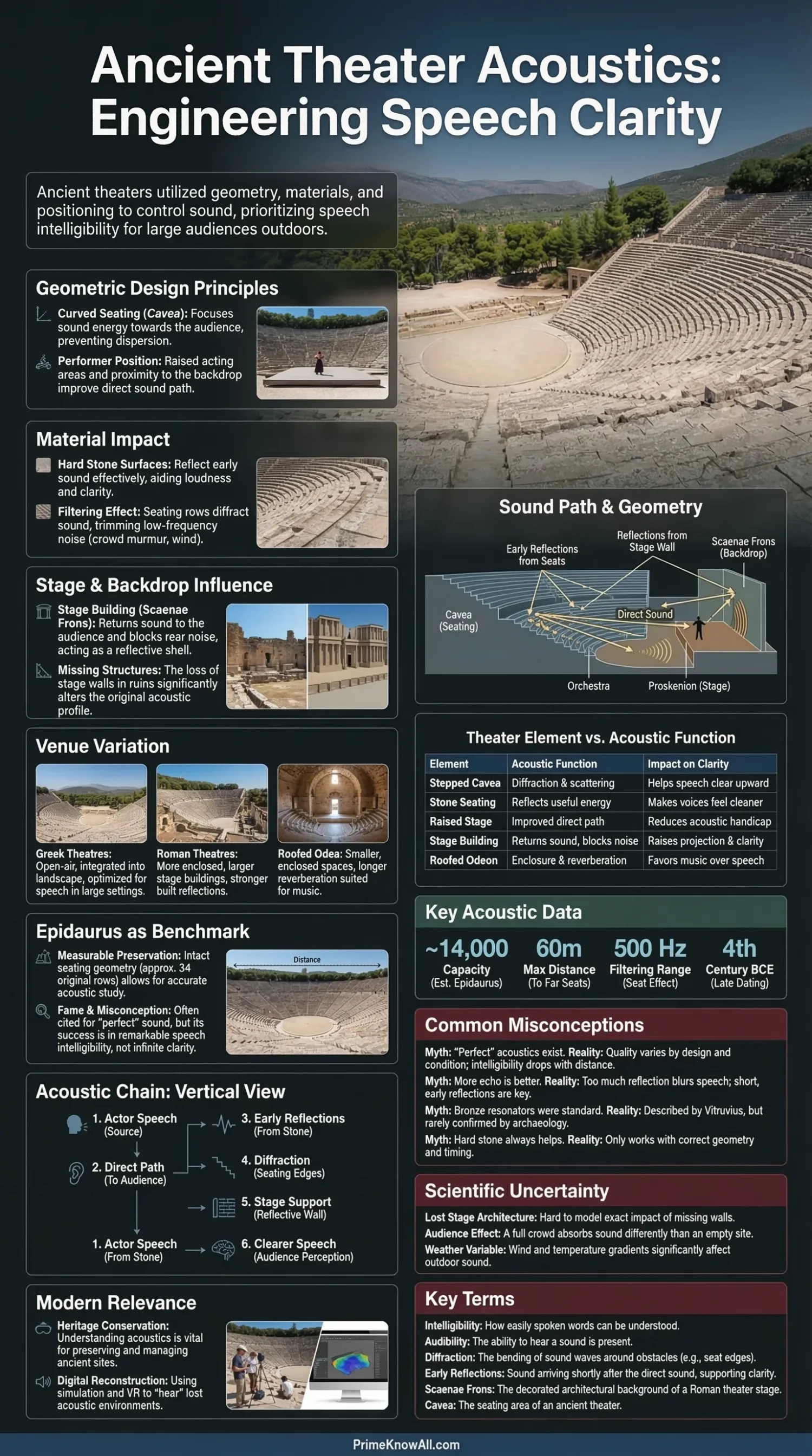
- The real target was clarity, not theatrical magic.
- Epidaurus became the benchmark because its seating geometry and preservation make the acoustic logic easier to study.
- Seat rows mattered more than casual visitors usually expect.
- Greek theatres, Roman theatres, and roofed odea did not behave the same way.
- Modern acoustic research still uses these sites to test ideas about outdoor speech, heritage preservation, and digital reconstruction.
If you remember one thing, remember this: ancient theatre acoustics were mainly about keeping spoken words intelligible across a large crowd. That is a different problem from making music lush, loud, or echo-filled.
Why Ancient Theatres Sounded Better Than an Empty Field
An ancient theatre worked because it reduced the usual penalties of outdoor listening. A speaker in an open field loses words to distance, wind, and background noise. A well-built theatre countered those losses by giving the audience a clear line of sound, reflective surfaces, and stepped geometry that shaped how sound moved upward through the seating.
Acoustic engineering is the practice of shaping a space so sound behaves in a useful way. In ancient performance buildings, that meant helping the audience hear consonants, timing, and vocal direction. The goal was practical: a public performance failed if the crowd could not follow the words.
- Geometry sent sound toward listeners instead of letting it disperse in all directions.
- Hard stone returned early reflections instead of swallowing them.
- Tiered seating changed the sound field in ways flat ground could not.
- Rural or sheltered settings helped the signal-to-noise ratio.
What Ancient Builders Were Really Trying to Improve
The builders were not chasing “volume” alone. They were balancing audibility, speech intelligibility, and coverage across a large audience. Those are related, but they are not the same thing.
Speech intelligibility, a measure of how easily listeners can understand words, mattered more than pure loudness. A voice can be audible yet still hard to understand if low-frequency crowd murmur, wind, or long delayed reflections blur the sharper parts of speech. This is one reason ancient theatres with short, clean early reflections can feel clearer than spaces that seem louder.
- Audibility: can the audience hear that a voice is present?
- Intelligibility: can the audience understand the words?
- Coverage: do listeners across different seating zones receive a similar experience?
- Noise control: can the venue keep background sound from masking speech?
Pause Here: The Main Idea
- Ancient theatres were built first for usable speech, not for cinematic echo.
- The best spaces gave listeners a strong direct sound path plus a few helpful reflections.
- When people call the effect “magic,” they usually compress several design choices into one myth.
| Element | What It Did for Sound | Why It Mattered |
|---|---|---|
| Stepped cavea | Added diffraction and scattering along the seating tiers | Helped speech stay clear as sound moved upward through the audience |
| Stone seating | Reflected useful energy while trimming some muddy low-frequency noise | Made voices feel cleaner, especially in quiet conditions |
| Raised acting zone | Improved the direct path from performer to listener | Reduced the acoustic handicap of speaking from a low orchestra floor |
| Stage building or backdrop | Returned sound toward the audience and blocked part of the rear noise field | Raised clarity and helped projection |
| Roofed odeon | Added enclosure and longer reverberation | Favored music and smaller-scale performance more than a fully open theatre |
Why Epidaurus Became the Reference Example
Epidaurus matters because it is both famous and measurable. The theatre belongs to the Sanctuary of Asklepios at Epidaurus, a UNESCO World Heritage site, and it remains one of the clearest case studies for how a large open-air theatre could support speech without electronic reinforcement. The venue is usually dated to the late 4th century BCE and is tied to Polykleitos the Younger in ancient and later tradition.
Modern reporting and research keep returning to the same numbers because they are easy to picture: the theatre has 34 original rows with 21 Roman additions, and listeners in the far seats are nearly 60 meters from the center area where tour demonstrations usually happen. Capacity estimates vary by source, but they usually fall in the range of about 12,000 to 14,000 spectators.
The most useful lesson from Epidaurus is not that “a pin drop reaches everyone.” It is that the venue keeps speech surprisingly understandable for a large outdoor crowd under favorable conditions. Modern tests pushed back against tourist exaggerations: tiny sounds may travel farther than intuition suggests, yet recognizability drops with distance, and whispers are not equally clear from every seat.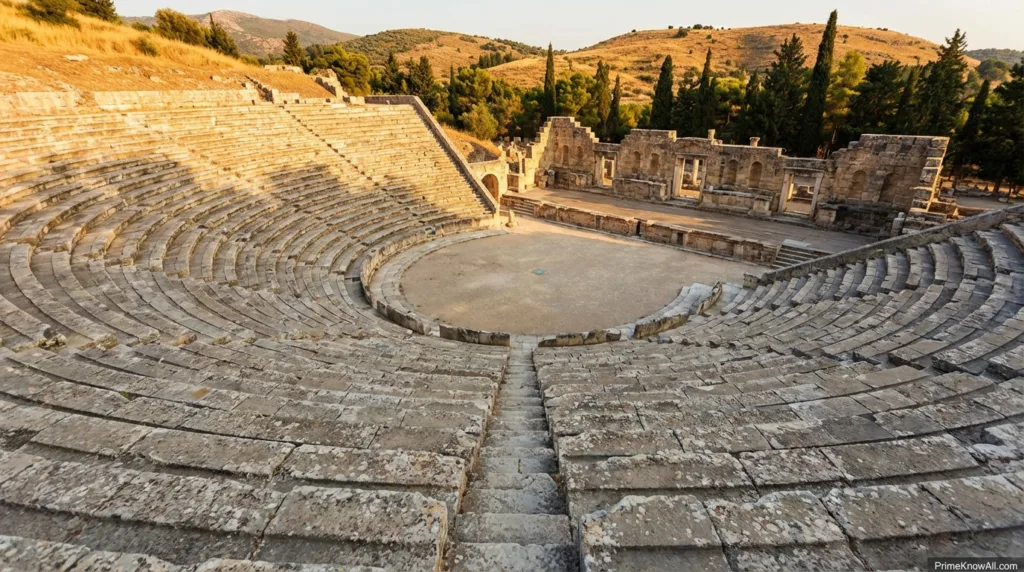
- Its preservation makes acoustic study easier than at many more damaged sites.
- Its fame keeps it at the center of public debate about ancient sound.
- Its geometry gives researchers a strong case for testing the role of seat diffraction and stage position.
Which Parts of the Building Did the Heavy Lifting
No single feature explains the result. Ancient theatre acoustics came from a chain of design choices that worked together. When one link disappeared, especially the stage building, the sound field changed.
The Cavea Was More Than Seating
The cavea, the stepped seating bowl, shaped the audience’s listening experience as much as it shaped sightlines. Research on Epidaurus has long pointed to the seat rows as active acoustic elements. Rather than acting like passive stone benches, they behaved like a patterned surface that altered the balance between useful speech information and softer low-frequency background noise.
Diffraction, the bending of sound around edges, is a plain way to describe part of this effect. Each riser and edge can redirect energy. A 2007 study linked the row geometry at Epidaurus with a filtering effect around roughly 500 Hz, a range that matters because low crowd rumble and wind-related masking often sit below the sharper speech cues listeners need.
The Stage Zone Changed the Direct Path
Where the performer stood mattered. Older discussions sometimes treated the orchestra as the obvious speaking point, but later performance arrangements that moved actors upward or nearer a built backdrop improved the direct acoustic path to more seats. Britannica’s theatre history summary makes this point plainly: once performers were raised, more of the audience had a cleaner line of sound.
The Missing Stage Building Still Matters Today
Many ruins sound different now than they did in antiquity. A lost scaenae frons, the built stage wall behind the performers, changes reflections and weakens some of the support ancient audiences may have heard. This is why acoustic simulation and reconstruction matter so much in recent scholarship. Researchers are often studying a damaged acoustic machine, not the complete original one.
A good analogy helps here. Think of the seating bowl as a stone equalizer rather than a giant loudspeaker. It did not create energy from nowhere. It helped trim some muddy sound and preserve the parts of speech the human ear uses to identify words.
- Seat rows shaped the spectral balance of the sound.
- Performer height and position shaped the direct path.
- Backstage architecture shaped reflections and rear shielding.
- Audience occupancy changed absorption and clarity.
Before Moving On
- Epidaurus sounded good because several parts worked together.
- When the stage wall disappears, the ancient acoustic picture becomes harder to reconstruct.
- The phrase “perfect acoustics” hides the fact that these venues were tuned mainly for speech in open air.
How Greek Theatres, Roman Theatres, and Odea Differed
Ancient performance buildings were not one acoustic type. Greek open-air theatres, Roman theatres, and roofed odea served overlapping but different performance needs. The later building history of these forms shows a steady interest in balancing audience size, visibility, and sound control.
A 2025 acoustics paper on the development of Greek theatres argued that the move from more rectilinear seat arrangements to the familiar semicircular form did two things at once: it increased capacity and improved acoustics. That matters because it suggests the famous theatre form was not just visually elegant; it also solved practical performance problems.
Roman theatres usually leaned more heavily on built stage architecture, especially the scaenae frons. That gave them a different balance of reflection and enclosure. A 2025 study on Pompeii’s three performance venues showed that the amphitheater, the Grand Theater, and the Odeon produced clearly different sound environments: the open amphitheater suited spectacle, the Grand Theater balanced drama and music, and the smaller roofed Odeon favored intimacy and speech clarity.
- Greek open-air theatre: best remembered for speech and public drama in a large landscape setting.
- Roman theatre: more architectural enclosure behind the stage, with stronger built reflection.
- Odeon: smaller and often roofed, giving a tighter, more controlled sound for music and recitation.
Common Misreadings About Ancient Theatre Acoustics
- Wrong: Every ancient theatre had miraculous acoustics.
Better Reading: Acoustic quality varied a lot by form, preservation, topography, and lost architectural parts.
Why This Gets Mixed Up: Public memory is dominated by Epidaurus, so one famous example gets treated as the whole story. - Wrong: A semicircle alone explains the effect.
Better Reading: Shape helped, but seat geometry, stage structures, materials, performer position, and background noise also mattered.
Why This Gets Mixed Up: The semicircle is easy to photograph, while acoustic behavior is harder to see. - Wrong: More echo meant better sound.
Better Reading: Too much lingering sound can blur speech; short, useful reflections are often better for drama.
Why This Gets Mixed Up: Modern audiences sometimes equate “big sound” with “good sound.” - Wrong: Hard stone always improves acoustics.
Better Reading: Hard surfaces help only when geometry and timing also work in your favor.
Why This Gets Mixed Up: Material is easier to point to than the timing of reflections. - Wrong: Vitruvius proves that bronze resonators were standard everywhere.
Better Reading: Vitruvius describes them, but archaeology has not confirmed broad, routine use across the surviving theatre record.
Why This Gets Mixed Up: Ancient texts feel definitive even when the physical evidence is thin. - Wrong: Outdoor theatres can be judged by indoor hall rules without adjustment.
Better Reading: Open-air venues often need different interpretive tools because there is no ceiling and far fewer late reflections.
Why This Gets Mixed Up: People assume one acoustic formula should fit every performance space.
What This Adds Up To
- The famous stories are not pure fiction, but they are usually overstated.
- Ancient theatre acoustics make the most sense when you ask what kind of sound the space was built to support.
- The best venues were not “magical”; they were well-resolved outdoor speech spaces.
A Vertical View of How the Sound Worked
A simplified vertical infographic based on what researchers keep finding at open-air theatres such as Epidaurus.
1. The Actor or Chorus Produces Speech
The source matters first. Clear diction and forward projection carry better than soft, low, diffuse sound.
2. The Direct Path Reaches the Audience
Raised acting positions and good sightline geometry also help the sound path stay clean.
3. Stone Surfaces Return Early Reflections
Early reflections support loudness and timing without creating long indoor-style reverberation.
4. Seat Edges Diffract and Filter
At Epidaurus, research has tied the stepped rows to a filtering effect around 500 Hz, helping speech cues survive background murmur.
5. The Stage Building Adds Support When Present
A built backdrop can reflect sound forward and block part of the rear noise field.
6. The Audience Hears Clearer Speech, Not Unlimited Loudness
That final distinction is the whole point. Ancient theatre design improved understanding more than raw amplitude.
Where the Same Logic Appears in Daily Life
Ancient acoustic logic still shows up in ordinary listening situations. The materials and scale change, but the listening problem stays familiar.
- Outdoor graduation speech on flat grass: people at the back hear a voice but miss words. Why? There is too little helpful reflection and too much distance loss.
- Stadium announcer with a rear wall behind the mic position: speech often feels more focused. Why? The wall supports early reflections instead of letting sound vanish backward.
- Podcast recorded in a tiled kitchen: everything sounds bright yet smeared. Why? Reflective material without the right geometry gives too much uncontrolled reflection.
- Public speaker standing halfway up broad steps: the voice can feel clearer than on flat pavement. Why? The stepped geometry changes how sound reaches listeners.
- Roofed bandstand in a park: music gains body compared with an open platform. Why? Partial enclosure changes reverberation and support.
- Outdoor cinema with a solid stage shell: dialogue sounds better than at a bare temporary screen. Why? A shell helps direct sound forward, much like a stage building did.
- Historic-site VR recreations: researchers now let people “hear” lost buildings digitally. Why? Acoustic heritage can be modeled even when the original architecture is incomplete.
What Modern Engineers Still Learn From These Venues
The lesson is not to copy Greek theatres stone for stone. The lesson is to understand which design choices matter most when a crowd needs clean speech outdoors. That is why ancient theatres keep appearing in papers on acoustic heritage, outdoor measurement, simulation, and reconstruction.
Recent work keeps pushing in two directions. One branch asks how sound actually behaved in the surviving ruins. Another asks how the missing buildings probably changed that behavior. In 2025, research on Pompeii compared multiple venue types inside one city, while other projects used VR, ambisonic auralization, laser scanning, and acoustic archiving to preserve or re-hear lost sound environments.
- Outdoor speech venues still need short, useful reflections.
- Heritage conservation now treats sound as part of the monument, not an afterthought.
- Digital reconstruction helps test what vanished stage walls or roofs may have done.
Keep These Three Points
- Ancient theatres are still useful because they show how far passive design can go without electronics.
- Open-air acoustics need their own reading tools; indoor hall habits do not always transfer well.
- The field now treats sound as heritage, not just stone, dates, and ruins.
What We Still Cannot Confirm with Confidence
Some parts of the story are still uncertain. That matters, because ancient acoustics are easy to romanticize.
- Lost stage architecture: many theatres are missing the very parts that may have helped projection most.
- Full audience conditions: a packed crowd absorbs sound differently from an empty ruin filled with tourists.
- Weather: wind, humidity, and temperature gradients can alter outdoor listening in ways no single demonstration captures.
- Vitruvian resonators: the written description survives, but broad archaeological confirmation does not.
- Measurement standards: researchers still debate which metrics describe open-air theatres best, because no roof means fewer late reflections and less stable indoor-style decay behavior.
This is the honest limit of the topic: ancient theatres can be explained well in broad mechanical terms, but not every famous claim can be verified seat by seat, century by century, with the original architecture fully restored.
Quick Test
These short scenarios help check whether the acoustic logic is really clear.
A theatre loses its stage wall during centuries of damage. What usually changes first: visual symmetry or acoustic support?
Acoustic support usually changes first in a way listeners notice. The missing wall removes forward reflections and weakens part of the sound return that once helped speech reach the audience.
A visitor hears a coin from far away but cannot identify whispered words. Does that mean the theatre “failed”?
No. It means audibility and intelligibility are different. A tiny sound can register at distance even when speech detail is no longer easy to decode.
An open-air theatre is made of hard stone but has poor speech clarity. What is the likely missing piece?
The missing piece is usually geometry or timing, not material alone. Hard surfaces help only when the reflections arrive usefully and the direct path stays strong.
Two venues seat similar crowds. One is open-air, the other roofed. Which is more likely to support intimate music?
The roofed venue is more likely to support intimate music. Added enclosure usually gives more reverberant support and a more controlled sound field than a fully open theatre.
A builder increases theatre capacity by pushing the seating into a more resolved semicircle. Could acoustics improve too?
Yes. Recent work on Greek theatre development argues that the move toward the canonical semicircular form raised capacity while also improving acoustic behavior.
The Part Worth Keeping in Mind
Ancient theatres were not mysterious sound machines; they were highly resolved public speech spaces. Their best results came from a disciplined mix of geometry, material, performer placement, and controlled reflection.
The most common mistake is to treat one spectacular demonstration as proof that every ancient theatre worked the same way. The rule worth remembering is simple: when speech must carry outdoors, clarity beats raw loudness.
Sources
- UNESCO – Sanctuary of Asklepios at Epidaurus – Official page for the World Heritage site that includes the theatre, its 4th-century BCE setting, continued use, and why its proportions and acoustics matter. Reliable because it is the formal international heritage record for the monument.
- PubMed – Acoustic Diffraction Effects at the Hellenistic Amphitheater of Epidaurus – Index page for the 2007 study that linked the seat rows with an acoustic filtering effect. Reliable because it records peer-reviewed article metadata and abstracts from a trusted biomedical and scientific index.
- PubMed – On the Acoustics of Ancient Greek and Roman Theaters – Useful for the measured comparison between Greek and Roman theatre acoustics and the role of architectural variables. Reliable because it points to a peer-reviewed acoustics paper and preserves the abstract and citation record.
- PubMed – Acoustical Aspects of the Development of Greek Theaters in the 4th Century B.C.E. – Supports the point that the shift toward semicircular design improved both capacity and acoustic behavior. Reliable because it indexes a recent peer-reviewed study with abstract access.
- Acta Acustica – Time-Frequency Diffraction Acoustic Modeling of the Epidaurus Ancient Theatre – Explains how diffraction at seating tiers contributes to the sound field, especially for distant listeners. Reliable because it is a specialist acoustics journal with article-level access.
- Heritage – Pompeii Performance Soundscapes in the Amphitheater, the Grand Theater, and the Odeon – Good source for comparing how different Roman venue types produced different sonic results. Reliable because it presents article-level methods, findings, and DOI-linked publication data.
- University of Chicago – Vitruvius, On Architecture, Book V – Topic-specific translation of the ancient text discussing theatre design and sounding vessels. Reliable because it gives direct access to a classic primary source through an academic host.
- Encyclopaedia Britannica – Theatre: Acoustics, Design, Architecture – Helpful reference summary on how performer position, stage development, and theatre form affected audibility. Reliable because it is a long-standing editorial reference source with subject review.
FAQ
Why were ancient theatres so good for speech?
Because the best ones combined a strong direct sound path, hard reflective materials, stepped seating, and stage geometry that helped words stay clear over distance.
Was Epidaurus really perfect?
No theatre is literally perfect. Epidaurus is exceptional, but modern tests show that famous tourist claims are often overstated, especially for whispers and tiny sounds at the farthest seats.
Did the Greeks use bronze vases as ancient speakers?
Ancient texts describe tuned vessels, but archaeology has not confirmed that they were standard equipment across surviving theatres. They remain one of the field’s most debated ideas.
Did Roman theatres sound the same as Greek theatres?
No. Roman theatres usually relied more on built stage architecture, while roofed odea behaved differently again because enclosure changes reverberation and support.
Why do researchers still study these buildings now?
They help explain passive outdoor acoustic design, heritage preservation, and the digital reconstruction of lost sound environments using simulation, scanning, and auralization.
Can modern venues copy ancient theatre acoustics exactly?
Not exactly. Modern venues serve different performance styles and audience expectations, but they still borrow the same ideas about geometry, reflection, and speech clarity.
