Obelisks were never just tall stones. In ancient Egypt, they were solar monuments cut from a single block, raised near temple entrances, and filled with royal messages about gods, kings, and order.
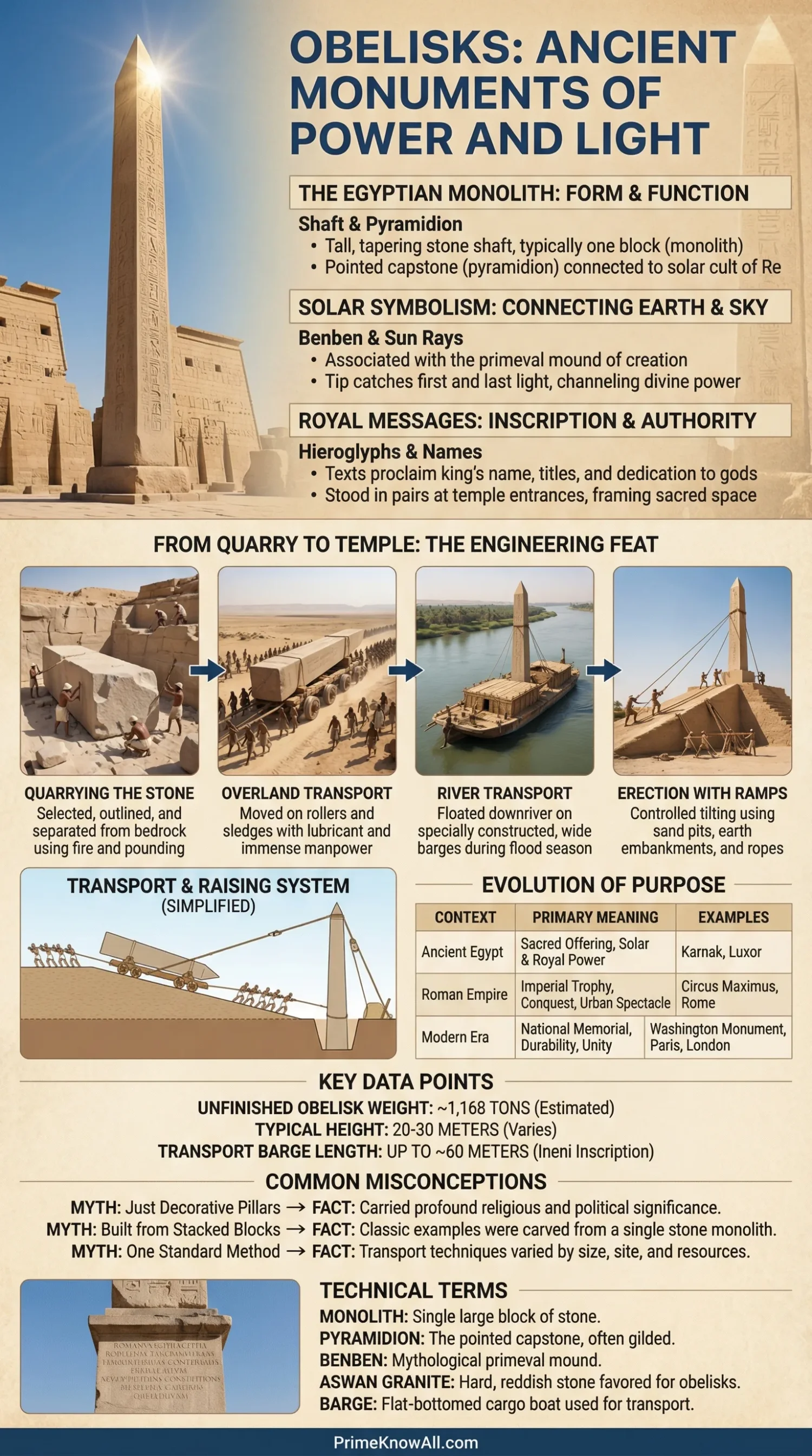
What makes the subject so interesting is the double story. An obelisk is both a symbol and a transport problem. It had to be quarried, moved, lifted, and set in place before anyone could read its meaning. Later, when Romans, popes, and modern cities moved obelisks again, the shape stayed familiar but the message changed.
If you remember one thing, remember this: an obelisk works on two levels at once. It is a public sign of belief and authority, and it is proof that a society could move and raise a single stone on a huge scale.
- Ancient Egyptian obelisks were normally monoliths, meaning one block of stone.
- They were tied to solar belief, especially the cult of Re, and often stood in pairs at temple entrances.
- The move mattered almost as much as the monument. Transport and erection were part of the public message.
- When obelisks left Egypt, their meaning shifted toward imperial display, urban planning, Christian reuse, and later national memory.
What an Obelisk Actually Is
An obelisk is a tall, four-sided stone shaft that narrows upward and ends in a pointed top called a pyramidion. In the Egyptian version, that shaft was usually cut from a single stone, covered with hieroglyphic inscriptions, and placed where people could see both its height and its writing.
An obelisk, in simple terms, is a vertical monument built to be seen from far away and read up close. A monolith is a monument cut from one block. A pyramidion is the pointed capstone at the top. Those three ideas explain most of the form.
- Shape: square or nearly square at the base, tapering as it rises.
- Material: hard stone, often red granite from Aswan.
- Surface: inscriptions naming rulers, gods, and dedications.
- Setting: often placed in pairs near temple entrances in Egypt.
| Part | What It Is | Why It Mattered |
|---|---|---|
| Shaft | A tall tapering stone body, often a monolith | Its sheer height projected durability and royal reach |
| Pyramidion | The pointed top, often finished to catch light | Linked the monument to sunlight and divine brightness |
| Hieroglyphs | Texts carved on all four sides | Turned the monument into a public statement |
| Temple Placement | Commonly at or near entrances, often in pairs | Framed the sacred approach and marked ritual space |
| Stone Source | Often quarried in Aswan | Made the monument a showcase of material control and labor |
What Obelisks Meant in Egypt
In ancient Egypt, obelisks were closely tied to the sun. They were associated with Re, and official Egyptian heritage material links them to the benben, the first mound of land to rise at creation. That is why the form is not random. It points upward, catches light, and turns stone into theology.
The message was never only religious. The king’s name and titles on the shaft told viewers who had offered the monument and under whose rule divine favor was being displayed. In that sense, an obelisk was part prayer, part political inscription, part engineered spectacle.
One useful analogy helps here: an obelisk worked a bit like a vertical headline carved in stone. From a distance, the shape announced presence. Up close, the inscriptions explained whose order, whose god, and whose reign the monument was meant to affirm.
- Solar meaning: the form and tip turned sunlight into part of the monument’s message.
- Royal meaning: names and dedications tied the ruler to divine favor.
- Protective meaning: museum interpretation also notes that obelisks could radiate a protective presence at temples and tombs.
What to Hold On to Here
- In Egypt, the obelisk was not just a marker. It was a solar and royal sign.
- The text on the stone mattered as much as the shape.
- Its placement near temples helped turn approach, sightline, and ritual into one experience.
How a Stone Needle Was Made
Egyptian obelisks began in the quarry, not in the temple. The stone had to be selected, outlined, cut from bedrock, shaped, smoothed, inscribed, and only then moved. That long process is one reason unfinished examples matter so much: they let modern readers see work that a finished monument hides.
One of the clearest examples sits in Aswan. The Unfinished Obelisk, now documented by Egypt’s Ministry of Tourism and Antiquities, shows how ambitious these projects could be. Had it been finished, it would have stood around 42 metres high and weighed about 1,168 tonnes. Cracks in the stone stopped the project. That failure is valuable because it leaves the quarrying process visible.
Another hard number comes from Hatshepsut’s standing obelisk at Karnak. A base inscription recorded that the cutting of that particular obelisk took seven months. That does not mean every obelisk followed the same timetable, but it does show the pace of one royal project with unusual clarity.
- Aswan granite was prized for hardness and visual presence.
- Fissures, meaning natural cracks in the stone, could end a project even after heavy labor had begun.
- Tool marks and guide lines at unfinished sites help archaeologists reconstruct the work sequence.
How People Moved Hundreds of Tons Without Engines
The best-supported answer is this: ancient Egyptians combined quarry access, river transport, barges, ramps, teams of workers, and careful control of balance. There is still debate over the exact setup in every case, but the basic picture is clear enough. Water, leverage, planning, and labor did the work that engines do today.
The evidence comes from several directions at once. An inscription tied to the official Ineni says a boat was built to move a pair of obelisks: 120 cubits long, about 200 feet, and 40 cubits wide, about 67 feet. Relief scenes from Hatshepsut’s temple also show obelisk transport by barge. Britannica notes that once the shaft reached its destination, workmen raised it using an earth ramp and tilted it into place on its base.
This vertical visual summary shows the most likely chain of work behind an Egyptian obelisk, combining quarry evidence, inscriptions, and temple scenes.
Workers marked a long block in hard quarry stone, often at Aswan, where granite quality made giant monoliths possible.
They separated the block from bedrock, shaped the taper, and prepared the pointed pyramidion.
The shaft had to reach a loading point, likely by controlled hauling over land with timber, sledging, and manpower.
A barge is a wide, flat cargo vessel. Ineni’s inscription shows that very large boats were built for obelisk transport on the Nile.
At the temple, the shaft was brought onto its base area and lifted using earthworks, ropes, and careful angle control.
Once upright, the obelisk did what it was made to do: catch light, frame approach, and announce divine and royal order.
- Barge: a wide cargo vessel suited to heavy loads on water.
- Ramp: an earth or fill structure that let workers change the monument’s angle gradually.
- Erection: the controlled act of raising a monument into its standing position.
One point deserves caution. People often want a single secret trick that explains every obelisk. The evidence does not support that. Methods likely varied by size, site, season, labor force, and destination. What stays steady is the reliance on water transport, heavy coordination, and slow controlled lifting.
Pause Here
- Ancient transport was not magic. It was logistics, river access, and patient control of mass.
- Inscriptions and reliefs give real evidence, not just guesswork.
- The unfinished examples matter because they show the job before the polished finish.
How Rome Changed the Message
Rome reused the obelisk form but changed what it said. Beginning with Augustus, emperors brought Egyptian obelisks to Rome to decorate imperial space and to mark Roman control over Egypt. The stone still carried sun symbolism, but now it also carried the politics of conquest, possession, and display.
Smarthistory’s work on Roman obelisks makes this shift unusually clear. One obelisk that once stood at Heliopolis was brought to Rome by Augustus and set up in the Circus Maximus. The base received a new Latin dedication saying Egypt had been brought under Roman rule and that the monument had been rededicated to Sol, the Roman sun god. Same form. New audience. New ruler. New civic setting.
That is why Roman obelisks should not be read as simple preservation. They were acts of translation and appropriation. Rome did not just admire Egypt’s engineering. It absorbed Egyptian prestige into Roman urban life, where race spectators, citizens, and visitors saw these stones as part of the capital’s visual language.
- Egypt: temple entrance, sacred offering, royal dedication.
- Rome: civic spectacle, imperial trophy, urban centerpiece.
- Later Christian Rome: reused monument with a cross and new inscriptions.
What Later Relocations Tell Us About Engineering and Power
When later societies moved obelisks, the move itself became part of the message. A ruler, church, or city that could relocate an ancient monolith was making a public claim about competence, order, and legitimacy.
The Vatican obelisk is a famous case. According to Vatican documentation, when Pope Sixtus V had it moved to the center of St Peter’s Square in 1586, the operation used 907 men, 75 horses, and 44 winches. The bronze sphere was replaced with a cross. The monument was not merely repositioned. It was reframed within Christian Rome.
New York offers a different version of the same pattern. The Central Park Conservancy notes that the park’s obelisk, commonly called Cleopatra’s Needle, measures about 69 feet and weighs around 200 tons, with a pedestal and steps weighing another 50 tons. After reaching the Hudson in 1880, it took 19 days to cross the 86th Street Transverse and 20 more days to reach its final position. Around 10,000 people watched it being raised in January 1881. That is urban theater as much as transport.
Modern memorial obelisks continue this afterlife. The Washington Monument, begun in 1848 and completed in 1884, adopted the obelisk form to symbolize strength and unity. It is not Egyptian in origin, but its silhouette borrows the old visual grammar of permanence and upward reach.
- Renaissance Rome: technical mastery in service of papal order.
- Nineteenth-century New York: engineering display mixed with museum ambition and city identity.
- Modern national memorials: the obelisk form as a shorthand for endurance and public memory.
What This Adds Up To
- Obelisks keep their visual force because the shape is simple, tall, and legible.
- Each relocation rewrites the monument’s meaning without changing its outline.
- Transport history is not background detail. It is part of the monument’s public life.
Common Misreadings
Obelisks are easy to recognize, which is one reason they are easy to misread. The outline looks simple, so people often flatten the history behind it. These are the misunderstandings that show up most often.
- Wrong: “An obelisk is just a thin pyramid.”
Correct: A pyramid and an obelisk share a pointed geometry, but an obelisk is a tapering shaft with a pyramidion, not a pyramid standing upright.
Why it gets confused: both forms use angular upward lines. - Wrong: “Obelisks were mainly decorative.”
Correct: In Egyptian settings, they carried religious and royal meaning, and in Roman settings they could signal conquest and prestige.
Why it gets confused: later garden, plaza, and memorial obelisks can look purely ornamental. - Wrong: “Ancient builders had one fixed transport method.”
Correct: The broad method is visible, but the exact setup likely changed from project to project.
Why it gets confused: people prefer one hidden trick to a messy technical process. - Wrong: “If the shape stayed the same, the meaning stayed the same.”
Correct: Meaning shifted from temple offering to imperial trophy to Christianized marker to national memorial form.
Why it gets confused: stone looks stable even when context changes. - Wrong: “Every obelisk is Egyptian.”
Correct: The form begins in Egypt, but later societies copied or adapted it for very different reasons.
Why it gets confused: the Egyptian version is the model most people recognize first.
Where the Form Still Feels Familiar
Even people who never study ancient Egypt still meet obelisk logic in everyday visual culture. The form survives because it solves several public design problems at once: it marks a place, organizes sightlines, reads clearly from a distance, and suggests durability without much explanation.
Real-World Situations That Make the Point Clear
- Standing in St Peter’s Square: the obelisk works as a visual anchor in a vast open space.
That happens because tall central forms help people orient themselves fast. - Seeing the Washington Monument from far across the Mall: the silhouette stays readable even at long distance.
That is one reason the obelisk form fits civic memory so well. - Walking past Cleopatra’s Needle in Central Park: an Egyptian monument becomes part of New York’s identity.
The old stone now speaks in a modern urban setting as much as an ancient one. - Looking at city squares in Rome: imported obelisks still structure plazas, traffic, and ceremony.
They continue to organize space long after their first religious context disappeared. - Visiting a cemetery with small obelisk grave markers: the reduced form still signals permanence and remembrance.
Even in miniature, the outline carries a memory of endurance. - Watching tourists photograph the Luxor Obelisk in Paris: a monument from one culture becomes a focal point in another capital.
The shape still acts like a visual magnet because it is simple and vertical.
What We Know and What We Cannot Confirm
The outline of obelisk history is clear, but some technical details remain open. That is not a weakness in the subject. It is the normal limit of working with ancient evidence.
- We do know that quarry evidence, inscriptions, and relief scenes support large-scale river transport and controlled raising methods.
- We do know that unfinished examples in Aswan are vital for understanding how monoliths were cut and why some projects failed.
- We do not have a full ancient manual giving one step-by-step recipe for every obelisk move.
- We cannot assume that one technique fits every stone, season, destination, or reign.
- We should also avoid treating symbolism as frozen. Egyptian, Roman, papal, and modern civic readings are related, but they are not identical.
Where Caution Helps
- The hardest part is often not defining the monument, but explaining which evidence supports which step.
- Technical reconstructions are strongest when they combine quarry traces, texts, reliefs, and later experiments.
- Any claim that says “this is exactly how every obelisk was moved” is probably too neat.
Quick Test
Use these short checks to see whether the main ideas are clear.
Were ancient Egyptian obelisks normally built from many stacked blocks?
No. The classic Egyptian obelisk was usually a monolith, meaning one piece of stone.
Did obelisks only serve as decoration?
No. In Egyptian settings they carried solar, royal, and sacred meaning, and later cultures reused them for new political messages.
Is the transport story separate from the symbolism?
Not really. Moving and raising a massive monolith was itself a display of order, labor control, and authority.
Did Rome keep the Egyptian meaning unchanged?
No. Rome kept the form but gave it new work to do in imperial city space.
Does one ancient method explain every obelisk move?
No. The broad pattern is visible, but the exact technical setup likely varied with the monument and the site.
Why the Shape Still Works
Obelisks still make sense to modern eyes because they combine clean form, public visibility, and historical weight. A viewer can understand the outline in one glance, then discover layer after layer of context: stone source, transport effort, inscriptions, reuse, and political afterlife.
Two-sentence summary: In Egypt, obelisks joined sun belief, royal inscription, and engineering skill in one monument. Once they began to move across empires and cities, they kept their outline but gained new meanings tied to conquest, Christianity, museums, and national memory.
The most common mistake is treating transport as a side note, when the move itself was often part of the monument’s message.
The rule worth keeping: when an obelisk changes location, its symbolism changes with it.
Sources
- Britannica – Obelisk — Useful for the basic form, early surviving examples, Hatshepsut’s seven-month cutting inscription, and the earth-ramp raising method. Reliable because Britannica is an edited reference source used for stable factual summaries.
- The Metropolitan Museum of Art – Cleopatra’s Needle — Helpful for solar symbolism, the pyramidion, and temple placement. Reliable because it comes from a major museum with Egypt specialists and object-based interpretation.
- Ministry of Tourism and Antiquities, Egypt – The Unfinished Obelisk — Best for the Aswan quarry example, the 42-metre estimate, and the 1,168-tonne figure. Reliable because it is the official Egyptian heritage portal for the monument.
- UNESCO World Heritage Centre – Nubian Monuments from Abu Simbel to Philae — Useful for why the Aswan quarry and unfinished obelisk matter for understanding Egyptian stone-working. Reliable because UNESCO maintains World Heritage documentation and site value statements.
- Institute for the Study of Ancient Cultures, University of Chicago – Through the Stereoscope: Karnak Section — Used for the inscription about the 120-cubit by 40-cubit transport boat. Reliable because it is a university publication drawing on Egyptian inscriptional evidence.
- Smarthistory – Obelisks and Ancient Rome — Valuable for Augustus, Roman relocation, new Latin dedications, and the political reuse of Egyptian monuments. Reliable because Smarthistory is written and reviewed by art historians and museum-connected scholars.
- Vatican – Obelisk — Used for the 1586 move to the center of St Peter’s Square and the figures of 907 men, 75 horses, and 44 winches. Reliable because it is the official site documenting the monument in its present setting.
- Central Park Conservancy – How the Obelisk Made Its Home in Central Park — Used for the New York obelisk’s size, weight, route, and installation timeline. Reliable because the Conservancy manages the site and documents its conservation history with partner institutions.
- U.S. National Park Service – Washington Monument — Helpful for the modern civic meaning of the obelisk form in the United States. Reliable because the National Park Service is the official federal steward of the monument.
FAQ
What did obelisks symbolize in ancient Egypt?
They were closely tied to solar belief, especially the cult of Re, and also acted as public statements of royal authority. Their pointed tops, inscriptions, and temple placement all supported that reading.
How were ancient obelisks transported?
The strongest evidence points to a mix of quarry hauling, river barges, ramps, ropes, and carefully controlled lifting. Inscriptions and relief scenes support this broad picture, even though every technical step is not known in full detail.
Why did the Romans move Egyptian obelisks to Rome?
Roman emperors used them to decorate the capital and to mark control over Egypt. In Rome, the obelisk became an imperial urban monument rather than a temple offering in its original sense.
Why is the Washington Monument an obelisk?
The obelisk form was chosen because it conveyed endurance, unity, and public memory through a very clear silhouette. It borrows the visual force of the ancient form without copying Egyptian religious meaning directly.
Are all obelisks Egyptian?
No. The form begins in Egypt, but later societies reused and adapted it for Christian, imperial, civic, funerary, and national memorial settings.
