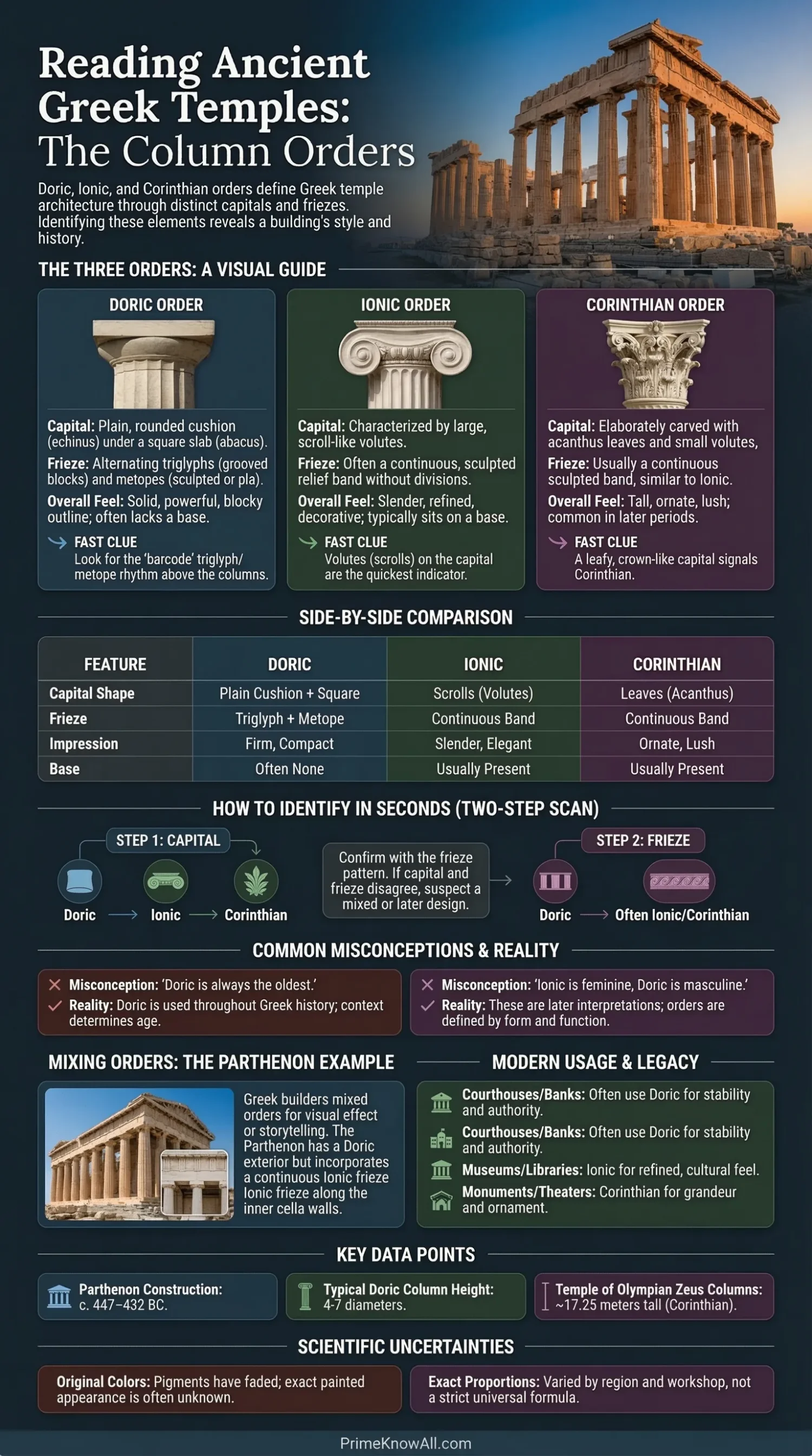
Ancient Greek column orders are the Doric, Ionic, and Corinthian styles—each defined by a particular capital and the horizontal parts above it. Read the capital plus the frieze, and you can often tell what you’re looking at in seconds. That skill also helps you notice when a temple’s design was updated or mixed across eras.
These orders are not “decorations” added at the end. They work like a visual system: column shape, spacing, and the carved bands above the columns all fit together. Temples follow the system closely in many cases, but Greek builders also made local and practical choices when stone, budget, or site constraints pushed back.
If you remember one thing… focus on the top of the column. A plain cushion-like capital points toward Doric, scrolls point toward Ionic, and carved leaves point toward Corinthian.
Main Points To Hold On To
- An order is a repeatable set of parts with shared proportions, not just a single column type.
- Doric often looks compact and uses a frieze with triglyphs and metopes.
- Ionic is usually slimmer, uses scroll-like volutes, and often has a continuous frieze.
- Corinthian is identified by leafy capitals and becomes common later, especially in Hellenistic and Roman contexts.
- Greek temples sometimes mix orders (for example, a Doric exterior paired with Ionic elements higher up or inside).
What A Column Order Really Means
A column order is a standardized set of architectural parts—column, capital, and entablature—designed to look consistent when repeated around a building.
Here are the parts that matter most when you “read” an order. Keep them in mind, because Greek builders put their main signals right where the eye naturally lands.
- A capital is the top of a column that spreads the load and creates the order’s most recognizable silhouette.
- An entablature is a horizontal stack of elements sitting on columns, usually: architrave (lowest band), frieze (middle band), and cornice (top projecting band).
- A frieze is the middle band of the entablature; in Doric it is often broken into triglyphs and metopes, while Ionic friezes are often continuous.
- Fluting is a set of vertical grooves on a column shaft that catch light and make the profile feel sharper from far away.
Small takeaway to save
- If you only check one detail, check the capital.
- If you want a second confirmation, check the frieze.
- If both agree, you’re usually on solid ground—unless the building is deliberately mixing orders.
Doric Order: Plain Capitals And A Patterned Frieze
The Doric order is often the easiest to recognize because its capital is simple and its entablature uses a very specific rhythm of triglyphs and metopes.
A classic Greek Doric column often sits directly on the platform (the stylobate) without a separate base, though later traditions may add one. The capital typically reads as a firm “stack”: a rounded, cushion-like piece under a square slab. It looks restrained up close, but from a distance it gives a temple a steady, blocky outline.
How Doric Announces Itself
- Capital: plain, rounded cushion profile under a squared top.
- Frieze: alternating triglyphs (grooved blocks) and metopes (panels that can be plain or carved).
- Overall feel: often appears compact compared with other orders, especially in many mainland examples.
A triglyph, meaning a “three-groove” block, is a vertical element in the Doric frieze; the metope is the panel space between triglyphs. If you see that alternating pattern above the columns, you can usually label the exterior order as Doric with high confidence.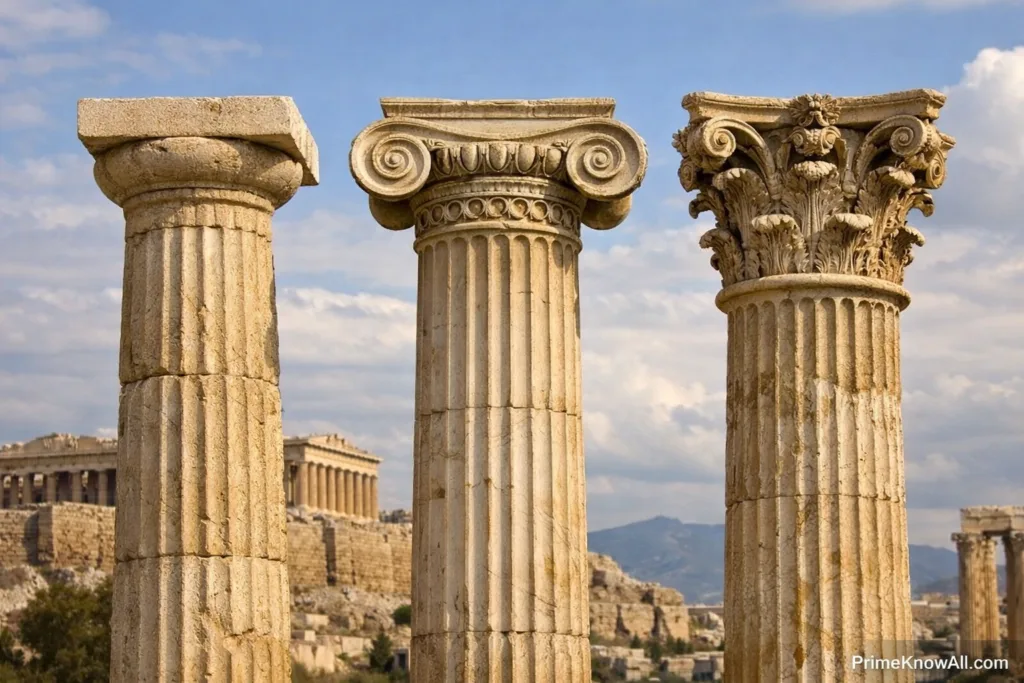
Ionic Order: Scroll Capitals And A Continuous Band
The Ionic order is marked by its volutes—the scroll-like shapes on the capital—and by an entablature that can support a continuous frieze rather than broken panels.
Compared with many Doric temples, Ionic buildings often feel more linear and refined, partly because the column is commonly slimmer and includes a distinct base. In Greek practice, Ionic details also invite close viewing: carved moldings, a long frieze, and capital profiles that create crisp shadows.
What To Look For On An Ionic Column
- Capital: a pair of outward-facing volutes (scrolls) that read clearly even from far away.
- Base: usually present, creating a visual “foot” under the shaft.
- Frieze: often a continuous band that can carry relief sculpture across a long stretch.
A volute is a spiral form carved into the Ionic capital. It is not just decoration: it gives the capital a strong outline so the order stays readable from street level. Ionic capitals can also vary in how “tight” the spiral looks, and some famous examples show unusually rich carving.
Two-order checkpoint
- Doric: plain capital + triglyph/metope rhythm.
- Ionic: scroll capital + long frieze band.
- Quick habit: look up first, then look along the frieze.
Corinthian Order: Leaf Capitals And Late Popularity
The Corinthian order is recognized by an ornate capital carved with acanthus leaves and other vegetal forms, creating a “bouquet” silhouette.
In Greek architecture, Corinthian develops later than Doric and Ionic. It appears in the late Classical era and becomes far more common in the Hellenistic and Roman periods. That timeline is a helpful clue: if a temple’s main exterior colonnade is Corinthian, the overall project is often later, rebuilt, or completed under later influence.
Corinthian In One Look
- Capital: stacked leaves that curl outward, often with small scrolls tucked between them.
- Effect: a busier outline that reads as lush even at a distance.
- Use pattern: appears earlier in small or special contexts, then spreads widely in later Greek and Roman building.
Acanthus is a Mediterranean plant whose leaves became a repeating motif in carved ornament. In Corinthian capitals, the leaf pattern creates a strong “upward” motion, which makes the column feel taller even when its actual height is similar to other orders.
For a real scale check, the Temple of Olympian Zeus in Athens was planned as a vast Corinthian temple with 104 columns and columns rising to about 17.25 meters in height, according to the official site description for the Olympieion. Numbers like these help explain why Corinthian could feel so theatrical in later monumental projects.
A Useful Reminder About “Late”
When people say Corinthian is “later,” it does not mean Doric and Ionic vanish. Older orders keep showing up in later centuries, especially when builders want a familiar civic look. A better rule is: Corinthian is more likely to dominate major temple exteriors in later eras, but context still matters.
Side-By-Side Comparison You Can Use On Site
When you are trying to decide quickly, it helps to compare the same parts across orders. The table below keeps the focus on capital, base, and frieze, because these are the fastest tells.
| Feature | Doric | Ionic | Corinthian |
|---|---|---|---|
| Capital Shape | Plain cushion + square top | Scrolls (volutes) | Leaves (acanthus) |
| Base | Often none in Greek Doric exteriors | Usually present | Usually present |
| Frieze | Triglyph + metope pattern | Often continuous band | Often continuous band |
| Common First Impression | Firm, compact rhythm | Slender, linear elegance | Ornate, leafy silhouette |
| Good Backup Clue | Corner triglyph rhythm around edges | Three-part architrave bands are common | Capital looks like a carved “basket” of leaves |
How To Identify An Order In About 15 Seconds
Use a two-step scan: capital first, then frieze second. If both cues match the same order, you can be fairly confident without measuring anything.
The Two-Step Scan
- Step 1 (Top silhouette): plain cushion = Doric; scrolls = Ionic; leaves = Corinthian.
- Step 2 (Band above columns): triglyph/metope rhythm = Doric; continuous relief band = often Ionic/Corinthian.
- Step 3 (Check the base): a clear base often aligns with Ionic/Corinthian in Greek practice, though later rebuilds can blur this.
One analogy that helps: think of orders like typefaces. Doric behaves like a clean, sturdy “default font” for temples; Ionic adds more “strokes” and a smoother line; Corinthian is closer to a display font that demands attention. It’s not a perfect match, but it explains why the orders feel different even before you name them.
Mini reminder to keep nearby
- Capital gives you the fastest label.
- Frieze gives you the strongest confirmation.
- If the two disagree, suspect a mixed design or a later phase.
Why Temples Mix Orders
Greek temples can mix orders because builders treated the order as a toolkit, not a cage. A building may keep a Doric “shell” for tradition while using Ionic elements where a long sculpted band or a different visual effect fits better.
A Famous Mixed Example
The Parthenon is often described as Doric, and its outer colonnade reads that way, but it also incorporates an Ionic frieze running around the upper walls of the cella. That choice gives the building both a Doric public face and a continuous narrative band in a more Ionic spirit.
Other Common Reasons For Mixing
- Visual storytelling: a continuous frieze is better for a long procession scene than separate metope panels.
- Regional taste: some areas favored Ionic details even when the broader plan stayed Doric.
- Later phases: repairs, additions, or completions can introduce a new order without replacing the whole building.
- Interior vs exterior: the outside may stay conservative while the inside adopts more elaborate detailing.
Mixing-orders checkpoint
- If a building is “mostly Doric” but has a long carved band, that band may be Ionic in character.
- If a later phase aims for grandeur, Corinthian may appear on entrances or colonnades.
- Rule of thumb: treat mixed signals as a clue, not a mistake.
Proportions, Fluting, And Optical Tweaks
Beyond capitals and friezes, Greek temple columns use proportion and subtle “optical” adjustments so the building reads well from ground level.
Proportions: Helpful, But Not A Single Formula
It’s tempting to treat proportions as a strict rule (Doric = short, Ionic = tall, Corinthian = taller). In reality, proportions vary by period, region, and workshop. Still, the general trend—slimmer profiles in Ionic and Corinthian compared with many Doric examples—often holds as a first impression rather than a measurement tool.
Entasis And Curvature
Entasis is a slight swelling of the column shaft that helps the column look straight from a distance. It’s easy to miss in photos, but it matters on site because temples are meant to be read from below, in bright light, with long shadows.
Fluting As A Light Tool
Flutes are not just decoration; they are a way to control highlights and shadows. In midday sun, fluting makes a round shaft look sharper and helps the temple keep its graphic clarity even when viewed from far across a sanctuary.
Stone, Color, And The Parts We No Longer See
Many temple photos give a “white marble” impression, but ancient temples could include paint, metal attachments, and color contrasts that are now missing. That matters for orders, because carved details on capitals and moldings were meant to be more legible than bare stone sometimes allows.
Even when a temple is built in fine stone, time removes the small edges that sharpen the order’s profile. Weathering can soften Doric triglyph grooves, blur Ionic moldings, and chip Corinthian leaf tips. That’s one reason it helps to pair a capital read with a frieze read instead of relying on one detail only.
Small note that saves time
- Damage can hide delicate features, especially in Corinthian capitals.
- Repairs can introduce later-looking pieces into an older setting.
- When details are worn, look for the overall silhouette and the frieze pattern.
A Vertical Infographic: The Three Orders As A Spotter’s Stack
This visual is built as a vertical “stack” so it reads well on mobile. It focuses on what the eye can catch fast: capital, frieze, and one famous example for each order.
Common Misconceptions
This topic gets simplified online, so it helps to keep a few corrections handy. Each misconception below includes the wrong idea, a clean fix, and why the mix-up happens.
- Misconception: “Orders are only about the column.”
Fix: An order includes the entablature too, especially the frieze.
Why it’s misunderstood: photos often crop out the bands above the column tops. - Misconception: “Doric always means early.”
Fix: Doric continues to be used across long periods; the context matters.
Why it’s misunderstood: Doric is taught as “the first order,” which can sound like a strict date stamp. - Misconception: “Ionic = feminine, Doric = masculine.”
Fix: Those labels are later interpretive habits; the real identifiers are forms and construction choices.
Why it’s misunderstood: simplified art-history summaries often repeat memorable metaphors. - Misconception: “Corinthian is just fancy Ionic.”
Fix: Corinthian shares parts of Ionic vocabulary but is defined by a distinct leaf capital and a different visual goal.
Why it’s misunderstood: both can use continuous friezes, so people focus on the frieze and miss the capital. - Misconception: “If one part is Ionic, the whole temple is Ionic.”
Fix: Temples can be Doric outside and still use Ionic elements in selected zones.
Why it’s misunderstood: labels are often applied as a single tag in travel writing. - Misconception: “All Greek temples were white.”
Fix: temples could include color and attachments that are now gone.
Why it’s misunderstood: weathered stone creates a clean modern look in photos.
Where You See Column Orders In Everyday Life
Even if you never visit Greece, these shapes show up in modern life because they became a shared visual language for “public” architecture. Here are grounded examples that make the idea stick.
- You walk past a courthouse with a strict, repetitive façade. The design often borrows a Doric-leaning rhythm to signal stability. Why this happens: Doric reads clearly from a distance and looks disciplined in long rows.
- You visit a museum wing with scroll capitals. Those scrolls echo Ionic and make the entrance feel more “crafted” than purely rugged. Why this happens: volutes add an instant signature without relying on heavy ornament.
- You see leafy capitals in older theaters or memorials. That leaf crown is a Corinthian move. Why this happens: the silhouette stays legible even when details are high above eye level.
- You notice a continuous sculpted band wrapping a building. That idea matches an Ionic-style frieze more than Doric panels. Why this happens: a long band is better for a single story that needs uninterrupted space.
- You pause a movie scene set in “ancient” architecture. Set designers often pick Doric for quick recognizability, then add Ionic/Corinthian for texture. Why this happens: these cues read fast on camera.
- You explore a historical game world on console or PC. Developers frequently use Doric vs Ionic vs Corinthian as a shorthand for place and era. Why this happens: orders act like visual labels that players learn without a tutorial.
- You scroll architecture photos on social platforms. Capitals become the “hook” detail that people zoom in on. Why this happens: the capital is the most compact summary of the order.
Practical memory hook
- If the building wants to look “official,” it often borrows Doric restraint.
- If it wants a crafted look, it leans on Ionic detail.
- If it wants instant ornament, it reaches for Corinthian.
Quick Test: Can You Name The Order?
Each prompt below is a short scene description. Tap to reveal the answer and the reason. These are written to match how people actually notice buildings: a glance up, a quick pattern read, then a label.
Test 1: “The capital is plain and cushion-like, and the band above the columns alternates grooved blocks with flat panels.”
Answer: Doric. Why: the triglyph/metope rhythm is the giveaway.
Test 2: “You see scrolls on each capital, and above them runs one long sculpted band without breaks.”
Answer: Ionic. Why: the volutes plus a continuous frieze fit Ionic well.
Test 3: “The top of each column looks like a carved crown of leaves, and the silhouette is busy even from far away.”
Answer: Corinthian. Why: the leafy acanthus capital is the defining mark.
Test 4: “The outer columns look Doric, but a continuous sculpted band wraps around the upper wall inside the colonnade.”
Answer: Mixed orders. Why: the exterior can read as Doric while an Ionic-style frieze appears higher up or on the cella.
Test 5: “The capital details are worn, but the frieze clearly shows triglyphs and metopes.”
Answer: Doric. Why: even when capitals erode, the Doric frieze pattern often remains readable enough to confirm.
Limitations And What We Still Don’t Know
Even with clear order “rules,” some parts of Greek temple appearance remain uncertain. That is normal for ancient architecture that survived through reuse, earthquakes, weathering, and restoration.
- Original color schemes: pigment traces exist in some cases, but the full painted look of many temples is not fully recoverable from surviving fragments.
- Exact workshop proportions: builders followed shared habits, yet measurements vary by place and time; not every Doric or Ionic example fits a single ratio.
- Missing details: capitals and moldings can be re-carved or replaced, making it harder to separate an original phase from a later repair without detailed study.
- Labels can oversimplify: calling a building “Doric” may describe its outer shell while important parts use Ionic or Corinthian vocabulary.
If you want the most honest field rule: treat orders as strong signals, then keep a little room for exceptions. Greek builders were skilled, but they were also practical.
Sources
Links below are selected for accuracy and editorial standards. Official institutions are listed with dofollow; academic or reference resources may use nofollow.
The Metropolitan Museum of Art – Architecture in Ancient Greece
(Explains Doric vs Ionic regional popularity and describes Corinthian capital features; written and reviewed by a major museum.)
Encyclopaedia Britannica – Order (Architecture)
(Defines what an architectural order is and places Doric/Ionic/Corinthian in historical context; Britannica has editorial review and named reference standards.)
Acropolis Museum – The Frieze
(States that an Ionic frieze is incorporated into the Doric Parthenon and gives measurable details like total frieze length; official museum documentation.)
Hellenic Ministry of Culture / TAP – Olympieion (Temple of Olympian Zeus) PDF
(Provides verified dimensions and column counts/heights for the Corinthian Olympieion; produced for an official archaeological site.)
Smarthistory – Greek Architectural Orders
(Clear visual explanation used widely in education; content is curated by art historians and editors.)
Khan Academy – Greek Architectural Orders
(Beginner-friendly definitions with scholarly oversight; useful for quick cross-checks.)
ToposText – Vitruvius, Ten Books on Architecture (public domain translation)
(Primary text access for how later authors discussed orders; helpful for context, not a single “final” authority.)
FAQ
What are the three main Ancient Greek column orders?
The three widely taught orders are Doric, Ionic, and Corinthian. They are identified mainly by the capital and by how the entablature is handled above the columns.
Is the Parthenon Doric or Ionic?
Its exterior colonnade reads as Doric, but it also incorporates an Ionic frieze around the upper walls of the cella. It is a strong example of how Greek buildings can combine order vocabularies.
How can I tell Doric from Ionic quickly?
Look at the capital first: plain cushion suggests Doric, scrolls suggest Ionic. Then confirm by checking the frieze: Doric often alternates triglyphs and metopes, while Ionic often uses a continuous band.
Does Corinthian always mean Roman?
No. Corinthian develops in Greek architecture and becomes very common later, especially in Hellenistic and Roman settings. A Corinthian exterior can suggest a later date or later phase, but it is not a guaranteed “Roman-only” label.
Why do some temples look “plain” today?
Weathering can soften carved edges, and missing paint or metal details can remove contrast that once made forms pop. That’s why it helps to use more than one clue, such as capital plus frieze.
Summary: Doric, Ionic, and Corinthian are easiest to identify through the capital and the frieze. Most common mistake: naming an order from the column alone while ignoring the entablature above it. Sticky rule: Top first, band second.
