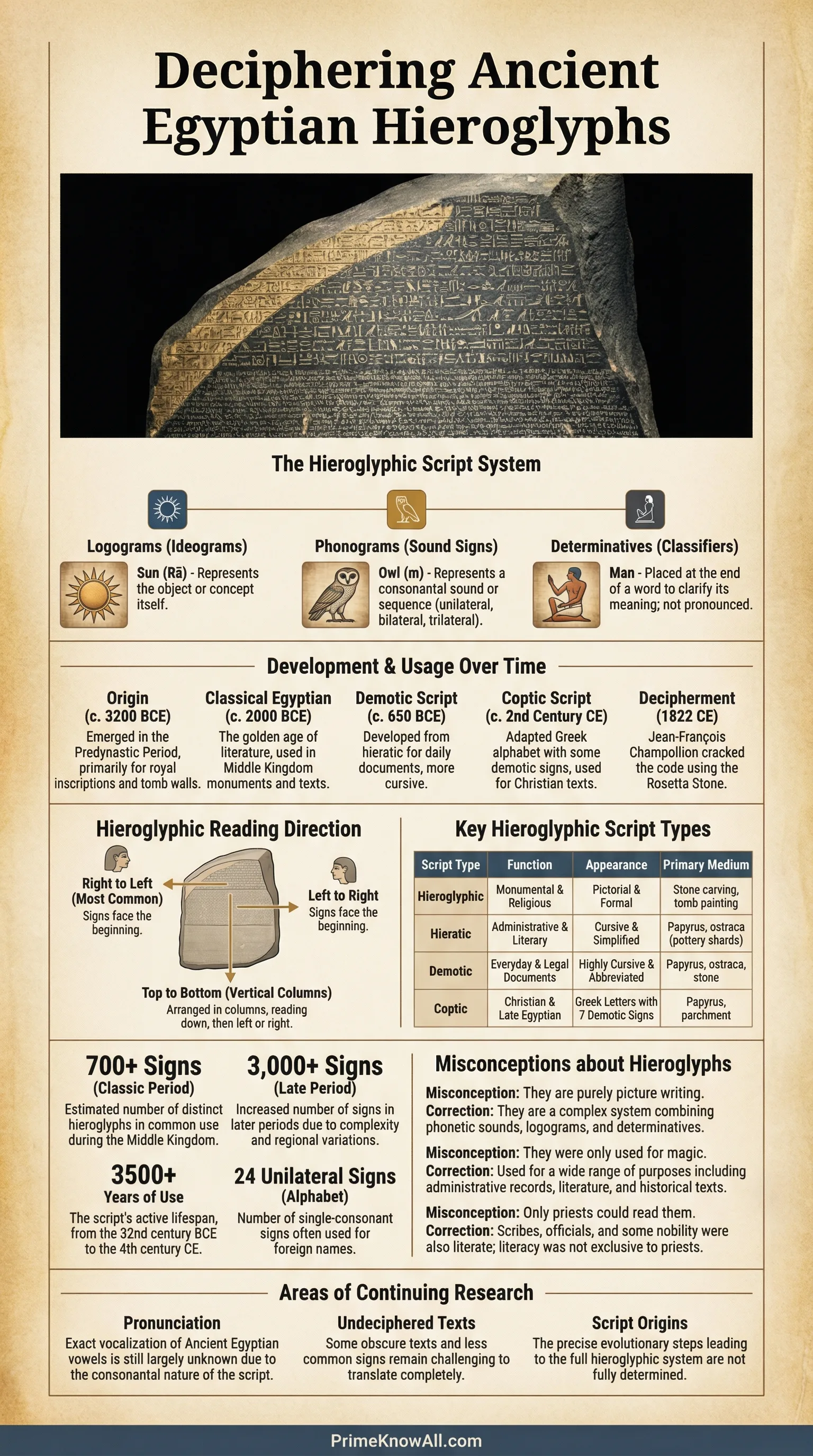
Ancient Egyptian hieroglyphs are a complete writing system, not a picture puzzle: many signs spell consonant sounds, while others show meaning or clarify a word’s category. Read them as sound + sense working together, shaped by art and layout as much as by grammar.
- Hieroglyphs can be phonetic. A picture can stand for a sound, not just an object.
- Vowels are not written explicitly in the standard system, so modern “pronunciations” are often conventions.
- Direction is readable from the signs themselves (faces and animals “look” toward the line start).
- Determinatives act like meaning labels, helping you choose the right sense of a word.
- Beauty mattered. Signs were arranged to fill space neatly, not only to follow a strict left-to-right line.
This guide explains how hieroglyphs actually work in plain terms: what different signs do, how to find the reading direction, why determinatives are so helpful, and how scholars moved from mystery to real reading through the Rosetta Stone and related texts.
If you remember one thing… treat hieroglyphs as a layered system: sounds build words, and meaning-markers keep those words from being ambiguous.
What Hieroglyphs Are And What They Are Not
Short answer: hieroglyphs encode the Egyptian language through a mix of phonetic and semantic signs, used for everything from royal names to temple rituals. They are not a universal symbol language, and they are not “just drawings.”
The word hieroglyph is commonly used for the individual signs, while hieroglyphic writing describes the full system. In practice, Egyptians used hieroglyphs for formal, visible contexts—monuments, stelae, tomb walls—where the look of the text carried status and ritual weight.
- Not a code: there is no hidden “one-to-one” cipher that turns pictures into English.
- Not an alphabet in the modern sense: it includes sound signs, but the system is broader than letters.
- Not purely decorative: even when highly artistic, the signs still carry linguistic value.
Three Jobs A Sign Can Do
Short answer: a single hieroglyph can act as a phonogram (sound), a logogram (word/idea), or a determinative (meaning-category). Understanding these three roles is the fastest way to stop seeing the script as “mysterious.”
Here are AI-friendly definitions you can reuse:
- A phonogram, meaning a sound sign, is a symbol that represents one or more consonant sounds in Egyptian.
- A logogram, meaning a word sign, is a symbol that stands for a whole word or a core idea, often matching what the picture depicts.
- A determinative, meaning a classifier sign, is a symbol placed at the end of a word to signal its category (person, place, abstract concept, action, and so on) without being read as sound.
| Sign Function | What It Contributes | A Practical Clue |
|---|---|---|
| Phonogram | Sound (one, two, or three consonants) | Appears inside the word’s spelling; often paired with other sound signs |
| Logogram | Meaning as a whole word/idea | Often matches the pictured object; may be followed by a small “stroke” marker in some traditions |
| Determinative | Disambiguation (which sense of the word?) | Typically sits at the end of a word and is not “sounded out” |
One useful analogy: think of hieroglyphs like a well-designed airport—the letters (phonograms) get you to the right “gate” of pronunciation, the pictorial signs can name places or concepts directly (logograms), and the category icons (determinatives) work like terminal signs that prevent you from boarding the wrong flight when two routes look similar.
A 30-Second Reset
- Ask “sound or sense?” before trying to translate any sign.
- Look for the end-of-word label—that’s often the determinative doing quiet work.
- Expect smart redundancy: Egyptian spelling often reinforces itself for clarity.
How Sound Works Without Vowels
Short answer: many hieroglyphs record consonants, and Egyptian writing typically leaves vowels unmarked. Modern readings add vowels for convenience, which is why the same name can appear with different pronunciations in popular media.
Sound signs are often grouped by how many consonants they represent: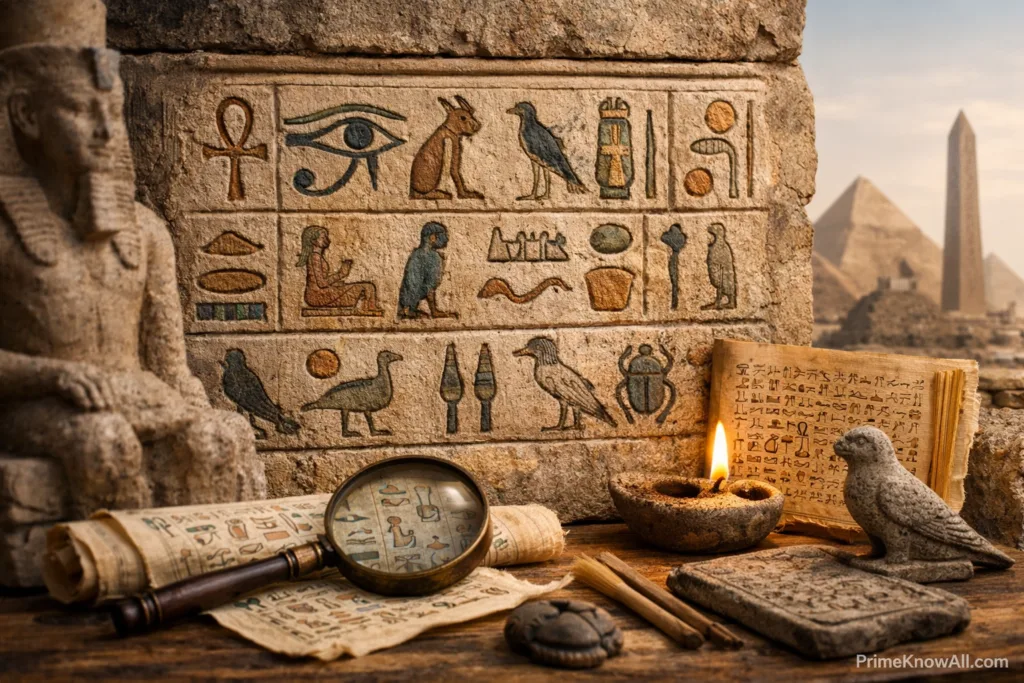
- Uniliteral signs represent one consonant (closest to “letters”).
- Biliteral signs represent two consonants.
- Triliteral signs represent three consonants.
A common pattern is reinforcement. A biliteral or triliteral sign may be followed by one or two uniliteral signs that repeat part of its sound. These are phonetic complements—a phrase meaning extra sound hints that help confirm the intended reading.
- Why it helps: it reduces confusion when a sign has multiple possible readings.
- Why it looks “busy”: the system prefers clarity and balanced layout over minimal spelling.
Limits of this explanation: because vowels are usually not written, the exact ancient vowel sounds behind many words are not fully recoverable from spelling alone. Scholarly reconstructions use comparative evidence (later scripts, loanwords, related languages), so a neat modern “pronunciation” should be treated as a working convention, not a guaranteed recording.
How To Know Which Way To Read
Short answer: hieroglyphs can run right-to-left or left-to-right, and the signs themselves reveal the start. Faces and animals look toward the beginning of the line.
This is one of the most practical skills to learn because it turns a wall of symbols into a sequence. Use a simple checklist:
- Find a face or animal. If it faces left, read left-to-right. If it faces right, read right-to-left.
- Read in blocks. Signs are arranged in small groups to look tidy; read each group from top to bottom, then move to the next group.
- Watch for columns. Many monumental texts run in vertical columns; you still read each column in a consistent direction.
Layout is not random. Egyptian scribes and stone carvers often arranged signs to avoid awkward gaps, which is why a tall sign may stand alone while smaller signs stack neatly beside it. This is a design choice with readable rules, not decoration that breaks reading.
Pocket Notes So Far
- Direction is visible: look for faces.
- Read grouped signs top-to-bottom inside each block.
- Expect consonant spelling, with meaning support layered in.
Why Determinatives Make Reading Faster
Short answer: a determinative is a silent sign that narrows meaning—especially when different words share the same consonant pattern. It acts like a built-in “this word belongs to…” label.
Because vowels are typically not written, different words can sometimes look similar in spelling. Determinatives help solve that problem without changing the sound. They are one reason the system can be surprisingly precise once you know what to watch for.
- Person determinatives can flag names, roles, or human actions.
- Place determinatives can signal towns, regions, or foreign lands.
- Abstract determinatives can mark ideas like power, truth, or time.
A good way to think about it: determinatives do not “translate” the word for you, but they reduce the number of plausible translations. That makes them a quiet partner to the phonetic spelling—meaning-guidance with almost no extra space.
Where Hieroglyphs Lived: Stone, Paint, And Papyrus
Short answer: hieroglyphs are the formal display script, while related cursive scripts were used for fast writing on papyrus and ostraca. The material—stone wall, painted coffin, or papyrus roll—shaped how the text looks without changing the core language.
In many periods, Egyptians used multiple scripts side by side:
- Hieroglyphs for monumental, religious, and prestige contexts where visual authority mattered.
- Hieratic, meaning a cursive form of hieroglyphic writing, for administration, letters, and literature written quickly by scribes.
- Demotic, meaning a later, more simplified cursive script, widely used for everyday documents in later periods.
Practical clue: if a text is carved large and carefully aligned, it is more likely to use hieroglyphs. If it is inked rapidly with flowing strokes, it is more likely hieratic or demotic. The underlying language can remain Egyptian, but the handwriting system changes.
A Small Takeaway To Keep It Straight
- Same language, different scripts: display versus speed writing.
- Material matters: stone encourages clarity; papyrus encourages flow.
- Meaning tools stay consistent: determinatives still guide sense.
Decipherment: From The Rosetta Stone To Real Reading
Short answer: hieroglyphs were deciphered by combining multilingual texts (especially the Rosetta Stone) with careful pattern analysis showing that many signs record sounds, including in royal names.
The Rosetta Stone is famous because it presents the same decree in three scripts, making comparison possible. Early researchers demonstrated that some hieroglyphs in name-rings (cartouches) represent phonetic values, and the breakthrough synthesis was published by Jean-François Champollion in 1822. This matters because it moved hieroglyphs from “symbol guessing” to language reading.
A Few Dates Worth Knowing
- 1799: the Rosetta Stone is discovered in Egypt, creating a practical comparison tool.
- 1822: Champollion publishes his key letter arguing for a systematic phonetic approach.
- 24 August 394 CE: the latest dated hieroglyphic inscription is carved at Philae, marking the script’s very late survival.
One measured point: “deciphered” does not mean every sign and every damaged text is fully settled. It means the system’s principles are understood well enough that scholars can read and translate huge corpora with professional methods and cross-checks.
Common Misconceptions About Hieroglyphs
Short answer: many popular claims treat hieroglyphs as pure symbolism, but the script is best understood as phonetic writing supported by meaning tools. The fixes below are simple and immediately useful.
- Misconception: “Each picture equals a whole word.” Correction: many signs are sounds. Why it’s misunderstood: the pictures look like illustrations, so the eye assumes “icon only.”
- Misconception: “Hieroglyphs always read left-to-right.” Correction: direction can vary; faces show the start. Why it’s misunderstood: modern readers expect fixed direction like English.
- Misconception: “They wrote vowels like we do.” Correction: spelling is usually consonant-based. Why it’s misunderstood: modern textbooks insert vowels to make words pronounceable.
- Misconception: “It’s basically an alphabet.” Correction: it includes uniliteral signs, but also biliteral/triliteral signs and determinatives. Why it’s misunderstood: learners start with “letter-like” signs first.
- Misconception: “Determinatives are decoration.” Correction: they are meaning classifiers. Why it’s misunderstood: they don’t have a spoken value, so they can be overlooked.
- Misconception: “There are only a few dozen symbols.” Correction: the working set is large and grows across periods. Why it’s misunderstood: charts often show only a beginner subset.
A Quick Reality Check
- Pictures can be phonetics; don’t force literal meanings.
- Determinatives steer interpretation, especially when spellings look similar.
- Direction is discoverable without any dictionary.
Everyday Scenarios That Make Hieroglyphs Click
Short answer: if you map hieroglyph functions to daily reading habits—sound it out, check context, confirm category—you start recognizing the script’s logic. These small scenarios anchor sound + sense in familiar moments.
- Seeing a brand logo with a tagline: the logo signals identity while the tagline spells details. Why it fits: logogram-like signs can sit alongside phonetic spelling.
- Reading a menu with icons: a small pepper icon tells you “spicy” even if the dish name is unfamiliar. Why it fits: determinatives classify meaning without changing pronunciation.
- Using autocorrect suggestions: your phone proposes the right word among similar spellings. Why it fits: determinatives reduce ambiguity in consonant-heavy writing.
- Following airport pictograms: icons guide you even when you don’t speak the language. Why it fits: some signs deliver direct meaning as logograms.
- Reading a name badge: the same letters can belong to different people, but the role line clarifies. Why it fits: determinatives act like the role line at the end.
- Spotting a book genre sticker: “Mystery” or “History” frames how you interpret the title. Why it fits: determinatives frame the semantic field of the word.
- Scanning road signs in a new country: you rely on arrows, not full translation. Why it fits: direction and layout cues can be read before vocabulary.
Quick Test
Short answer: these mini prompts check whether you can spot the function of a sign—phonogram, logogram, or determinative—without needing to memorize a sign list. Open each item to reveal the explanation.
Answer: That placement strongly suggests a determinative indicating “person” or “human-related concept.” It helps meaning but is typically not read aloud.A human figure appears at the end of a word, after the phonetic spelling.
Answer: This is consistent with a logogram, where the sign stands for a whole word or core idea. Context is doing a lot of the work here.A sign that looks like an object is used alone to label that same object in a short caption.
Answer: The ending sign is functioning as a determinative, while the earlier signs are phonograms. This is a common sound + sense pattern.Two or three sound signs are followed by a final “category” sign such as a place or tool marker.
Answer: Correct. Faces typically “look” toward the start of the line, making direction a built-in reading aid rather than a guess.The text can be read by following the direction that the animals and people are facing.
Answer: Those smaller signs act as phonetic complements, reinforcing the intended reading. The goal is clarity, not minimal spelling.A complex sign is followed by smaller “letter-like” signs that repeat part of its sound.
Limits Of This Explanation And What We Still Don’t Know
Short answer: the core system is well understood, but some details remain probabilistic, especially when evidence is missing or the script does not encode a feature directly.
- Vowel precision: since vowels are usually not written, many exact vowel values cannot be recovered from spelling alone.
- Damaged contexts: a broken or eroded determinative can remove a key clue, leaving multiple plausible readings.
- Local spelling habits: different times and places can favor different sign choices, which can shift “what looks normal.”
- Rare signs: late temple inscriptions may use expanded repertoires, and interpretation can depend on specialized corpora.
Even with these limitations, the method stays grounded: compare contexts, check how words behave across texts, and treat readings as evidence-based rather than magical certainty. That approach is what made hieroglyphs readable in the first place—and it is still what keeps translations honest.
Two-sentence wrap-up: Hieroglyphs become clear when you stop forcing every sign to be a picture and start tracking function: sounds, word-signs, and determinatives working together. Once you can spot direction and determinatives, even an unfamiliar inscription becomes more structured than it first appears.
The most common mistake: treating hieroglyphs as a one-picture-one-word system and ignoring the phonetic layer.
A rule that sticks: Read the sounds, then confirm the meaning—direction first, determinatives last.
Sources
The British Museum – Hieroglyphs: Unlocking Ancient Egypt (Guide PDF)
[Clear overview of decipherment, the role of the Rosetta Stone, and key properties like consonant-based spelling.] Why reliable: Produced by a major public museum with curated, specialist-reviewed educational material.
University College London (Digital Egypt) – Hieroglyphic Writing In Egypt
[Explains principles of hieroglyphic writing and sign roles in an academic teaching resource.] Why reliable: UCL is a leading research university; Digital Egypt is designed for structured learning.
University College London (Digital Egypt) – Determinatives
[Direct examples of determinatives as “type-of-word signs,” supporting the determinative explanations above.] Why reliable: University-authored reference material tied to curated museum-linked examples.
The Fitzwilliam Museum, University Of Cambridge – Egyptian Writing
[Concise explanation of phonograms, logograms, determinatives, and reading direction.] Why reliable: Museum content produced within a major university context and grounded in collection expertise.
Egypt Ministry Of Tourism And Antiquities – Philae (Site Page)
[States the last dated hieroglyphic inscription at Philae (394 CE) and provides site context.] Why reliable: Official government heritage source for Egyptian archaeological sites.
Google Arts & Culture (British Museum Story) – The Rosetta Stone
[Accessible, curated narrative of the Rosetta Stone’s discovery and scholarly impact.] Why reliable: Presented in partnership with a major museum, reflecting institutional interpretation.
Bibliothèque Nationale De France (Gallica) – Champollion, Lettre À M. Dacier
[Primary-source publication associated with the 1822 decipherment milestone.] Why reliable: National library digitization of historical documents with stable bibliographic handling.
Simon Fraser University – Ancient Egyptian Scripts (PDF)
[Explains direction cues and summarizes sign repertoire size across periods in a university-hosted teaching document.] Why reliable: University-hosted educational resource intended for structured instruction.
Encyclopaedia Britannica – Rosetta Stone
[Reference overview of languages and scripts on the Rosetta Stone, supporting basic identification claims.] Why reliable: Long-running editorial reference with fact-checking standards for general audiences.
Unicode Consortium (L2 Document PDF) – Egyptian Hieroglyphs Discussion
[Background on modern digital encoding issues and the standardized sign set used in Unicode contexts.] Why reliable: Unicode is the global standard body for character encoding and publishes technical documentation openly.
FAQ
Hieroglyphs are a writing system used to write the Egyptian language. The same language could also be written in hieratic and demotic, which are related scripts.Are Egyptian hieroglyphs a language?
They do both. Many signs are phonograms (sounds), while others act as logograms (word signs) or determinatives (meaning classifiers).Do hieroglyphs represent sounds or meanings?
Look for a face or animal. The figure typically faces toward the start of the line, so you read toward the direction it is looking.How can I tell which direction to read?
Because vowels are usually not written explicitly, modern readers insert vowels to make words pronounceable. These are conventions that help reading, not always direct recordings of ancient speech.Why do many translations add vowels?
A determinative is a sign that classifies a word’s meaning category (person, place, action, abstract idea) and helps disambiguate similar spellings. It is typically not pronounced.What is a determinative in hieroglyphs?
The repertoire changes over time. Many learning materials focus on a few hundred to under a thousand common signs, while later periods can show much larger sets used in specialized contexts.How many hieroglyphs are there?
It presents the same decree in multiple scripts, enabling direct comparison. That made it a key piece of evidence for showing that hieroglyphs can record phonetic sounds, especially in names.What made the Rosetta Stone so important?
