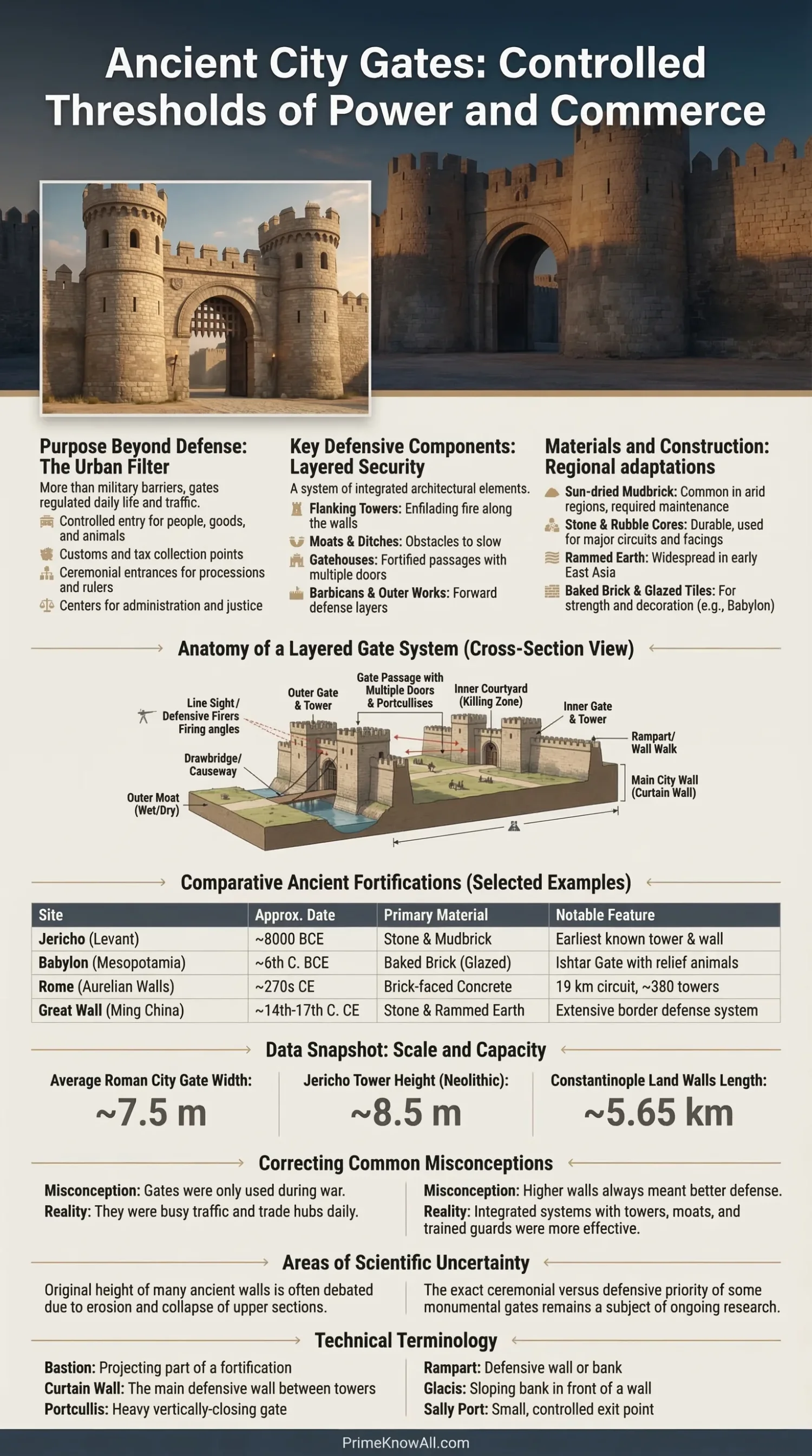
Ultra Short Answer: Ancient city gates and fortifications were not just military barriers. They were controlled thresholds that protected people, water, roads, and stored wealth while also shaping trade, ceremony, and the daily rhythm of urban life.
A city wall was a line between order and exposure. Ancient city gates and fortifications gave early cities a physical edge, but they also did quieter work: they filtered movement, marked political authority, protected wells and granaries, and told every visitor where power began. A wall could keep danger out; a gate decided who got through.
That is why city gates matter so much in archaeology. They are the narrow places where defense, traffic, ritual, architecture, and urban planning meet. A decorated gate like Babylon’s Ishtar Gate carried royal messaging. A hard, layered defense like the Theodosian Walls turned approach into a slow and risky act. Even the earliest known city wall at Jericho seems tied not only to protection but to the defense of a settlement’s water source.
If you remember one thing, remember this: a gate was never just an opening in a wall. In many ancient cities, it was the most managed place in the whole urban perimeter.
What to Hold On To
- Fortifications were built to slow, channel, and deter attack, not simply to make a city look imposing.
- Gates were the weak point of any wall, so builders often gave them extra towers, doors, courts, and bridges.
- Many walls mixed stone foundations, mudbrick, rammed earth, brick facing, ditches, and terrain.
- On ordinary days, gates handled movement: people, carts, animals, messengers, officials, and goods.
- What survives today is a biased sample. Later repairs and rebuilds often outlast the first version of a wall.
What Counts as Ancient City Gates and Fortifications
Short answer: an ancient fortification is any built defensive system that slows entry, controls approach, or protects a settlement boundary. A gate is the designed passage through that system, and because it concentrates movement, it is usually the most carefully engineered part.
Several terms appear again and again in this subject, and they are easier to follow when they are defined plainly. A gatehouse is the fortified passage through a wall. A rampart is the raised defensive bank or wall line itself. A moat is a ditch, dry or wet, cut in front of a wall to make approach harder. A bastion or tower is the projecting element that lets defenders watch and fire along the wall face. A curtain wall is the long stretch between towers.
- Wall: the main barrier around the city or citadel.
- Gate: the controlled opening where people and vehicles pass.
- Tower: the elevated watch and fighting position.
- Moat or Ditch: the obstacle in front of the wall.
- Outer Works: added lines that force attackers to slow down before reaching the main barrier.
Not every ancient city had every one of these parts, and they did not look the same in every region. Mesopotamian defenses often leaned on mudbrick and baked brick, Roman systems used concrete and brick facing, and many Chinese city walls relied on rammed earth before later brick revetment became more common. The basic idea stayed recognizable: protect the urban edge and manage the crossing points.
Why Ancient Cities Needed Gates and Walls
Short answer: ancient cities built walls because density creates value. Once a settlement held people, grain, workshops, animals, archives, and sacred space in one place, that concentration needed protection and control.
Defense is the obvious reason, but it is not the only one. At Jericho, the earliest known city wall uncovered so far was at least 4 metres high and backed by a tower around 28 feet tall, and Britannica notes that it also protected the settlement’s water supply. That pairing matters. A wall often defended not only people, but the things that made urban life possible.
- Population: more people living close together meant higher loss if a raid succeeded.
- Storage: grain, tools, and animals had to be shielded from theft or siege pressure.
- Water: springs, canals, and access points could decide whether a city endured.
- Authority: rulers and temples used walls and gates to show who governed the space inside.
Gates also handled the practical side of urban life. A 2020 PLOS One study of 32 Roman sites found an average of five gates per city and an average gate width of a little over 7.5 metres. The same study argues that the total width of gates rises with population much more slowly than city size does, which suggests that bigger cities pushed more movement through each controlled entry rather than simply cutting openings everywhere.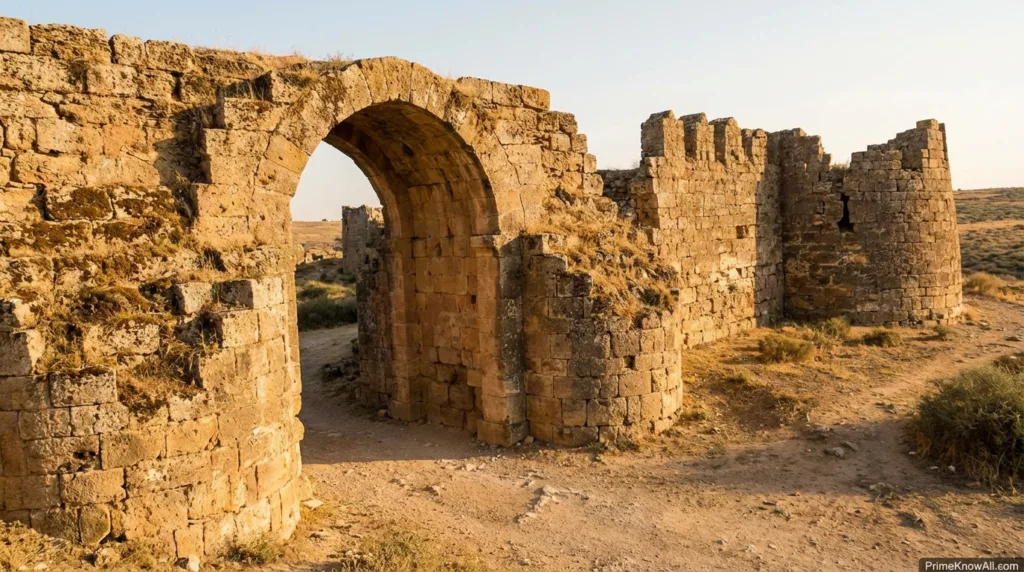
That point corrects a common oversimplification. City gates were traffic devices as much as defensive devices. They channeled carts, animals, visitors, troops, and imported goods into places where they could be seen, checked, taxed, welcomed, delayed, or blocked. In some periods and regions, gates also served as places where levies were collected or access was limited during crisis.
Pause Here
- Walls protected value concentrated inside the city.
- Gates balanced flow and security.
- The busiest gate could be an economic asset, not just a military risk.
How These Systems Were Built
Short answer: ancient fortifications worked best when architecture and geography worked together. Builders tried to strip speed from the attacker before the attacker ever touched the main wall.
Materials Were Chosen by Region, Cost, and Repair Needs
In places where good building stone was scarce, walls often rose as mudbrick on stone foundations. In Babylon, bricks became part of visual language as well as structure, with the Ishtar Gate finished in glazed brick relief. Roman city walls could use tufa concrete and brick facing, as seen in the Aurelian Walls. In China, many early city walls were built from rammed earth, later strengthened or faced with brick in many cases.
- Mudbrick: fast to produce and easy to repair, but vulnerable to water.
- Stone: durable and heavy, but harder to quarry and move.
- Concrete and Rubble Cores: useful for long urban circuits in imperial settings.
- Baked Brick: costlier than raw mudbrick, yet better for exposed or decorative surfaces.
The Gate Needed Extra Protection Because It Was the Weak Point
A strong wall with a careless gate was a bad bargain. That is why many ancient gates were flanked by towers, sealed by more than one set of doors, or shaped so that entrants had to slow down, angle their approach, or cross a bridge. The Koç University Istanbul City Walls project notes that wooden bridges over the moat in front of the main Theodosian gates could be removed during attack. The whole passage was designed as a controlled choke point, not a simple opening.
- Flanking towers allowed defenders to watch the approach from both sides.
- Narrow passages reduced the number of people entering at once.
- Courtyards and double gates trapped momentum.
- Bridges turned access into something the city could grant or deny.
A useful analogy helps here. A city gate was a little like an airport security lane, customs desk, and ceremonial arch compressed into one narrow place. It had to admit the right people, slow the wrong ones, and still look like the face of the city.
Terrain Did Half the Work
Builders rarely trusted masonry alone. They used ridges, cliffs, slopes, river edges, and open killing zones in front of the wall. Jericho’s early wall tied into a watchtower and the protected spring area. Many later cities placed gates where roads naturally converged, because forcing the route is as valuable as raising the wall.
- High ground gave range and visibility.
- Ditches and moats broke the approach line.
- Road alignment let defenders predict movement.
- Open ground removed cover for attackers.
How a Defensive Belt Worked
Short answer: a city’s defensive belt was a layered sequence, not one object. The point was to make every step toward the gate slower, more visible, and more expensive.
Builders chose a ridge, spring line, river edge, or rise in the ground so the city already had a defensive edge before masonry started.
Ditches, moats, slopes, and open ground forced traffic into a limited set of routes and made surprise harder.
The curtain wall enclosed the urban perimeter and created the first hard stop against direct entry.
Towers projected from the wall so defenders could see along the face and protect the sections between them.
Doors, towers, courts, and sometimes removable bridges turned the crossing point into a place of inspection and delay.
Once through the gate, traffic entered the city street system, often toward markets, administrative areas, or processional routes.
This sequence explains why fortifications should be read as systems. A wall without towers, a ditch without a controlled gate, or a grand gate without a defendable approach all leave gaps in the logic.
What This Section Really Means
- Ancient defenses worked in layers, not in isolation.
- A gate was strongest when the road, ditch, bridge, and tower all cooperated.
- Good fortification design removed speed from the attacker.
Well-Known Examples That Show the Range
Short answer: no single city can stand for the whole story. Jericho, Babylon, Hattusha, Constantinople, and Rome show very different answers to the same problem: how to defend an urban edge while keeping a city usable.
| Site | Date | Why It Matters | Useful Number |
|---|---|---|---|
| Jericho | About 8000 BCE | Earliest known city wall uncovered so far; linked to settlement protection and the water source. | Wall at least 4 m high; tower about 8.5 m tall |
| Babylon / Ishtar Gate | Neo-Babylonian period, c. 575 BCE for the gate | Shows how a city gate could be both defensive and visually programmed for royal power. | UNESCO notes that about 85% of the site remains unexcavated |
| Hattusha | Late Bronze Age | Its Lions’ Gate and Royal Gate show sculpture and fortification working together. | UNESCO singles out the gates as unique artistic achievements |
| Constantinople | Early 5th century CE | One of the clearest examples of a layered late antique urban defense system. | Main land-wall section about 5,650 m long |
| Rome / Aurelian Walls | 270s CE | A fast imperial response to external pressure around a huge metropolitan circuit. | About 20 km long, with 380 towers and 16 gates |
Jericho: Early Urban Defense in Raw Form
Jericho matters because it pushes the story of urban fortification back into the Neolithic. Its wall and tower are blunt, physical, and direct. They do not yet show the ornamental gate culture seen later, but they make a simple point with unusual clarity: once a settlement becomes worth protecting, architecture changes.
Babylon: The Gate as Message
The Ishtar Gate turns defense into image. Smarthistory describes its blue glazed brick surface and marching relief animals, while UNESCO places Babylon among the most influential urban sites of the ancient Near East. This is where fortification stops looking purely functional. A visitor did not just pass a barrier here; the visitor passed a statement about kingship, gods, and imperial order.
Hattusha: Fortification and Sculpture Together
At Hattusha, the city gates are remembered not only as defensive points but as carved, named thresholds. UNESCO highlights the Lions’ Gate and Royal Gate because they show that the edge of a city could also be an artistic zone. The urban perimeter was not mute. It spoke through stone.
Constantinople: Layered Defense on a Grand Urban Scale
The Theodosian Walls reveal what happens when fortification becomes a city-scale science. The Koç University project records the main land-wall stretch at about 5,650 metres. Gates, towers, and moat worked together, and the road into the city passed through spaces that could be narrowed, watched, and defended in sequence.
Rome: Emergency Construction for a Giant City
The Aurelian Walls are a reminder that even a dominant empire could feel exposed. Turismo Roma describes a circuit of about 19 kilometres, towers set roughly every 30 metres, and a later heightening of the wall under Honorius and Arcadius. Rome’s answer was not elegance alone. It was scale, speed, and repeatable urban engineering.
One more nuance deserves attention. Some of the best-preserved city walls people visit today are not ancient in the narrow Bronze Age or classical sense, but later rebuildings or repairs, especially in East Asia and Europe. That survival bias can distort the picture. What lasts longest is not always what came first.
What Happened at the Gate on an Ordinary Day
Short answer: on most days, the gate was a management tool, not a battlefield. Traffic, checking, welcome, delay, and display were more common than open combat.
- Merchants arrived with goods. The gate turned outside movement into regulated urban entry.
- Carts and animals passed through narrow points. That made inspection easier and congestion more predictable.
- Officials watched the threshold. In some cities and periods, levies or toll-like duties were linked to these crossings.
- Messengers and visitors announced themselves. The gate was the first administrative filter.
- Processions used the same route. A ceremonial arrival worked better when the city could frame it through a monumental entrance.
- Soldiers guarded the weak point. Even during peace, the gate needed readiness because it was always the likeliest breach point.
This ordinary-day role is one of the biggest things popular summaries miss. City gates were not dead masonry waiting for a siege. They were active pieces of urban machinery, where movement from countryside to city became visible, countable, and controllable.
What to Keep in Mind Now
- The wall enclosed the city, but the gate ran the city’s edge.
- Daily traffic is part of fortification history, not a side note.
- Monumental gates often blended security with image-making.
Common Misreadings
Short answer: many wrong ideas about ancient fortifications come from looking only at ruins, films, or later reconstructions. The stone that survives can hide how these systems really worked.
| Mistaken Idea | Clear Correction | Why It Spreads |
|---|---|---|
| Ancient gates were only for war. | They were also spaces of inspection, movement control, welcome, and public display. | Sieges are more dramatic than daily traffic, so entertainment overweights battle scenes. |
| More gates always meant better defense. | More gates also meant more vulnerable crossings, so builders had to balance flow and risk. | A large number sounds powerful, but every opening weakens a wall if it is badly managed. |
| The highest wall always won. | Terrain, tower placement, gate design, maintenance, and manpower often mattered just as much. | Height is easy to notice in ruins and images; logistics are harder to see. |
| All major city walls were stone. | Many used mudbrick, rammed earth, mixed cores, or stone foundations with softer upper works. | Stone survives erosion better, so it dominates the modern visual record. |
| Surviving walls show what most ancient cities looked like. | Preservation is selective. Rebuilt, repaired, or monumentalized circuits have a better chance of survival. | Visitors naturally mistake survival for normality. |
Where the Logic Still Feels Familiar
Short answer: the idea behind an ancient city gate still appears in modern spaces whenever movement is concentrated into a watched threshold.
- Airport security lanes: large flows are narrowed into manageable channels because open access is not the goal; filtered access is.
- Stadium turnstiles: a crowd becomes easier to count and control once it is funneled through fixed points.
- Port checkpoints: goods move faster when the crossing is regulated, even if that feels slower to the individual traveler.
- Old-town vehicle barriers: the street network is protected by controlling where entry can happen at all.
- University or embassy gates: the entrance does security work, but it also signals status and institutional identity.
- Festival procession routes: arrival through one formal threshold still shapes how authority and celebration are staged.
These parallels are not exact matches, and they should not flatten history. Still, they help anchor one simple truth: threshold design changes behavior. Ancient builders knew that as well as modern planners do.
So the Pattern Is Clear
- Ancient gates shaped behavior by forcing movement through watched points.
- The same logic still appears whenever access is filtered rather than left fully open.
- Daily use is part of the history of a fortification, not a footnote to it.
Why Archaeologists Keep Returning to These Walls
Short answer: walls and gates still produce new evidence because they hold construction phases, repair episodes, and movement data in unusually readable form. They are some of the clearest places where material remains meet urban behavior.
- Babylon, 2024: an archaeomagnetic study of bricks from the Ishtar Gate showed that fired mudbricks can help date different construction phases and refine the gate’s sequence under Nebuchadnezzar II.
- Khaybar, 2024: researchers identified a Bronze Age oasis rampart in north-western Arabia that was originally about 14.5 km long and reinforced by 180 bastions, widening the map of early walled landscapes.
- Jinancheng, 2024: a LiDAR and deep-learning study reported 94.12% precision in detecting city-wall traces in one Chinese case, showing how digital survey can help monitor damaged sites.
None of these studies turns one site into a universal model. What they do is better. They show that city fortifications are still active research terrain, whether the question is dating, preservation, landscape scale, or hidden wall lines under vegetation and modern disturbance.
What We Still Cannot Say With Certainty
Short answer: ancient walls look solid, but the interpretation around them is often partial. Archaeology can show masonry, phases, damage, and routes; it cannot always recover the full lived meaning of every gate.
- Original height is often uncertain. Upper parts collapse first, so many surviving walls look lower than they once were.
- Repair phases can hide first phases. A famous gate may preserve a late version better than its earliest form.
- Excavated sites are not an even sample. Monumental capitals are studied more often than ordinary towns.
- Ceremonial meaning is harder to measure than wall thickness. Texts help, but they rarely tell the whole story.
- No wall does not mean no urban life. Some settlements used terrain, distance, or political conditions instead of heavy enclosure.
This is the right place for caution. Surviving fortifications can tell a great deal about labor, fear, traffic, and authority, but they do not give a perfect map of how every ancient society thought about safety or identity.
Last Mental Snapshot
- Walls survive better than routines, so archaeology sees stone more clearly than behavior.
- Repair history can be as informative as first construction.
- A missing wall does not automatically mean a weak or simple settlement.
Quick Test
This short self-check helps the subject stick. Open each answer only after making a choice.
Which early site is often cited as the earliest known city wall uncovered so far?
Jericho. The wall is usually dated to about 8000 BCE, and the associated tower is one reason the site appears so often in discussions of early urban defense.
Why is a gate usually the most engineered part of a wall?
Because it is the point where access must stay possible while security stays credible. That tension forces extra design work: towers, doors, bridges, courts, and narrow passages.
What makes Babylon’s Ishtar Gate different from a plain defensive opening?
Its glazed brick reliefs and royal symbolism turned the gate into a visual statement. It defended the city, but it also projected power and ceremony.
Does a larger city always solve traffic pressure by adding many more gates?
Not necessarily. Research on Roman cities suggests that total gate width rises with population, but more slowly than population itself, which implies heavier use of each controlled crossing in bigger settlements.
Why can later walls distort how people imagine ancient fortifications?
Because later circuits are often better preserved. Visitors may take what survives best as the norm, even when earlier walls were built in other materials or looked very different.
Ancient city gates and fortifications were parts of living urban systems, not isolated military shells. They defended water, stored food, roads, archives, markets, and ritual space while also telling outsiders how a city wanted to be seen.
The most common mistake is treating a gate as decoration added to a wall rather than the most managed crossing in the entire perimeter.
Rule to remember: the stronger the wall, the more carefully the gate had to be designed.
Sources
- UNESCO World Heritage Centre – Babylon — Useful for Babylon’s period, urban importance, and the note that about 85% of the site remains unexcavated. Why reliable: UNESCO documents heritage sites through formal evaluation and state reporting.
- UNESCO World Heritage Centre – Hattusha: the Hittite Capital — Useful for the role of the Lions’ Gate and Royal Gate in the city’s artistic and defensive identity. Why reliable: this is the official World Heritage record for the site.
- Koç University – Theodosian Walls — Useful for the scale and design of Constantinople’s land walls and gates. Why reliable: it is part of a specialist academic digital project focused on Istanbul’s walls.
- Koç University – Gates of the Theodosian Walls — Useful for how monumental gates were paired with towers and coordinated with the larger defensive line. Why reliable: the page belongs to the same expert research project and focuses on gate architecture directly.
- Turismo Roma – The Aurelian Walls — Useful for length, tower spacing, construction period, and later raising of the wall. Why reliable: it is the official tourism and heritage portal of the city of Rome.
- UNESCO World Heritage Centre – City Walls of the Ming and Qing Dynasties — Useful for the later survival lesson shown by Nanjing and Xi’an and for construction details in Chinese urban walls. Why reliable: it is an official heritage dossier hosted by UNESCO.
- PLOS One – Using City Gates as a Means of Estimating Ancient Traffic Flows — Useful for the measured data on Roman city gates, average gate counts, average widths, and the relation between gate width and population. Why reliable: peer-reviewed open-access research with data presented in the paper.
- PLOS One – An Archaeomagnetic Study of the Ishtar Gate, Babylon — Useful for recent work on construction phases, inscribed bricks, and scientific dating potential. Why reliable: peer-reviewed open-access research focused on the gate itself.
- Journal of Archaeological Science: Reports – The Ramparts of Khaybar — Useful for the Bronze Age oasis rampart, its original length, and the documented bastions in north-western Arabia. Why reliable: peer-reviewed research article built from survey, remote sensing, architectural study, and dated contexts.
- Journal of Cultural Heritage – Archaeological Site Segmentation of Ancient City Walls Based on Deep Learning and LiDAR Remote Sensing — Useful for current survey methods and the reported precision of digital wall detection. Why reliable: published scholarly work in a specialist heritage journal.
- Encyclopaedia Britannica – Walls of Jericho — Useful for the basic archaeological summary of Jericho’s wall height, tower, and protective role. Why reliable: a long-running editorial reference source.
- Smarthistory – The Ishtar Gate and Neo-Babylonian Art and Architecture — Useful for the gate’s glazed-brick imagery and how ornament worked with royal messaging. Why reliable: specialist art-history teaching resource written by subject experts.
FAQ
What was the main purpose of ancient city gates?
The main purpose was controlled access. Gates let cities admit people, goods, and animals through a space that could be watched, defended, and, in some settings, inspected or taxed.
Were ancient city walls only for defense?
No. They also marked urban boundaries, protected water and storage, supported political authority, and shaped how traffic moved between city and countryside.
Why were gates more complex than the rest of the wall?
Because they had to stay open enough for daily use but strong enough to survive attack. That tension led to towers, multiple doors, bridges, and layered passages.
What materials were common in ancient fortifications?
Common materials included stone, mudbrick, rammed earth, rubble cores, baked brick, and, in Roman contexts, concrete with brick facing. The mix depended on region, cost, and repair needs.
Which ancient city has one of the earliest known walls?
Jericho is often cited for one of the earliest known city walls uncovered so far, dating to about 8000 BCE.
Why do some ancient walls survive while others vanish?
Survival depends on material, climate, later rebuilding, urban reuse, and conservation history. What survives best is not always what was most typical.
