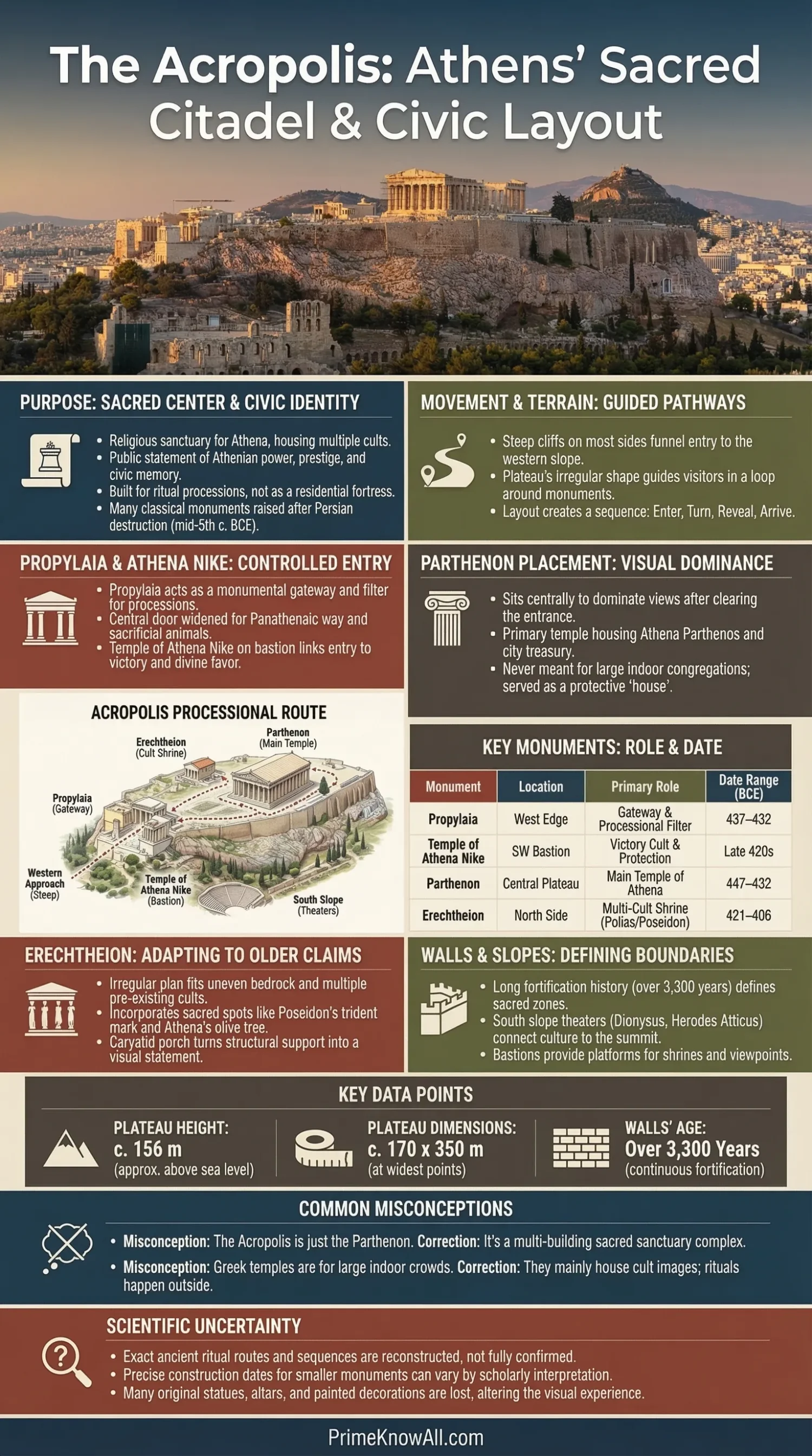
The Acropolis of Athens was built to stage a city’s identity in stone—religion, civic memory, and state ritual all in one place. Its layout is a deliberate sequence: a controlled western entry through the Propylaia, then a rising walk that frames the Parthenon and leads to smaller cult spaces like the Erechtheion and the Temple of Athena Nike. Think of it less as “one temple” and more as a sacred district shaped by processions, sightlines, and uneven bedrock.
The hilltop is not huge, which is part of the point. At roughly 156 m high and about 170 by 350 m across, the plateau is small enough to feel contained, yet large enough to fit a handful of buildings with very different jobs—gateway, main temple, older cult shrine, and edge sanctuaries.
If you remember one thing… the Acropolis works like a planned route, not a random cluster: enter, turn, reveal, then arrive.
What To Know First
- The Acropolis began as an upper citadel, but by the Classical period it functioned mainly as a sanctuary for Athena.
- The western side is the practical approach, so the main entrance and the Propylaia sit there for a reason.
- The Parthenon is visually dominant, but the site’s meaning depends on multiple cult spaces, especially the Erechtheion.
- Many buildings date to the mid-to-late 5th century BCE, after Persian destruction, under Perikles’ building program.
- Today’s paths can feel “touristy,” but the underlying layout still carries processional logic—where you walk changes what you see.
Purpose: What The Acropolis Was For
Short answer: the Acropolis was a religious center and a public statement of Athenian power, built to host ritual, protect prestige, and anchor a shared civic story.
Language helps here. An acropolis is a fortified upper citadel—a high place designed to resist attack—yet Athens gradually turned that “upper fortress” into a sanctuary for Athena. That shift shows up in what the plateau holds: not housing blocks or markets, but temples, altars, and processional routes that made the city’s identity feel physical.
- Sanctuary function: the hill became a “home address” for Athena, with multiple cult zones rather than a single worship hall.
- Civic messaging: visitors met a designed sequence that turned arrival into a ceremony.
- Memory after war: many Classical monuments rose after Persian damage, linking architecture to recovery and confidence.
One easy modern comparison helps, without stretching it too far. The Acropolis is like a museum that controls your camera angles: the entrance corridor narrows choices, the main object appears when you clear a corner, and smaller displays sit where you naturally pause and look.
How The Site’s Shape Controls Movement
Short answer: the Acropolis is steep on most sides, so it funnels people to the western approach; once you are on top, the plateau’s irregular shape nudges you into a loop around major monuments.
The hill is rocky and abrupt, which makes the “top” feel separate from the city below. That physical separation matters because sanctuaries work best when they feel set apart. A climb changes breath, noise, and attention—then the gateway tightens the experience even more.
- One main entry zone: the west is the workable slope, so it becomes the symbolic “front door.”
- Nearly flat top: you can gather, process, and stop at multiple points without feeling like you are on a cliff edge the whole time.
- Edges do work: bastions and walls define where movement ends, which makes viewpoints and shrine corners feel intentional.
Small Recap
- Terrain decides the main entrance, so layout starts outside the buildings.
- Movement is part of meaning: where you walk shapes what you notice.
- Edges are not leftover space; they help define ritual zones.
Entrance Choreography: Propylaia And Athena Nike
Short answer: the Propylaia is not just a gate; it is a filter that turns arrival into a formal transition, with the Temple of Athena Nike perched nearby to tie entry to victory and divine favor.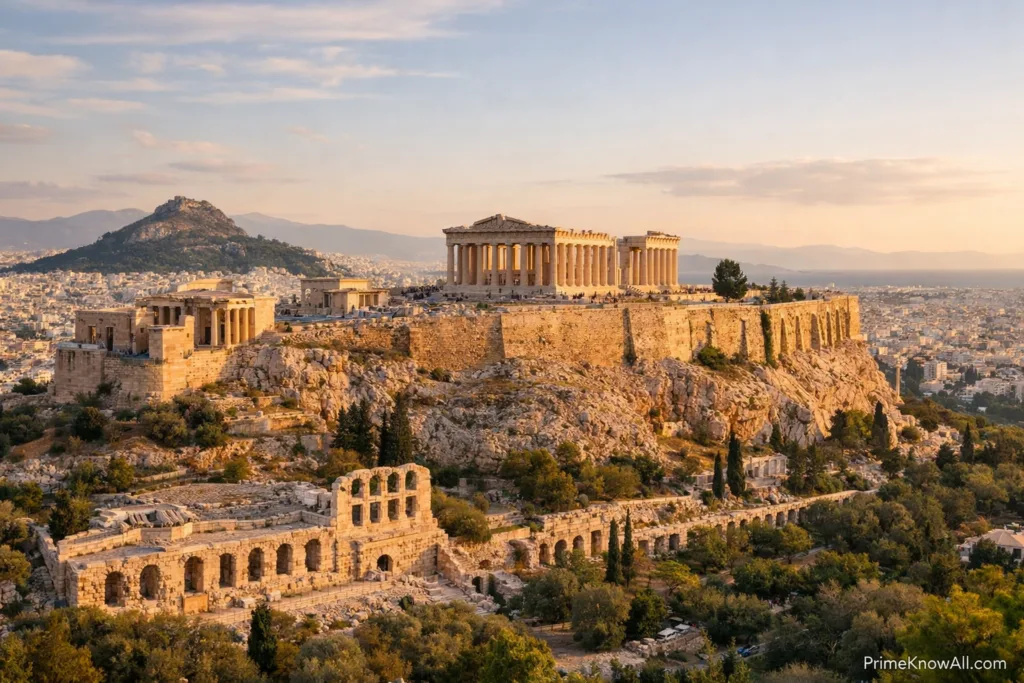
The Propylaia has a central passage and side wings, and it was built to handle both crowds and ceremony. One detail that reveals intent: the complex had five doors, and the central opening was made wider to help the Panathenaic procession pass through with sacrificial animals. That is “layout” doing a job—allowing a ritual to run smoothly.
Close by, the Temple of Athena Nike sits on a bastion at the southwestern edge. It is small, but it faces outward, so it reads like a public marker: you are entering Athena’s space under the sign of Victory. Dates for the temple’s construction can vary slightly by scholarly tradition and how phases are counted, but many references place it in the late 5th century BCE.
- Propylaia = a monumental “before the gates” zone that makes the entrance feel official.
- Athena Nike = a compact Ionic temple on an entry bastion, linking approach with military success and protection.
- Procession design = the pathway is built to carry a civic ritual, not just tourists.
Parthenon Placement: Center Without Being The Whole Site
Short answer: the Parthenon sits where it can dominate your view, but the Acropolis is planned so you never interact with it alone; you meet it as part of a sequence that also pushes you toward other sacred points.
The Parthenon was built in white Pentelic marble, and its planners used subtle “refinements” where lines that look straight are actually slightly curved. Even if you do not name these techniques, you can feel them: the building looks steady and alive at the same time. The temple’s plans are credited to Iktinos and Kallikrates, with Pheidias overseeing the project, and work began around 447 BCE.
It also helps to remember what a Greek temple is, in practical terms. A temple is a building that houses a deity’s image and offerings; it is not meant to hold a large indoor congregation like many later religious buildings. The Parthenon’s interior room, called the cella, is the enclosed space that held the cult statue and treasure. A cella is a temple’s inner chamber, meaning the “inside room” that the building protects.
Modern Athens still treats that placement as sensitive. Recent reporting noted that the Parthenon briefly stood without scaffolding for a few weeks starting September 26, 2025, and that restoration work has been ongoing since 1975. The same skyline “visibility” is why advertising stunts near the Acropolis can trigger immediate pushback.
- Visibility logic: the Parthenon rewards the moment you clear the entrance and turn.
- Function logic: it protects cult objects and, at times, served financial roles linked to the city-state.
- Material logic: Pentelic marble is bright, so the building reads from far away in clear light.
| Monument | Where It Sits | Primary Role | Commonly Cited Date Range |
|---|---|---|---|
| Propylaia | West edge, main entry zone | Monumental gateway for controlled arrival | 437–432 BCE |
| Temple Of Athena Nike | Southwest bastion near entry | Victory cult tied to approach | Late 420s BCE (sources vary by phase) |
| Parthenon | Central plateau, visually dominant | Main temple of Athena Parthenos | 447–432 BCE (building and decoration phases) |
| Erechtheion | North side, uneven ground zone | Multi-cult shrine (Athena Polias and others) | 421–406 BCE |
Memory Hook
- Gate first, then reveal the centerpiece.
- Center matters, but the site only makes sense when you keep walking.
- Small shrines near edges can carry big meaning.
Erechtheion: A Building Built Around Old Stories
Short answer: the Erechtheion exists because the Acropolis was not a blank slate; it had older sacred claims, and this building was designed to fit them instead of wiping them out.
The Erechtheion’s shape looks “odd” if you expect one clean rectangle, but it makes sense once you accept the ground. Uneven bedrock forced the design onto different levels, and the program had to include multiple cult targets. Museum descriptions note a split: the eastern section related to Athena Polias and her wooden cult statue, while the western section connected to Poseidon-Erechtheus and other local figures.
The famous Caryatid porch also shows how layout becomes a message. Those figures are not “random decoration.” They sit where a normal support system would go, so you see an architectural job—holding—turned into a visual statement.
- Uneven terrain explains the building’s stepped plan.
- Multi-cult layout reflects older sacred zones that Athenians chose to keep inside the main sanctuary.
- Porches organize movement: you approach, pause, and then change direction.
Walls, Edges, And The Slopes Below
Short answer: the Acropolis is not only the “top”; walls, bastions, and the south slope sites help explain how the sanctuary stayed protected and how public culture connected to it.
UNESCO’s description underlines that strong fortification walls have surrounded the summit for over 3,300 years. That long wall-history matters because it reminds you the hill served different needs at different times: defense, storage, and sacred display. When you read the plateau as a “walkable story,” the walls act like punctuation marks that stop you from drifting off the script.
Then there is the south slope, which functions almost like an “outer ring” of the Acropolis experience. The Theatre of Dionysus sits at the foot of the slope, tied to the cult of Dionysus, and the Odeon of Herodes Atticus anchors the western end. These places show how religious practice, performance, and the city’s daily life could meet right below the sacred rock without turning the summit into a crowded multipurpose plaza.
- Walls = long-term boundary-making, not just military leftovers.
- Bastions = edge platforms that support shrines and viewpoints.
- South slope monuments = performance and cult spaces that extend the Acropolis’ cultural footprint.
What To Hold On To
- Summit and slopes work together; the “site” is bigger than the plateau.
- Walls guide how people move and how they stop.
- Layout is still readable today, even with modern paths.
One-Page Visual Map
Vertical Walkthrough (read top to bottom). Each box is a “stop” with what it does and why it sits there.
Common Misconceptions
- Misconception: “The Acropolis is the Parthenon.” Correction: it is a multi-building sanctuary. Why it gets mixed up: the Parthenon dominates photos and skyline views.
- Misconception: “Greek temples are meant for indoor crowds.” Correction: temples mainly house cult images and offerings; large gatherings happen outside. Why it gets mixed up: later religious buildings trained people to expect big interiors.
- Misconception: “The entrance is where it is for symbolism only.” Correction: geography forces a workable approach on the west. Why it gets mixed up: the ceremonial feel hides the practical constraint.
- Misconception: “Erechtheion is weird because architects were less skilled.” Correction: it is complex because it had to fit uneven ground and multiple cult areas. Why it gets mixed up: people expect one clean rectangle per temple.
- Misconception: “Everything on the Acropolis was built at one time.” Correction: the site includes layers, with a major Classical burst plus later changes. Why it gets mixed up: guidebooks focus on the 5th-century BCE highlights.
- Misconception: “The walls are just background.” Correction: walls shape movement, edges, and long-term use of the summit. Why it gets mixed up: walls do not photograph as cleanly as columns.
Everyday Situations Where The Layout Makes Sense
- You enter a concert venue through a narrow corridor and the main stage appears after one final turn. That delay is design, just like the Propylaia controlling first sightlines.
- A campus places its main library in the center and smaller departments along the edges. The Acropolis does a similar thing: the Parthenon anchors, while other cult zones keep their own space.
- A public procession needs a wider doorway so people and objects can move together. The Propylaia’s central passage reflects that same “route planning” logic.
- A small memorial sits at a corner you pass every day so it stays in your peripheral vision. Athena Nike’s bastion placement uses that “corner emphasis.”
- A building is forced to step down because the ground drops and leveling it would cost too much. The Erechtheion’s multi-level solution is a high-status version of the same constraint.
- City rules tighten around a landmark’s skyline view because it carries shared meaning. Modern disputes over drones, filming, or scaffolding show that the Acropolis is still treated as a sensitive visual symbol.
- People keep taking the same path in a park even if new signs appear. On the Acropolis, the rock’s shape keeps “preferred routes” stable across time.
Quick Test
What is the simplest way to describe the Acropolis’ main purpose?
It functioned mainly as a sanctuary for Athena and a public display of civic identity.
Why is the main approach on the west side?
The hill is steep on most sides, so the west offers the most workable route for entry and processions.
What does the Propylaia do beyond being a gate?
It controls arrival by narrowing movement and shaping what visitors see first.
Why does the Erechtheion look irregular compared to the Parthenon?
It was built to fit uneven ground and include multiple cult areas rather than forcing one neat rectangle.
Is the Acropolis only the monuments on the top plateau?
No—walls, bastions, and south slope sites like the Theatre of Dionysus help explain how the whole complex worked.
Limitations And What We Do Not Fully Know
Some parts of the Acropolis are clearer than they look, and some are murkier than people expect. A few limits are worth keeping in mind, especially when reading simplified plans.
- Exact ritual routes can be reconstructed, but not every step is “confirmed” in the way a modern building code drawing would be.
- Construction dates for certain monuments (especially smaller ones) can shift by a few years depending on which building phase a source emphasizes.
- Lost features matter: statues, altars, and painted surfaces changed how spaces felt, and many are no longer in place.
- Later reuse reshaped parts of the site, so “original layout” is sometimes a layered story rather than one frozen moment.
Sources
UNESCO World Heritage Centre – Acropolis, Athens
[Dimensions, height, long-term fortification context, and official heritage description.]
Why reliable: UNESCO entries are curated as part of the World Heritage documentation process.
Acropolis Museum – The Parthenon Gallery
[Parthenon planners, materials, design intent, and gallery orientation matching the temple.]
Why reliable: The Acropolis Museum is the primary public institution presenting the site’s sculpture and context.
Acropolis Museum – The Propylaia
[Entrance layout details including multiple doors and procession-aware design.]
Why reliable: It is written to support the museum’s curated interpretation of the monument’s function and form.
Acropolis Museum – The Temple Of Athena Nike
[Bastion placement, architect attribution, and commonly cited construction range.]
Why reliable: The museum synthesizes scholarly consensus for public education using site-specific evidence.
Acropolis Museum – Erechtheion (Official Page)
[Split functions of the temple and reasons tied to terrain and cult needs.]
Why reliable: It reflects the museum’s research-based narrative for the monument’s design and use.
Hellenic Ministry Of Culture (Odysseus) – Propylaia
[Official cultural-heritage entry for location context and monument overview.]
Why reliable: Odysseus is a state-run portal maintained by Greece’s Ministry of Culture.
Hellenic Ministry Of Culture (Odysseus) – Temple Of Athena Nike
[Official description of the temple’s placement and monument setting.]
Why reliable: It is an institutional record tied to national cultural heritage management.
Hellenic Ministry Of Culture (Odysseus) – Theatre Of Dionysus
[South slope context and the theatre’s relationship to Dionysus’ cult space.]
Why reliable: It is an official monument entry written for public heritage documentation.
Hellenic Ministry Of Culture (Odysseus) – Odeon Of Herodes Atticus
[South slope monument overview and placement on the Acropolis’ western end.]
Why reliable: It is a state-curated description attached to a protected monument.
YSMA – Propylaia (Acropolis Restoration Service)
[Restoration-focused monument page including construction range and incompletion context.]
Why reliable: YSMA is directly connected to the Acropolis’ restoration program and technical stewardship.
ODAP (Greek Ministry Supervised) – The Acropolis Of Athens (PDF)
[Monument summaries and date ranges in a curated, site-specific booklet.]
Why reliable: ODAP is a public-sector body tied to Greece’s archaeological sites and publications.
Encyclopaedia Britannica – Acropolis Of Athens
[Reference overview on the Acropolis as citadel and sanctuary.]
Why reliable: Britannica is an edited reference work with named editorial standards and revision history.
Encyclopaedia Britannica – Parthenon
[Reference summary for dates, architects, and basic temple function.]
Why reliable: It is a curated dictionary-style reference with ongoing editorial updates.
Hesperia (ASCSA) – The Akroteria Of The Nike Temple (PDF)
[Academic discussion of the Nike Temple’s decorative program and chronology considerations.]
Why reliable: Hesperia is a peer-reviewed journal published by the American School of Classical Studies at Athens.
Associated Press – Parthenon Restoration And Scaffolding (Nov 2025)
[Modern context on restoration timelines, scaffolding changes, and visitor numbers.]
Why reliable: AP is a long-standing news agency with editorial controls and on-the-ground reporting.
Reuters – Drone Advertising Dispute Near The Acropolis (May 2025)
[Modern example of why the Acropolis skyline remains tightly managed.]
Why reliable: Reuters is a global wire service known for verification standards and dated reporting.
FAQ
What was the Acropolis of Athens built for?
It served mainly as a sanctuary for Athena and as a public setting where Athens could show civic identity through architecture, ritual, and art.
Why is the main entrance on the west side?
The hill is steep on most sides, so the west offers the most practical approach; that practical constraint became the ceremonial front door.
Is the Parthenon the same thing as the Acropolis?
No. The Parthenon is the best-known temple on the Acropolis, but the Acropolis is a site with multiple monuments, walls, and sacred zones.
Why does the Erechtheion have an irregular plan?
It was designed to fit uneven terrain and to include multiple cult areas, which led to a multi-level layout and distinct porches.
How big is the Acropolis plateau?
UNESCO describes the Acropolis as about 170 by 350 meters in overall dimensions and around 156 meters in average height above the basin of Athens.
Are the south slope monuments part of the Acropolis experience?
Yes. Places like the Theatre of Dionysus and the Odeon of Herodes Atticus sit on the south slope and show how cult and performance connected to the sacred rock.
The Acropolis’ purpose and layout are easiest to read as a planned route: approach on the west, pass through a designed gate, then circulate among monuments that each represent a different piece of the city’s sacred identity. It is a small plateau with outsized clarity: movement is part of meaning.
The most common mistake is treating the site like a single building instead of a sequence of spaces. A simple rule that sticks: if you want to understand the Acropolis, follow the walk before you study the columns.
