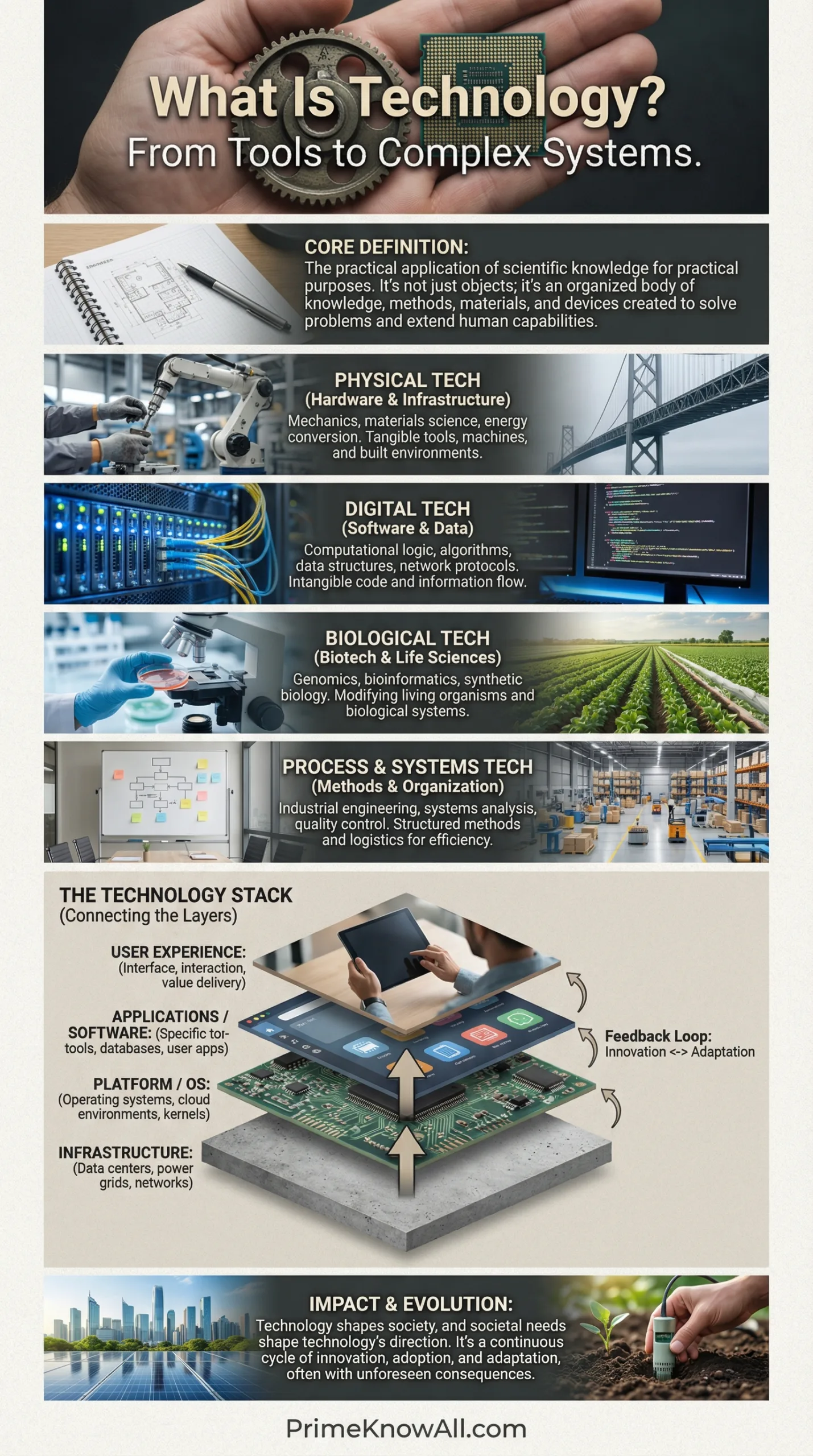
In everyday speech, technology can mean a smartphone, a factory robot, or “anything modern.” In a clearer sense, technology is the practical use of knowledge to achieve a goal by shaping the world through tools, methods, and organized systems. That definition is broad on purpose, because software and roads are both technology, even though one is intangible and the other is concrete.
Technology As A Working Definition
A useful definition needs to be wide enough to cover many fields and precise enough to separate technology from “knowledge” in general. A practical definition is this: Technology is the designed application of knowledge to produce repeatable outcomes—whether the outcome is a stronger material, a faster calculation, cleaner water, or a safer landing on a runway.
- Purpose: technology aims at a result (solve a problem, extend a capability, reduce cost, improve safety).
- Design: it involves choices—materials, architecture, interfaces, tolerances, rules, workflows.
- Reproducibility: it can be used again with similar results, not just once by chance.
- Operation: it includes how people run, maintain, and repair it in real conditions.
- Constraints: it lives inside limits—energy, time, budget, safety margins, reliability, and the environment.
One sentence test: If something can be built, taught, operated, and scaled to reliably do work in the world, it is almost certainly technology.
Why “Technology” Is Often Misunderstood
The word technology is used in at least three overlapping ways, which is why discussions can get messy. People might mean a device (“new technology”), a method (“a manufacturing technology”), or an entire system (“transportation technology”). All three are valid, but they point at different layers of the same stack.
Another reason is that technology is not only “high-tech.” A lever, compass, paper, and vaccination cold chain are technologies too. When the definition is limited to electronics, it misses the deeper idea: technology is organized capability, not just gadgets.
What Counts As Technology
To avoid fuzzy debates, it helps to look at what technology includes. Technology can be physical (a bridge), digital (an encryption protocol), biological (a fermentation process), or organizational (a logistics system). The common thread is intentional design plus repeatable use.
- Artifacts: tools, machines, infrastructure, devices, materials.
- Techniques: procedures, recipes, manufacturing steps, laboratory protocols.
- Knowledge-in-use: engineering rules of thumb, standards, operating manuals, code.
- Systems: supply chains, power grids, satellite networks, hospitals, cloud platforms.
- Interfaces: the ways humans and machines coordinate—controls, dashboards, signage, ergonomics.
If something is only an idea with no pathway to implementation, it is not technology yet. If it becomes a method people can follow, or a tool people can operate, it crosses the line into technology.
Technology As Objects, Methods, And Systems
A strong definition treats technology as more than an object. A smartphone is a product, but it also depends on software, manufacturing, standards, energy, and networks. In practice, technology behaves like a socio-technical system: a blend of tools, processes, organizations, and human behavior that produce a result.
| Lens | What It Focuses On | Simple Example | What You Notice |
|---|---|---|---|
| Artifact | Physical or digital thing | Water filter | Materials, performance, durability |
| Method | Repeatable procedure | 3D printing workflow | Steps, tolerances, quality control |
| System | Interacting parts with a shared outcome | Public transit network | Reliability, bottlenecks, maintenance |
| Infrastructure | Foundational layer enabling other tech | Electric grid | Capacity, resilience, failure modes |
| Platform | Reusable base for many applications | Cloud computing services | Scaling, security, interoperability |
This multi-layer view explains why a “small” change—like a new battery chemistry or a better scheduling algorithm—can have an outsized effect. It modifies not only the object, but the system behavior around it.
Major Types Of Technology People Encounter
Categories help readers map the landscape without pretending the borders are perfect. Most real-world technologies are hybrids that combine multiple domains, like sensors + software + materials + operations.
Information And Computing Technology
Computing technology turns information into action: storing it, processing it, transmitting it, and protecting it. Even when it feels invisible, it shapes everyday services through data and automation.
- Hardware: chips, sensors, servers, networking equipment.
- Software: operating systems, apps, databases, machine learning models.
- Protocols: rules that let systems talk, like routing and encryption standards.
Energy And Power Technology
Energy technology is about converting and delivering power safely and efficiently. It includes generation, storage, and distribution. A key theme is trade-offs: cost vs. reliability, density vs. safety, performance vs. longevity.
- Generation: turbines, solar cells, geothermal systems.
- Storage: batteries, pumped hydro, thermal storage.
- Delivery: grids, transformers, microgrids, power electronics.
Materials And Manufacturing Technology
Materials technology changes what objects can be. Manufacturing technology changes how reliably and cheaply those objects can be made. Together, they influence everything from aerospace structures to medical implants through strength, weight, and durability.
- Materials: alloys, composites, polymers, ceramics, semiconductors.
- Processes: casting, machining, lithography, additive manufacturing.
- Quality: metrology, inspection, standards, traceability.
Biological And Medical Technology
Biotechnology and medical technology use biological knowledge to prevent disease, support diagnosis, and improve treatment. Here, the meaning of technology clearly goes beyond devices; it includes protocols, sterile processes, and regulated production.
- Diagnostics: imaging, lab tests, biosensors.
- Therapies: targeted drugs, implants, controlled delivery systems.
- Operations: clinical workflows, cold chains, safety procedures.
Transportation And Space Technology
Transportation technology moves people and goods; space technology extends that capability beyond Earth. Both demand high reliability because failures can be catastrophic. That pressure drives redundancy, testing, and systems engineering.
- Vehicles: aircraft, trains, ships, rockets, satellites.
- Navigation: inertial sensors, guidance algorithms, positioning systems.
- Infrastructure: ports, runways, rail signaling, launch facilities.
Technology Versus Science And Engineering
These terms are connected, but they are not interchangeable. Science seeks explanations about how the world works. Engineering designs solutions under constraints. Technology is the result and the practice: the tools and methods that reliably do work in the world. In other words, science is often about understanding, engineering is about designing, and technology is about implementing and operating.
Clear thinking tip: If you are asking “Why does this happen?” you are leaning toward science. If you are asking “How can we make it work safely and reliably?” you are leaning toward engineering. If you are pointing to the finished solution and its use, you are talking about technology.
- Science produces models and theories that explain phenomena.
- Engineering turns goals into designs that can be built and validated.
- Technology turns designs into capabilities people can deploy at scale.
Technology Has A Life Cycle
Technology is not a single moment of invention. It is a life cycle that runs from early experiments to widespread use, and sometimes to replacement. Understanding the life cycle helps explain why “new” technologies can feel unpredictable: the weak points often appear during real-world adoption, not in the lab.
- Discovery And Proof: a concept becomes a working prototype, often fragile and expensive.
- Engineering And Scaling: reliability improves; costs fall; processes become repeatable.
- Standardization: interfaces, safety rules, and compatibility norms emerge.
- Adoption: people integrate it into routines; training and maintenance mature.
- Optimization: incremental improvements dominate; efficiency and usability rise.
- Obsolescence Or Transformation: it is replaced, merged, or repurposed into something new.
Many “breakthroughs” are actually the result of better integration: small improvements across components that make the whole system cheaper, safer, and easier to use.
Technology Is Never Just Technical
Every technology comes with human choices: what problem to solve, what risks to accept, what constraints matter most, and who will maintain it. That is why technology changes as it moves between contexts. The same tool can behave differently depending on training, incentives, and infrastructure.
This is also why “technology adoption” is not only about performance. A design can be technically impressive yet fail because it is too hard to repair, too costly to run, or poorly matched to the environment. Real-world success depends on fit: the alignment between a tool and the system around it.
Benefits, Trade-Offs, And Responsible Design
Technology is powerful because it can amplify human capability, but amplification cuts both ways. Faster computation can improve medicine and engineering, yet it can also increase complexity and create new failure modes. A responsible view keeps benefits and trade-offs in the same frame.
- Safety: What happens when the technology fails? Are there fallback modes and clear warnings?
- Security: Could it be misused or accessed in unintended ways? Are updates and audits realistic?
- Reliability: Does it work under heat, cold, dust, vibration, or poor connectivity?
- Usability: Can people learn it quickly, and can they recover from mistakes?
- Sustainability: What are the energy, materials, and waste impacts across the full life cycle?
Practical rule: A “good” technology is not only high-performing. It is understandable, maintainable, and safe enough for the context. Those qualities are part of the definition, not an afterthought.
How To Evaluate A New Technology Clearly
When people hear “new technology,” the mind jumps to novelty. A better approach is to ask structured questions that reveal what the technology really is: an artifact, a method, a system, or a platform. These questions keep the conversation grounded and reduce hype.
- What problem does it solve? Define the goal in one sentence, using measurable terms.
- What is the core mechanism? The single idea that makes it work (a material property, an algorithm, a process).
- What are the dependencies? Power, connectivity, specialized parts, trained operators, maintenance schedules.
- What are the constraints? Cost, energy use, environment, safety standards, time to deploy.
- What does failure look like? Gradual degradation, sudden breakdown, silent error, confusing outputs.
- What makes it scalable? Manufacturing, supply chain, interoperability, training, documentation.
Asking these questions turns “technology” from a vague label into a well-defined capability that can be compared, tested, and improved.
Common Misconceptions About Technology
“Technology Means Electronics”
Electronics are important, but they are only one branch. Sanitation systems, food preservation, construction methods, and materials engineering are equally technological. Limiting the term to gadgets hides how much everyday life depends on non-digital innovation.
“Technology Is Always Progress”
Technology can improve safety and comfort, but it also creates new dependencies and risks. “Better” depends on context: a solution can be excellent for one environment and unsuitable for another. A mature definition treats technology as capability with consequences, not automatic progress.
“A Product Is The Whole Technology”
A product is usually just the visible tip. Behind it are standards, supply chains, training, maintenance, and infrastructure. Seeing technology as a system explains why the same device can succeed in one place and fail in another.
Sources
Encyclopaedia Britannica – Technology [A well-edited overview with a concise definition and examples across eras]
Encyclopaedia Britannica – History Of Technology [Background on how the term evolved and why it covers more than machines]
UNESCO – What Is Science And Technology? Meaning, Definition [A clear institutional framing of science and technology and how they relate]
Internet Encyclopedia Of Philosophy – Philosophy Of Technology [Accessible discussion of what “technology” means beyond devices and tools]
National Academy Of Engineering – President’s Perspective: What Is Engineering? [Helpful context for separating engineering, science, and technological outcomes]
FAQ
Is technology only devices and machines?
No. Technology includes devices, but also methods, processes, and systems that reliably produce outcomes. A manufacturing workflow, a medical protocol, or a logistics network can be technology even when there is no single “gadget” to point at.
What is the simplest definition of technology?
A practical definition is: the designed application of knowledge to achieve repeatable results. It covers tools, software, infrastructure, and organized techniques, while staying specific about purpose and reproducibility.
How is technology different from science?
Science focuses on explaining how the world works. Technology focuses on using knowledge to do something reliably in the world—build, measure, transmit, heal, or transform. The two reinforce each other, but their goals are different.
Can a process be considered technology?
Yes. A repeatable process—like water treatment, semiconductor fabrication, or fermentation—counts as technology when it is designed, teachable, and consistently produces a desired outcome under defined conditions.
Why does technology often require standards and infrastructure?
Because technology scales through compatibility and reliability. Standards reduce friction between components, and infrastructure provides the stable foundation—power, connectivity, maintenance—needed for systems to work safely and consistently at large scale.
