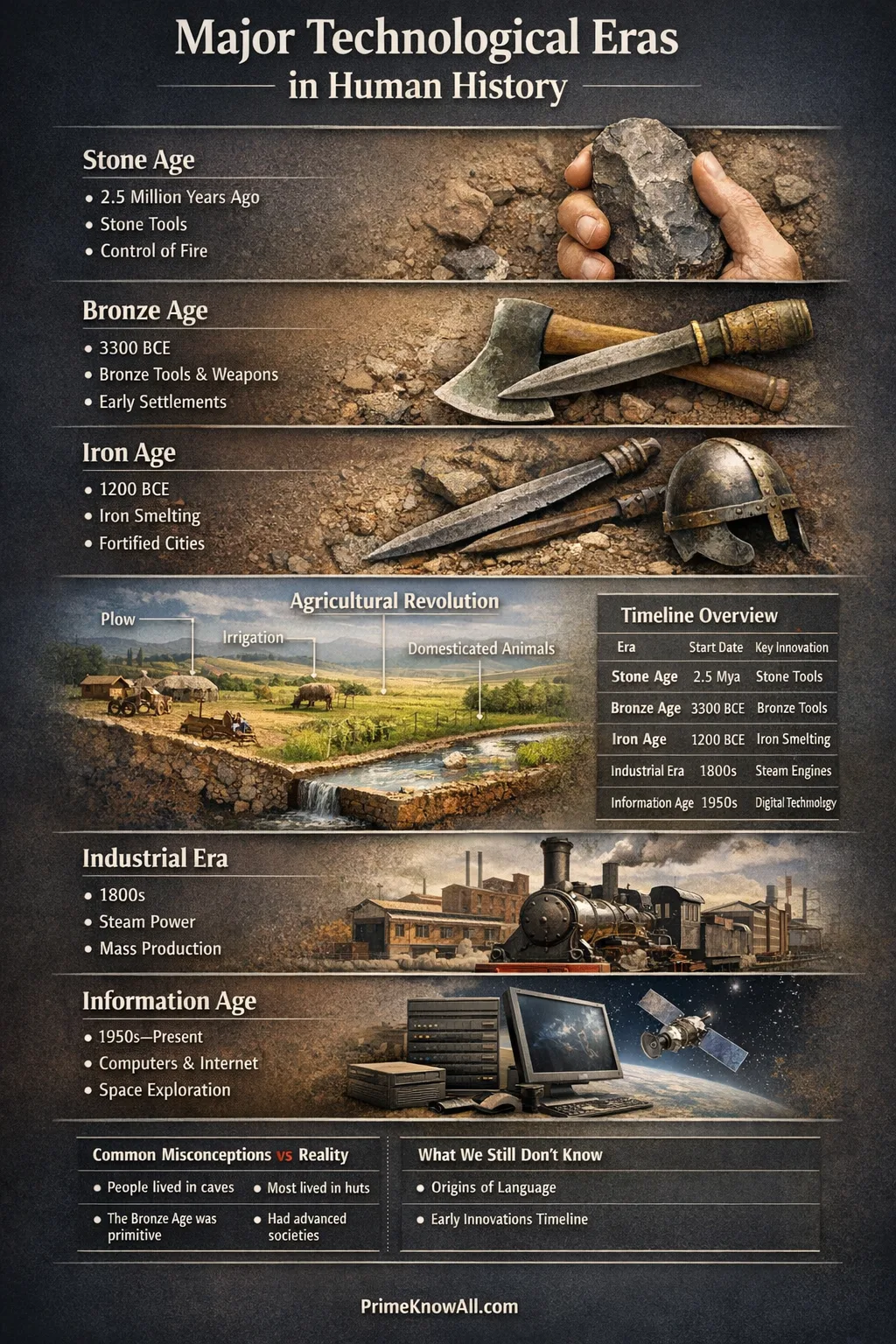
Human history can be read as a sequence of technological eras, each defined by a new way to shape matter, capture energy, or store information at scale. These eras do not replace one another overnight. They overlap, spread unevenly, and often accelerate when many small inventions lock together into a new system.
Instead of treating technology as a list of inventions, it helps to watch for moments when1 a society gains a repeatable capability: reliable fire, dependable food surplus, standardized metal tools, cheap printed knowledge, mechanical power, electrified networks, or programmable machines. Each capability changes what humans can build, how far they can coordinate, and how quickly they can learn.1
Why “Eras” Happen In Technology
A technological era begins when an idea becomes practical and shareable, not when it is first imagined. Many breakthroughs exist for centuries as fragile prototypes. An era arrives when the tools become cheap enough, standard enough, and useful enough that millions of people can build on them.
Eras also form because technologies are rarely isolated. A new material might require better furnaces. A faster machine might require better bearings. A larger network might require common standards. Once the supporting pieces exist, progress can feel sudden, even if the groundwork took generations.
A Useful Lens: Energy, Materials, Information, And Coordination
Most major shifts can be explained through four levers. When at least two of them jump forward together, an era shift becomes likely.
- Energy: from muscle to fire, then steam, electricity, and high-density fuels.
- Materials: from stone to metals, then alloys, plastics, and engineered composites.
- Information: from speech to writing, printing, computing, and global networks.
- Coordination: from small groups to cities, markets, industries, and digital platforms.
A Practical Map Of Major Technological Eras
The boundaries below are approximate. They are meant to clarify the story, not to flatten it. Real history is messy: a community can be in the digital era while still relying on Stone Age cooking methods, and both can be true at the same time.
| Era | Rough Time Range | Signature Capability | What It Enabled |
|---|---|---|---|
| Stone Tools And Early Fire Use | Millions of years ago to ~10,000 BCE | Cutting, scraping, controlled heat | Better diet, protection, new habitats |
| Agriculture And Permanent Settlements | ~10,000 BCE onward (varies by region) | Food surplus | Villages, storage, specialization, population growth |
| Metallurgy And Early Machines | ~3500 BCE onward | Metal tools, wheels, simple mechanisms | Cities, long trade routes, durable infrastructure |
| Classical Engineering Systems | ~500 BCE to ~500 CE (varies) | Standardized construction and hydraulics | Roads, aqueducts, large-scale public works |
| Printing And Knowledge Expansion | ~1450 CE onward | Mass copying of text | Faster learning, wider literacy, shared references |
| Industrial Mechanization | ~1700s to 1800s | Mechanical power from engines | Factories, rail transport, cheap manufactured goods |
| Electrification And Mass Production | Late 1800s to mid-1900s | Electric grids and standardized parts | Lighting, motors, appliances, global industry |
| Computing And Digital Networks | Mid-1900s to present | Programmability and networking | Automation, software, internet-scale services |
| Space Systems Era | 1950s to present | Satellites and deep-space capability | GPS, Earth observation, global communications |
| AI, Biotech, And Energy Transition | Early 2000s to emerging | Learning systems and biology-as-engineering | New medicines, smarter tools, cleaner infrastructure |
Stone Tools And Controlled Fire
The longest era in human history is built on a simple insight: with the right strike angle and the right stone, a human can manufacture a sharp edge on demand. Stone tools made cutting, scraping, and pounding more efficient, which changes food, mobility, and survival strategies.
Controlled fire adds a second superpower: predictable heat. Heat makes food easier to digest, improves safety in cold environments, and eventually supports early material processing. Fire is also a social technology, because it pulls people into shared light, shared time, and shared routines.
- Key materials: stone, bone, wood, fibers, hides.
- Core techniques: flaking, grinding, hafting, controlled heating.
- Big shift: better energy from food and broader geographic range.
Stone tools and fire are not “primitive.” They are technologies designed for repairability, local materials, and reliable performance in harsh conditions.
Agriculture And The Era Of Settled Life
Agriculture is an era because it turns nature into a managed system. Once communities can reliably produce and store calories, they can support more people in one place, and they can support people who do not farm full time. That unlocks specialization: builders, potters, traders, administrators, and later, engineers.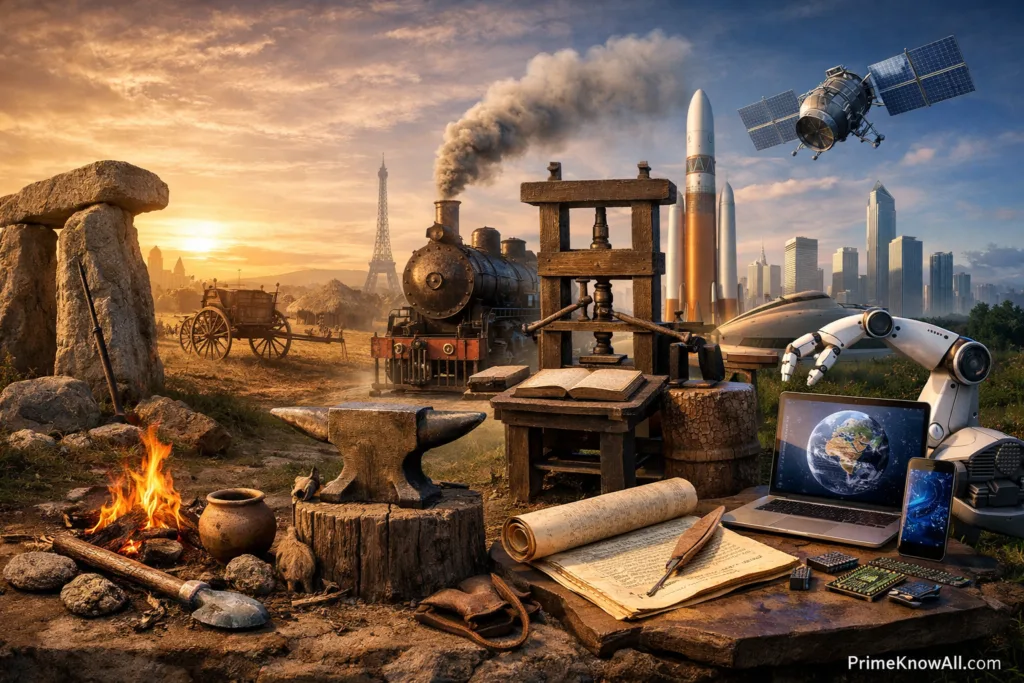
This era is also defined by new risks. Food storage attracts pests. Monocrops can fail. Water control becomes essential. In response, societies develop granaries, irrigation, and tighter systems of planning. Technology and organization become increasingly linked.
- Signature tools: sickles, grinding stones, plows (later), storage vessels.
- Infrastructure: irrigation channels, terracing, permanent housing.
- Social change: larger settlements and more complex coordination.
Metallurgy, Wheels, And Early Machines
Metallurgy matters because it produces standardizable strength. Stone can be sharp, but metal can be shaped into thin edges, long blades, durable fasteners, and precise forms that survive repeated stress. Once smelting and casting become reliable, tools become more consistent, repairs become easier, and production scales.
Alongside metal tools, early machines spread: wheels, levers, pulleys, and gears. These are simple ideas with large effects. They convert human and animal effort into controlled motion, helping societies move heavy loads, build taller structures, and process materials faster.
Metals also encourage networks. Smelting needs ore, fuel, and skill. Trade routes expand to move copper, tin, iron, and crafted goods. Over time, the real “technology” is the combination of materials plus logistics plus specialists.
Classical Engineering Systems And Public Infrastructure
Large states and large cities require technologies that keep working day after day. This era is marked by civil engineering: roads, bridges, ports, water supply, drainage, and standardized construction. When these systems function, they reduce friction in everyday life and make economies more predictable.
Many of the major advances here are not glamorous inventions. They are standards, maintenance practices, and trained labor. A paved road is a technology, but so is the system that keeps it from falling apart.
- What scales up: transportation reliability, urban water management, public works planning.
- What improves: measurement, surveying, and repeatable building techniques.
Printing And The Acceleration Of Shared Knowledge
Printing is an era shift because it turns knowledge into a manufactured good. When texts can be copied quickly and consistently, ideas travel farther, errors are spotted more easily, and learning becomes less dependent on direct apprenticeship. A printed diagram can teach a technique to someone who never meets the original author.
This change compounds. Shared references make it easier to debate claims, compare observations, and refine methods. Over time, printing supports the rise of scientific communication, technical manuals, standardized education, and professional communities.
What Changes When Information Becomes Cheap To Copy
- Memory moves outward: libraries and archives outlast individuals.
- Standards spread: shared units, shared drawings, shared terminology.
- Collaboration speeds up: people can build on each other’s work without starting from zero.
- Trust can improve: claims can be checked against the same text and the same diagrams.
Industrial Mechanization: Steam, Factories, And Speed
The Industrial era begins when mechanical power becomes available on demand. Steam engines, improved machine tools, and factory organization allow production to move from small workshops to systems that run continuously. The result is not only more goods, but also new expectations: faster transport, predictable supply, and standardized parts.
Mechanization also changes the geography of life. Factories concentrate labor and capital. Railways and steamships connect markets over long distances. Cities grow rapidly, and so do the demands for water, sanitation, and reliable energy. Technology becomes inseparable from infrastructure.
- Signature capabilities: machine power, precision manufacturing, mass logistics.
- Hard problems it forces: safety, pollution control, labor organization, urban planning.
Electrification And Mass Production
Electricity reshapes technology because it is an extremely flexible carrier of energy. With electric grids, power can be generated in one place and used almost anywhere. Motors replace complex belts and shafts. Lighting extends productive hours. Communication systems grow into dependable networks.
Mass production expands in this era because manufacturing becomes more modular. Components can be standardized, swapped, and improved in smaller steps. The hidden story is often the rise of measurement, quality control, and the ability to coordinate supply chains across regions.
Milestone Dates That Help Orient The Timeline
- Mid-1700s to 1800s: steam-driven industrial growth accelerates in parts of Europe and North America.
- Late 1800s: electric lighting and grid expansion begin reshaping cities and factories.
- Early to mid-1900s: mass production methods spread, alongside global transport and communications.
Computing And Digital Networks
The digital era is defined by programmability. A single machine can perform different tasks by changing instructions rather than rebuilding hardware. Once electronics shrink and become affordable, computation moves from rare rooms to desks, pockets, and embedded devices inside everyday objects.
Networking turns computing into a shared resource. The internet is not just faster communication; it is a platform for coordination: search, payments, maps, software distribution, remote work, and global communities. In practical terms, the digital era is an era of information logistics.
This era also produces new constraints. Digital systems amplify both good and bad inputs. They demand security, resilient infrastructure, and careful design around privacy and reliability. The technology moves fast, but trust is earned slowly.
- Core components: transistors, integrated circuits, software, data storage, networks.
- What becomes cheap: copying information, distributing tools, coordinating large groups.
- What becomes critical: standards, governance, and long-term maintainability.
The Space Systems Era: Satellites As Invisible Infrastructure
Spaceflight is often pictured as rockets and astronauts, but the deep change is the rise of space systems. Satellites make Earth-scale services possible: navigation, weather forecasting, disaster monitoring, broadcast and broadband links, scientific observation, and precise timing signals that financial and communication networks depend on.
What makes this an era is reliability. Launching once is a milestone. Maintaining constellations, managing orbits, and operating long-lived spacecraft is a system skill. It requires materials science, miniaturized electronics, software, and global ground support working together.
- Everyday impacts: GPS navigation, satellite weather imagery, long-distance communications.
- Scientific impacts: astronomy from space, planetary exploration, Earth observation at global scale.
- Engineering theme: extreme reliability under harsh constraints.
The Emerging Era: AI, Biotech, And Cleaner Energy Systems
Today’s frontier is not a single invention. It is a cluster of technologies that treat complex systems as something we can model, optimize, and sometimes design: machine learning, robotics, synthetic biology, advanced materials, and energy technologies that aim to reduce emissions while keeping economies reliable.
AI is becoming a general tool for pattern-finding, language interaction, and decision support. It can boost productivity, improve accessibility, and help scientists explore vast spaces of possibilities. At the same time, responsible use requires risk management, strong testing habits, and clarity about where AI is helpful and where it can mislead.
Biotechnology is shifting from observation to engineering. Faster sequencing, better lab automation, and genome-editing methods push medicine, agriculture, and materials research forward. Because biology affects living systems, this area also demands careful governance, safety norms, and transparent oversight.
Energy transition technologies focus on durability and scale: modern grids, storage, efficient electrification, and clean generation. The defining challenge is system integration. A grid is not one device; it is a web of hardware, software, regulations, maintenance, and long-term investment.
A Healthy Sign Of A New Era: Tools That Improve Other Tools
A shift becomes durable when it creates meta-tools: technologies that make it easier to invent, test, manufacture, and distribute the next generation. Printing did this for ideas. Industrial machines did it for parts. Digital systems do it for software. AI and lab automation may do it for discovery itself.
How One Era Blends Into The Next
Eras rarely end because the old tools stop working. They end because a new approach becomes more efficient across many tasks at once. When a technology improves multiple sectors—food, transport, health, communication—it attracts investment, talent, and infrastructure, and it starts to feel “inevitable.”
The most reliable indicator is scaling behavior. If performance improves quickly while costs fall, adoption spreads. When adoption spreads, standards form. When standards form, ecosystems develop. That is how an invention becomes an era.
Reading The Timeline Without Oversimplifying
It is tempting to treat technological history as a straight line of constant improvement. Real progress is more like a braided river: many streams merge, separate, and rejoin. A society can advance quickly in engineering while lagging in public health, or innovate in information while struggling with energy. The “era” language is useful as long as it stays grounded in systems, not myths.
Seen this way, the story of human technology is the story of expanding options. New eras do not just add gadgets. They expand what is possible—how far a message can travel, how precisely a tool can be made, how reliably a city can run, and how quickly knowledge can compound.
Sources
- Smithsonian National Museum of Natural History – Stone Tools [Background on early stone technologies and why they matter]
- University of Oxford (Ashmolean) – Neolithic Collection [Clear overview of early farming, domestication, and settlement change]
- Library of Congress – The Gutenberg Bible [Context on Gutenberg’s printing methods and early mass printing in Europe]
- Smithsonian Institution – Power Machinery [Industrial power machinery and why steam and turbines reshaped production]
- Computer History Museum – Timeline of Computer History [Milestones across computing, storage, networking, and software]
- Internet Society – A Brief History Of The Internet [Origins and evolution of the internet from people involved in its development]
- NASA – The Dawn Of The Space Age [Historical overview of early satellite milestones and the start of space systems]
FAQ
How many technological eras are there in human history?
There is no single official count. “Era” is a useful grouping, not a fixed law of nature. Most broad timelines include at least the shift to agriculture, the rise of metals, the printing expansion, industrialization, and the digital era, with space systems and AI/biotech often treated as newer layers.
Do technological eras happen everywhere at the same time?
No. Eras are uneven across regions and communities. Technologies spread through trade, migration, education, and infrastructure, and those channels move at different speeds. That is why multiple eras can coexist in the same century, or even in the same city.
Which factor matters most: energy, materials, or information?
They reinforce one another. A jump in energy makes heavier industry possible, better materials make machines reliable, and improved information systems help knowledge spread and standards form. The biggest shifts usually happen when two or three of these improve together.
Was the printing press really a technological era shift?
Yes, because it changes the economics of knowledge. When copying becomes cheap and consistent, learning accelerates, references become shared, and technical communities can form across long distances. It is less about one machine and more about a new information system.
Are we currently in a new technological era?
Many signs point to an emerging era built around AI, biotechnology, and major energy system upgrades. What will determine whether it becomes a clear “era” is scale: widespread adoption, stable standards, and infrastructure that makes these tools dependable for everyday life.
Article Revision History
