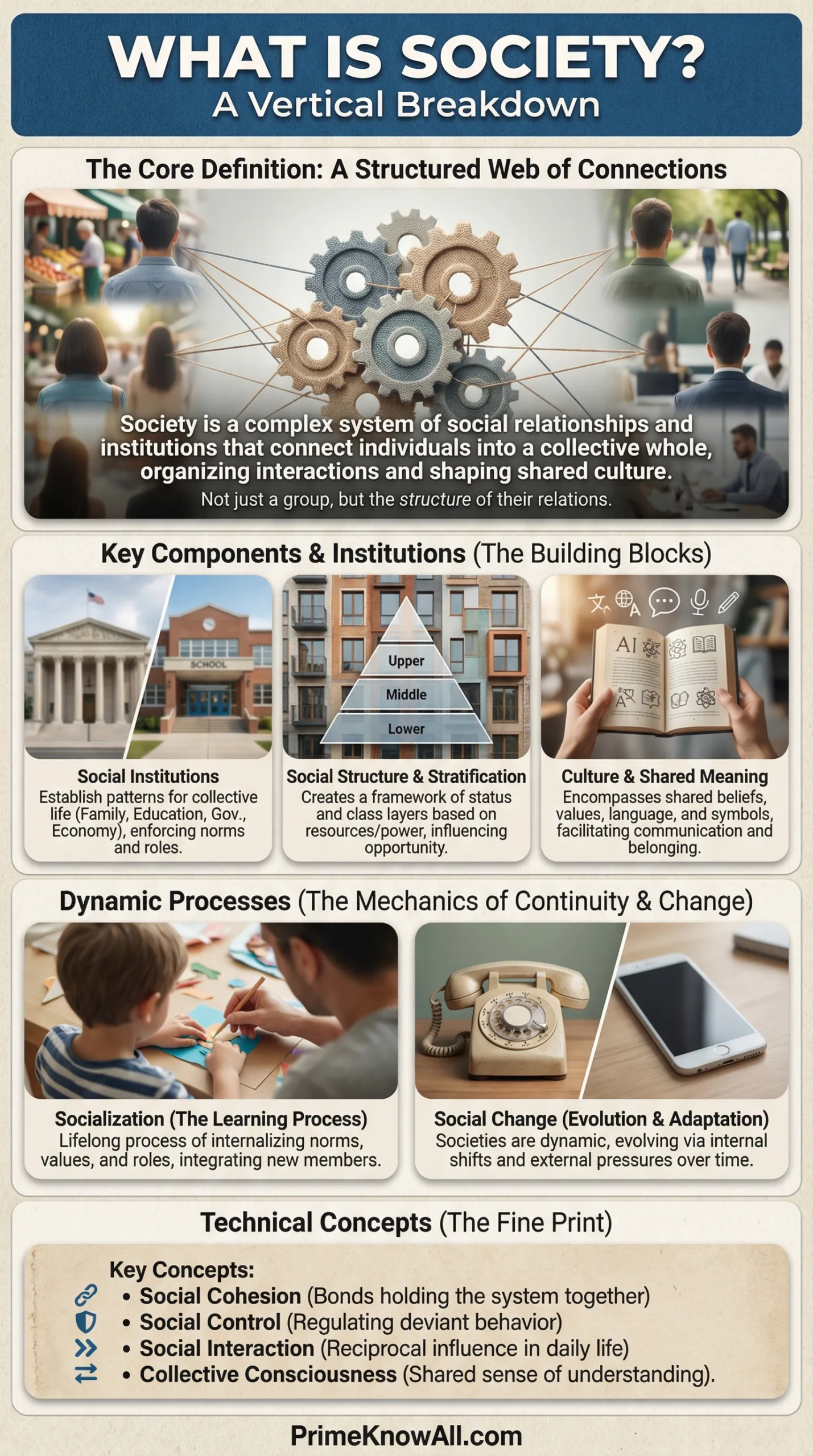
When people say society, they often mean “everyone else.” In reality, society is more specific: it is the organized pattern of relationships, shared rules, and everyday cooperation that makes life predictable enough to plan, build, trade, learn, and belong. It is not a place you can point to on a map, but it is real in the way that traffic or language is real: it shapes what people can do, and it is continuously shaped by what people do.
A Working Definition Of Society
A society is a large group of people who interact within a shared system of culture, institutions, and norms, creating relatively stable patterns of life over time. The key idea is pattern: not just individuals living near one another, but a repeating structure that organizes expectations, roles, and responsibilities.
That definition stays useful because it separates society from a few easy-to-confuse terms. A population is a headcount. A community is a network of belonging that can be small or large. A country is a political unit. A society can overlap with all of these, but it is best understood as the social system that makes coordinated life possible.
- Interaction: people respond to each other through communication, exchange, cooperation, and conflict.
- Shared meaning: a common culture (symbols, values, habits) helps actions make sense.
- Durable organization: institutions and norms stabilize behavior so life is not reinvented every morning.
What Society Is Made Of
Society is often described as “people living together,” but the important material is not only people. It is the connections between them, plus the shared expectations that tell those connections what they mean.
Relationships And Networks
A society is a web of relationships: family ties, friendships, work connections, neighborhood routines, professional networks, and online communities. These links can be close or distant, warm or tense, but together they create a network that moves information, trust, goods, and opportunities.
- Strong ties (family, close friends) often provide direct support and care.
- Weak ties (acquaintances, broad networks) often spread new information and connect different groups.
- Bridging connections link communities and reduce isolation, helping ideas and practices travel.
Culture
Culture is the shared “toolkit” of meanings: language, symbols, customs, values, and everyday habits. It tells people what counts as polite, what signals respect, which roles feel legitimate, and what goals are admired. Without culture, social life becomes noisy and uncertain; with culture, people can coordinate quickly using common cues.
Norms And Rules
Norms are the expectations that guide behavior, from subtle habits (how close to stand when talking) to formal rules (contracts and laws). Norms do not eliminate choice, but they create predictability. That predictability is a major part of what makes a society more than a crowd.
Institutions
Institutions are the recurring systems that organize major needs: raising children, producing goods, resolving disputes, sharing knowledge, and caring for health. An institution is not only an organization. “Education” is an institution; a particular school is one organization within it.
Roles And Social Structure
Every society has some form of social structure: the patterned arrangement of roles and relationships that persists over time. Roles (student, parent, manager, neighbor) come with expectations. Structure is what makes those expectations consistent enough that strangers can cooperate—buying food, catching a train, starting a job—without needing a personal agreement for every interaction.
A Practical Way To Picture Society
One helpful model is to imagine society as a layered system. Each layer is real, and each layer influences the others through feedback.
- Everyday interaction: conversations, routines, cooperation, conflict, and small decisions.
- Organizations: workplaces, schools, clinics, media platforms, volunteer groups.
- Institutions and culture: deeper rules, shared meanings, and long-term patterns that outlast any one person.
Major Ways Scholars Explain Society
There is no single “official” theory of society. Different frameworks spotlight different mechanisms: stability, inequality, meaning, or networks. Using more than one lens often gives the clearest picture.
| Approach | Main Focus | What It Explains Well | Common Blind Spot |
|---|---|---|---|
| Functional | Coordination and social order | How institutions work together to keep life stable | May underplay conflict and unequal outcomes |
| Conflict | Power and resource distribution | How inequality shapes opportunity and social change | May treat cooperation as only a side effect of struggle |
| Symbolic Interaction | Meaning in everyday life | How norms and identities form through interaction | May miss large-scale institutions and history |
| Social Construction | How categories become real through shared agreement | Why money, laws, and roles work when people treat them as valid | Can seem abstract if disconnected from material conditions |
| Network | Patterns of connections | How information, trust, and behavior spread across groups | May underplay culture and values if treated as “just links” |
Culture, Norms, And Values: The Invisible Architecture
Many of society’s strongest forces are invisible because they live in shared understanding. A value is what a group tends to treat as important (fairness, loyalty, independence, tradition, innovation). A norm is the expected behavior that fits those values. Together, they create a quiet pressure toward “what people like us do.”
Norms are reinforced through feedback. Sometimes it is gentle (approval, respect, invitations). Sometimes it is firm (penalties, exclusion, legal consequences). These responses are called sanctions, and they are a basic mechanism of social order.
- Informal norms: unwritten habits like turn-taking in conversation or queuing.
- Moral norms: expectations tied to deeper ideas of right and wrong, often enforced through strong approval or disapproval.
- Formal rules: written standards such as policies, contracts, and laws, backed by official enforcement.
Culture also supplies symbols—words, gestures, clothing, or rituals—that carry meaning beyond their physical form. A flag is cloth, but it can signal belonging. A handshake is a movement, but it can represent trust. That shared interpretation is a cultural agreement, and society depends on it.
Institutions And How They Coordinate Life
Institutions are society’s repeatable solutions to recurring needs. They reduce uncertainty by standardizing roles, responsibilities, and procedures. When institutions work well, people can make plans with fewer surprises. When institutions fail or lag behind reality, daily life becomes fragile and contested.
- Family and kinship: care, upbringing, and household organization.
- Education: training, credentials, and shared knowledge.
- Economy: production, exchange, work roles, and coordination of resources.
- Law and governance: rules, dispute resolution, and public coordination.
- Health systems: prevention, treatment, and social responses to illness.
- Religion and ethics: meaning, rituals, moral guidance, and community bonds.
- Media and technology: information flow, attention, and cultural narratives.
It helps to remember that institutions can be both enabling and constraining. They make cooperation possible at scale, but they also set boundaries on what is considered acceptable. That tension is normal: society cannot coordinate millions of lives without limits, yet it also cannot thrive if limits become needlessly rigid.
Power, Inequality, And Social Stratification
Society is not only shared meaning; it is also shared constraints, shared competition, and uneven access to resources. Power is the ability to shape outcomes—through money, authority, expertise, status, or network influence. Stratification is the pattern by which societies rank people and groups, affecting opportunities over time.
Inequality does not require anyone to be “evil” to exist. It can emerge from rules, inherited advantages, unequal schooling, job networks, geography, or historical patterns. What matters for understanding society is how these differences become stable—how they reproduce themselves through institutions, expectations, and everyday decisions.
- Economic resources: income, wealth, and material security.
- Social resources: networks, trust, and who can open doors.
- Cultural resources: language style, credentials, and knowledge of “how things work.”
- Institutional resources: access to quality services and fair procedures.
Thinking in terms of systems helps. Even when individuals act with good intentions, outcomes can still be unequal if the underlying system distributes risk and reward unevenly. That is why social analysis looks at both personal choices and the structures those choices operate inside.
Society And Technology: A Two-Way Street
Technology changes society, but society also shapes technology. Tools are built inside cultures, guided by values, business models, and institutional rules. Once adopted, tools reshape communication, work, learning, and even what people treat as “normal.”
Digital platforms are a clear example. They create new spaces for interaction, but they also introduce new forms of social organization: algorithmic recommendation, large-scale moderation, reputation systems, and rapid diffusion of trends. In practice, this can shift how people form identity, how communities define boundaries, and how institutions respond to public expectations.
- Speed: ideas and behaviors travel faster, which can intensify both coordination and confusion.
- Scale: communities can form beyond geography, based on interest, language, or shared experience.
- Visibility: everyday life becomes more observable, affecting norms and self-presentation.
- New gatekeepers: platforms, standards, and interfaces influence what people see and do.
Even in online spaces, society is not “just the internet.” It is still relationships, norms, and institutions—only expressed through new tools. A forum’s rules, a platform’s policies, and a community’s shared language can function like mini-institutions inside the wider social world.
How Societies Change
Societies change because people innovate, adapt, migrate, learn, and respond to new conditions. Some change is slow—new norms for work, family life, or education can take generations. Some change is fast—sudden shifts can follow crises, breakthroughs, or major economic disruptions. The pattern is rarely neat.
One useful way to track change is to watch how the layers move: everyday behavior, organizations, and institutions. A new habit (everyday layer) can push organizations to adjust, which can then pressure institutions to update rules, training, or standards. Or it can happen in reverse: a new policy or technology can reshape organizations, which then reshapes daily life. This is feedback, and it is a big part of why society is always in motion.
- Innovation: new tools, methods, or ideas that create new possibilities.
- Diffusion: the spread of practices across groups and regions through networks.
- Demographic shifts: changes in population size, age structure, and movement across places.
- Institutional reform: updates to rules, procedures, and public services.
- Cultural change: shifting values and meanings that redefine what feels acceptable.
Importantly, continuity and change often happen at the same time. A society can hold on to old traditions while adopting new technologies. It can celebrate stability in one area and experimentation in another. That mix is not a contradiction; it is a common social strategy for managing risk while still moving forward.
Common Misunderstandings About “Society”
The word society is used casually, so misunderstandings are easy. Clearing them up makes the concept more useful and less like a vague complaint about “the world these days.”
- Society is not the same as government. Government is one institution among many; society includes culture, norms, networks, and everyday cooperation.
- Society is not identical to culture. Culture is shared meaning; society also includes structured relationships and institutions that coordinate life.
- Society is not a single mind. It does not “want” things the way a person does, even if large trends can be measured and predicted.
- Society is not static. Even stable societies change through countless small adjustments and occasional big shifts.
- Society is not only conflict. Competition exists, but so do cooperation, care, and routine coordination that quietly keep life functioning.
When the idea is used carefully, society becomes a practical tool. It helps explain why some problems are not just personal failings, why some solutions require coordination, and why new technologies or new rules can ripple outward in surprising ways.
Sources
- BCcampus OpenEd – Introduction To Sociology: “What Are Society And Culture?” [Clear textbook definition of society, culture, and levels of analysis]
- Encyclopaedia Britannica – Social Structure [Strong overview of social structure as stable arrangements of institutions and relationships]
- Britannica Dictionary – Society [Concise definition emphasizing organized communities and shared values]
- American Sociological Association – What Is Sociology? [Professional association explanation of how sociology studies societies, groups, and interaction]
- OpenStax (Rice University) – Introduction To Sociology 3e: What Is Sociology? [Open textbook context for studying society and social patterns]
- Stanford Encyclopedia Of Philosophy – Social Ontology [Philosophical perspective on what makes social entities and institutions “real”]
FAQ
Is society the same thing as culture?
No. Culture is shared meaning—values, symbols, language, and habits. Society includes culture, but also the organized relationships, institutions, and norms that coordinate life over time.
Can a small group be a society?
A small group can be a community, but “society” usually refers to a larger system with durable institutions and stable patterns. That said, some small-scale, long-lasting groups with shared rules and recurring roles can function like a mini-society in practice.
Do online communities count as societies?
Many online communities develop norms, shared language, roles, and enforcement mechanisms, so they can behave like social systems. Whether they count as a full society depends on scale and durability, but they clearly show how society can form through interaction rather than geography.
Why do societies have rules that feel restrictive?
Rules and norms reduce uncertainty and enable coordination among strangers. The trade-off is constraint. Healthy societies tend to balance predictability with room for adaptation, so rules support cooperation without becoming unnecessarily rigid.
What is the simplest way to explain society to a child?
Society is “how people live together.” It includes the ways people cooperate, the rules they follow, and the places that help (schools, hospitals, stores, and laws). It is the shared system that helps life run smoothly.
Article Revision History
