Human societies form when people repeatedly coordinate their lives—sharing work, risks, and meaning—well beyond what a single individual can manage alone. A society is not only a population living near each other; it is a living web of relationships, shared expectations, and institutions that makes cooperation predictable. Over time, those webs expand, split, merge, and reorganize as environments shift, technologies change, and cultures accumulate new habits and ideas.
Societies also evolve in a practical sense: they adapt through learning and recombination. Some changes are slow and quiet—like the gradual hardening of norms around fairness—while others are rapid, driven by new tools or new ways of organizing. What looks like a sudden “turning point” often reflects years of small adjustments that finally align into a new pattern.
What Makes A Group A Society
A society needs more than proximity. It requires repeated interaction, some degree of mutual dependence, and a way to coordinate behavior beyond constant negotiation. This coordination is usually carried by shared rules—some written, many unwritten—and by the expectation that others will follow them most of the time.
In practice, societies show a few recurring ingredients that can be seen in small communities and in global networks alike:
- Boundaries that define who counts as “us” in at least some contexts, even if those boundaries are flexible.
- Norms that shape everyday choices—how to share, how to trade, how to show respect—often enforced by approval and disapproval.
- Roles that distribute tasks and authority, from informal leaders to specialized occupations.
- Collective memory in stories, rituals, records, and now digital archives, which stabilizes identity across generations.
These elements do not guarantee harmony. They simply make coordination possible at scale, allowing a group to act as more than a collection of individuals.
The Core Foundations Of Social Life
Cooperation That Pays Off
Human societies lean heavily on cooperation, but cooperation is rarely pure selflessness. It is often supported by reciprocity (help now, receive later), reputation (be known as reliable), and coordination benefits (achieve outcomes impossible alone). When cooperation becomes dependable, it opens the door to specialization—and specialization raises overall capacity.
Small groups can rely on direct observation and memory. As groups grow, they increasingly depend on signals and shared markers—uniforms, credentials, standards, and public commitments—to decide who to trust and how to divide work.
Kinship, Friendship, And Chosen Ties
Early human communities often formed around kinship, but human societies do not stop there. They also build durable “chosen ties” through friendship, alliances, and shared identity. These ties create networks that stretch beyond immediate family, enabling larger coalitions and more resilient support systems.
Kinship systems also do something subtle but powerful: they provide a ready-made logic for obligations—who helps whom, who inherits what, who speaks for the group—reducing the cost of constant renegotiation.
Language And Shared Meaning
Language turns social life into something that can be planned. It allows humans to coordinate future actions, communicate reasons, and pass down “how-to” knowledge with far higher fidelity than imitation alone. Over time, language supports collective concepts like law, property, citizenship, or membership—ideas that exist because people agree to treat them as real.
Shared meaning is also a form of compression. A simple label—like “contract” or “marriage”—can bundle complex expectations into a single word, making large-scale coordination much easier.
Norms: The Everyday Operating System
Norms are the quiet rules of daily life. They are not always written, yet they guide what counts as fair, rude, honorable, or acceptable. Norms spread through learning, social pressure, and the strong human tendency to copy what seems successful or common. Over time, stable norms become institutions, and institutions become the scaffolding for larger societies.
A practical way to think about norms: they reduce coordination cost. Instead of negotiating every interaction from scratch, people can rely on shared expectations. That is why a small, repeated behavior—like lining up, greeting, or queuing—can have an outsized effect on social order.
Scaling Up: From Small Communities To Large Societies
As communities expand, the main challenge is not simply feeding more people. It is managing coordination across distance, across strangers, and across time. Larger societies typically need new tools for:
- Information flow (how news travels, how rules are communicated, how knowledge is stored).
- Conflict management (how disputes are resolved without tearing the group apart).
- Resource coordination (how work and goods are allocated, tracked, and protected).
- Legitimacy (why people accept decisions that do not personally benefit them).
Many big historical transitions—from farming settlements to cities, from local markets to global trade—can be understood as new answers to those coordination problems. The specific path varies, but the underlying pressures are familiar: rising interdependence, denser networks, and a growing need for reliable rules.
Specialization And Interdependence
Specialization is a social multiplier. When individuals focus on narrower tasks, overall skill and efficiency rise. But specialization also creates interdependence: the more specialized a society becomes, the more it depends on coordination, standards, and trust to prevent bottlenecks and breakdowns.
This is why larger societies invest heavily in infrastructure (roads, ports, grids, platforms), in measurement (weights, time, money), and in shared procedures (contracts, certifications, audits). These are not only technical tools; they are social technologies that make cooperation scalable.
Why Cities Change Everything
Cities concentrate people, skills, and opportunities. That density accelerates innovation because ideas collide more often. It also raises the stakes of coordination: public health, transport, policing, housing, and water become system-level concerns. In city life, many interactions are with strangers, so societies build impersonal trust through rules, records, and institutions that work even when no one knows anyone else.
Patterns That Show Up Across Different Scales
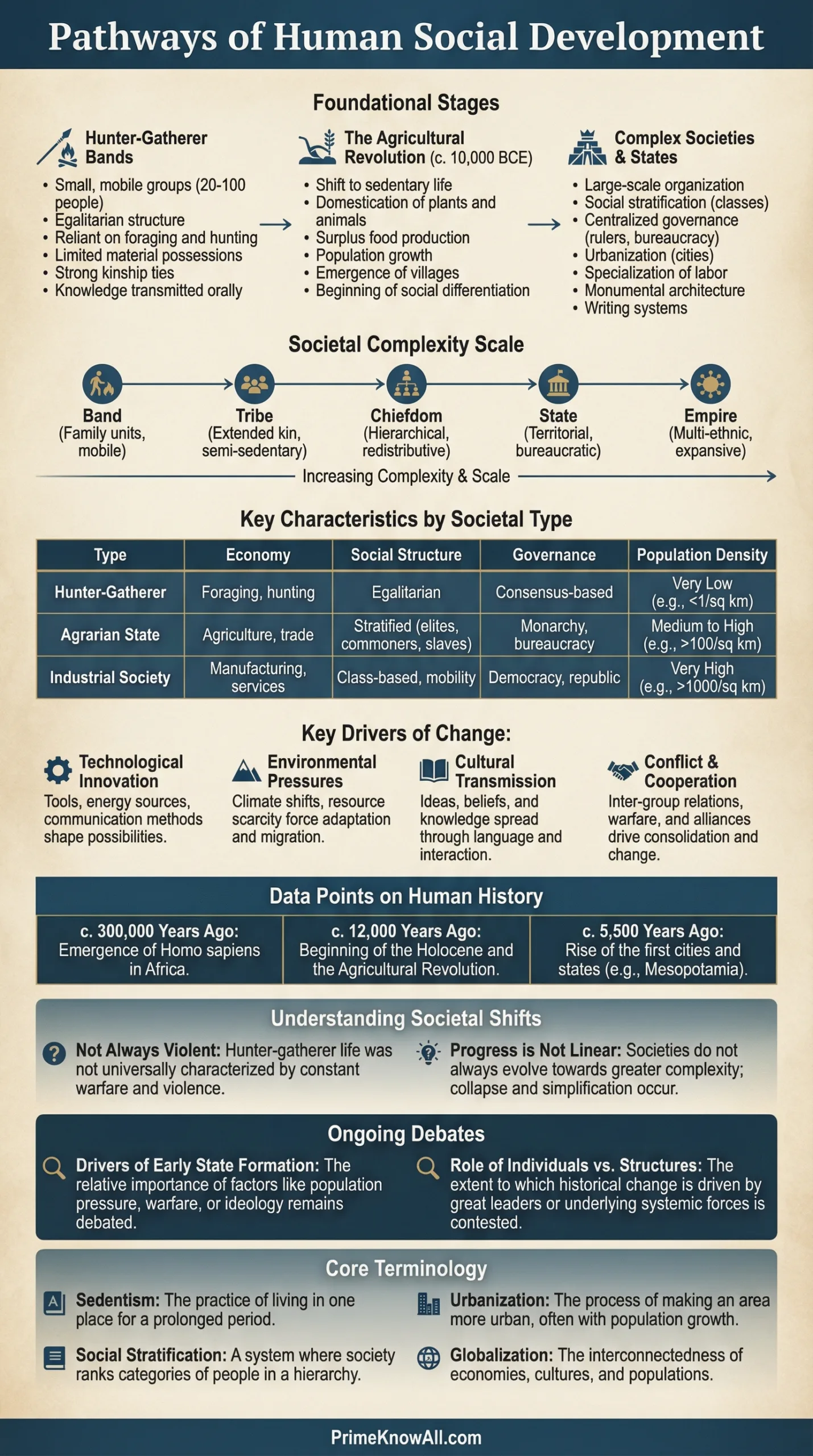
There is no single ladder that every society climbs. Still, certain patterns tend to appear as scale increases—especially around coordination, information, and authority. The table below is a simplified map, not a rigid template.
| Social Scale | Typical Coordination Style | Common Trust Mechanism | Institutional “Tooling” |
|---|---|---|---|
| Small Communities | Face-to-face agreements and shared routines | Reputation and direct observation | Informal leadership, customs, shared rituals |
| Regional Networks | Alliances, trade ties, recurring obligations | Reciprocity plus shared identity markers | Common standards, dispute mediators, proto-contracts |
| Complex States | Formal administration and layered decision-making | Rules backed by enforcement and legitimacy | Laws, taxation systems, courts, record-keeping |
| Global Systems | Network coordination across borders and platforms | Standards, audits, and interoperable protocols | International rules, supply chains, digital infrastructure |
What matters is the direction of the challenge: as scale increases, societies shift from personal trust toward system trust. That shift is a major theme in social evolution.
How Societies Change: The Main Engines
Societal change is usually driven by several forces at once. A new technology might enable change, but demography, ecology, and culture often decide whether it spreads or stalls. The most common engines include:
- Population dynamics: growth can intensify coordination needs; decline can strain institutions built for larger numbers.
- Resource constraints: scarcity pushes innovation, migration, substitution, or stricter rules around sharing.
- Technology: tools reshape work and communication, changing how authority and cooperation function.
- Exchange and contact: trade and movement spread ideas, practices, and institutions through borrowing and adaptation.
- Competition and selection: groups that coordinate more effectively may outlast or outcompete others, even without direct conflict.
Modern research often frames this as cultural evolution: practices and beliefs vary, spread through learning, and persist when they fit human psychology and local conditions. Importantly, cultural change is not always “better.” Some traits spread because they are memorable, prestigious, or easy to copy—not because they improve outcomes.
Diffusion: Why Ideas Travel Unevenly
Some inventions spread quickly; others remain local for centuries. This unevenness is often about compatibility. A new practice must fit existing incentives, social norms, and available infrastructure. Even a superior technique can fail if it threatens powerful groups, demands rare resources, or clashes with deeply held identities.
Diffusion also depends on networks. Dense, well-connected networks transmit change faster, but they can also amplify conformity. Looser networks can be slower, yet they may preserve diversity and allow parallel experiments that later become valuable.
Institutions: The Invisible Technology Behind Society
Institutions are stable patterns of rules and roles. They tell people what is expected, who decides, and what happens when rules are broken. Many institutions are explicit—courts, schools, markets—while others are implicit, like the expected meaning of a handshake, a queue, or a promise.
Institutions matter because they make cooperation less fragile. When a society depends on personal trust alone, a single betrayal can ripple outward. When a society has well-established institutions, trust can become distributed across procedures: contracts, verification, and third-party enforcement. That shift supports larger, more complex forms of coordination.
Institutional change is often gradual: new routines appear at the edges, prove useful, and slowly become “the normal way.” When it works, it feels boring—and that boredom is a sign of stability.
Legitimacy: Why People Accept Rules
Rules can be enforced by punishment, but long-term stability usually needs legitimacy: a shared belief that the rule-making process is acceptable. Legitimacy can come from tradition, performance (it delivers results), fairness, or shared values. Without legitimacy, enforcement becomes costly, and institutions become brittle.
Legitimacy also shapes adaptability. Societies that can revise rules without destroying trust tend to handle change better than societies where any reform is seen as betrayal.
Feedback Loops That Shape Social Evolution
Societies are complex adaptive systems. That means cause and effect often run in loops rather than straight lines. A small change—like a new way to measure value—can trigger a chain reaction in trade, labor, governance, and identity. Over time, feedback loops can lock in a path, creating what is often called path dependence.
Common feedback loops include:
- Scale and bureaucracy: bigger populations need more administration; administration enables even bigger scale.
- Trade and specialization: exchange supports specialization; specialization increases reliance on exchange.
- Innovation and norms: new tools require new rules; new rules enable wider use of tools.
- Information and coordination: better communication increases coordination; coordination creates demand for even better communication.
These loops help explain why societies can feel stable for long periods and then shift rapidly when multiple pressures align. The “rapid” part is often the visible phase of a longer, quieter buildup.
Resilience And Stress Without The Drama
Societies face stress from environmental shifts, economic shocks, technological disruption, and internal coordination failures. Resilient societies tend to have redundancy (multiple ways to do essential tasks), flexible institutions, and trusted dispute resolution. Fragile societies often depend on narrow bottlenecks: a single supply route, a single authority channel, or a single fragile agreement.
Resilience is not only material. It is also cultural: shared expectations about helping, sharing, and rebuilding can keep a community functional even when infrastructure is strained. In that sense, social capital—the practical value of relationships and trust—acts like an invisible reserve.
How Researchers Study The Formation And Evolution Of Societies
Because no single method can capture social evolution, researchers combine multiple lenses. A good explanation usually links individual behavior to collective outcomes using evidence at different scales.
Evidence From The Deep Past
Archaeology tracks long-term change through settlement patterns, artifacts, food systems, and infrastructure traces. Even without written records, shifts in toolkits, building styles, and trade materials can reveal changing social organization.
Evidence From Living Communities
Ethnography and fieldwork show how norms and institutions actually operate day to day. This matters because written rules often differ from lived practice. Fine-grained observation can reveal the small mechanisms—prestige, gossip, informal sanctions—that keep cooperation stable.
Comparative Databases And Computational Models
In recent decades, researchers have built large comparative datasets to test broad claims about social complexity, institutions, and cultural change. These datasets support pattern testing across many regions and time periods. In parallel, agent-based models and network analysis explore how simple behavioral rules can generate complex outcomes—helping explain why certain forms of cooperation are stable while others collapse under pressure.
Helpful Ways To Read Social Change
- Look for incentives: what gets rewarded, what gets punished, what gets ignored.
- Track coordination tools: standards, records, procedures, and trusted intermediaries.
- Notice the bottlenecks: points where one failure can cascade into many.
- Expect multiple pathways: similar outcomes can emerge from different histories.
Why “Progress” Is Not A Reliable Storyline
It is tempting to describe social evolution as a simple march from “simple” to “advanced.” Real history is messier. Societies often trade one capability for another: stronger central coordination can reduce flexibility; faster innovation can raise instability; higher connectivity can spread both useful knowledge and harmful errors.
A more accurate view treats societies as adaptive rather than “ascending.” They develop solutions that fit local constraints, available technologies, and inherited institutions. Over time, these solutions accumulate into distinct social architectures—different ways to build trust, allocate resources, and handle conflict.
Understanding how societies form and evolve is about understanding coordination: how humans build shared worlds, maintain them, and revise them when they no longer fit. That process is one of humanity’s most powerful inventions, and it remains unfinished.
Sources
- Stanford Encyclopedia of Philosophy – Cultural Evolution [Clear overview of cultural evolutionary theory and how culture can change through social learning.]
- Stanford Encyclopedia of Philosophy – Social Norms [Deep reference on what norms are, how they form, and how they stabilize behavior.]
- Santa Fe Institute – About: Complex Systems Science [Background on societies as complex adaptive systems and why emergence matters.]
- Max Planck Institute For Evolutionary Anthropology – Cultural Evolution [Research overview of quantitative work on cultural diversity and large-scale patterns.]
- Seshat: Global History Databank – Project Overview [A comparative database for studying long-run changes in social and political organization.]
- World Bank – Social Capital: A Multifaceted Perspective [Institutional view of social capital and why networks and trust affect outcomes.]
FAQ
Do human societies always start with kinship groups?
Kinship is a common early foundation because it creates built-in obligations and predictable support. But societies also form through alliances, shared work, trade, and shared identity. Over time, many stable societies rely heavily on non-kin cooperation among strangers.
What is the difference between culture and society?
A society is a network of relationships, roles, and institutions that coordinate life. Culture is the shared set of ideas, skills, symbols, and norms that people learn and transmit. Culture helps a society function, and society provides the structure that lets culture spread and persist.
Why do some norms become stable while others disappear?
Norms stabilize when they align with incentives, are easy to learn, and are supported by social feedback like approval, reputation, and predictable enforcement. Norms fade when they create high costs, clash with strong identities, or lose the institutional support that once kept them self-reinforcing.
Does bigger always mean more complex?
Larger populations often create pressure for more coordination, but complexity is not automatic. Some large societies maintain simple administrative structures, while some smaller ones develop sophisticated systems of rules and exchange. Complexity depends on interdependence, information systems, and institutional design—not only size.
What is one reliable sign that a society is changing?
Watch for changes in coordination tools: new standards, new record-keeping, new dispute resolution methods, new ways to verify trust, or new institutions that reduce friction. These shifts usually signal deeper changes in how people cooperate and how power and responsibility are distributed.
Article Revision History
