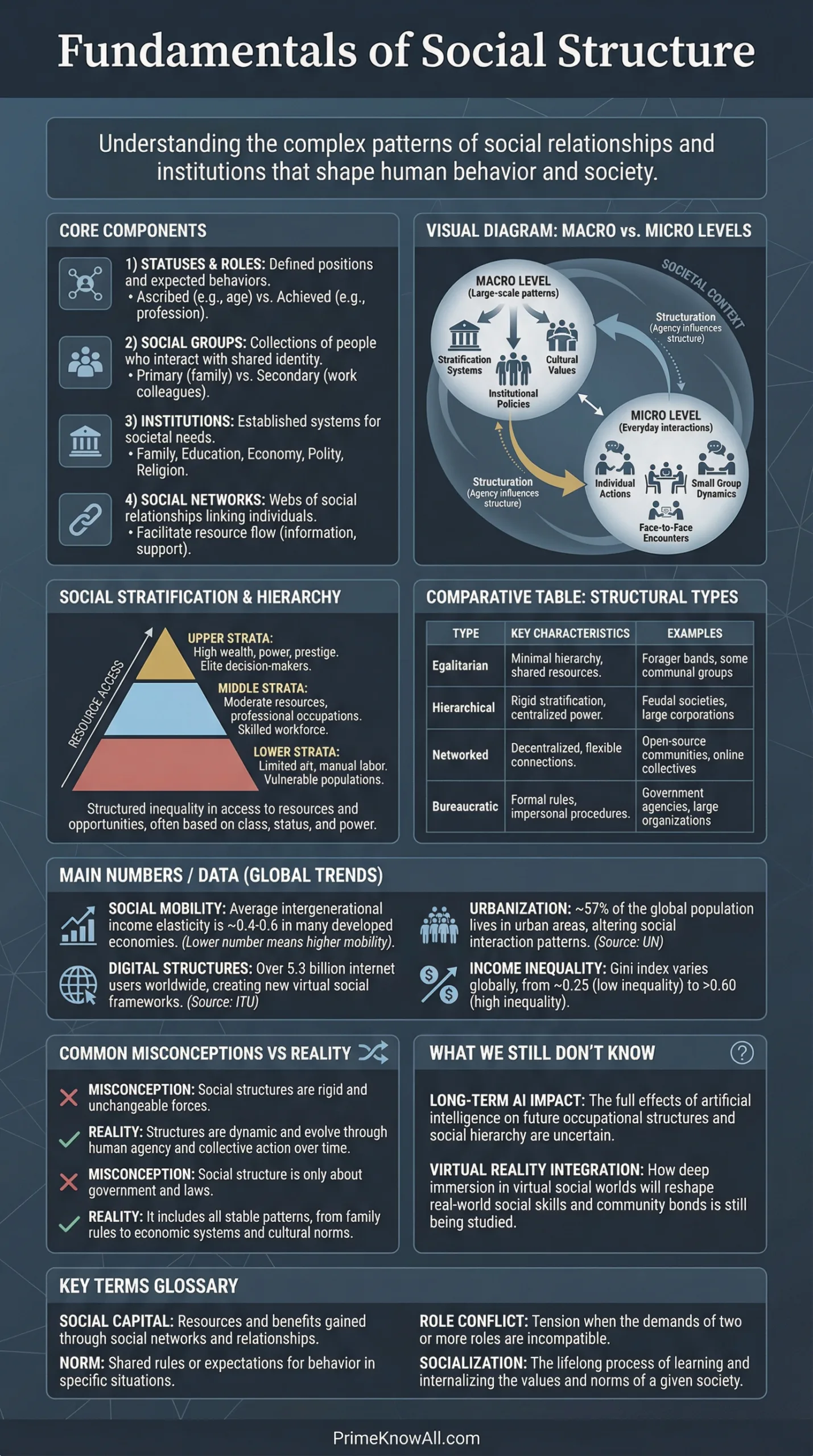
A social structure is the organized pattern of relationships, roles, and institutions that shapes how people live together. It is the reason many daily choices feel “personal” while still following shared paths—who talks to whom, who leads, who gets listened to, and which options seem realistic. When a society appears chaotic on the surface, it often runs on surprisingly stable rules, routines, and expectations underneath.
Social structures are not a single thing. They are a layered system made of norms, statuses, roles, groups, and institutions. Some parts are formal (laws, schools, job ladders). Others are informal (friend circles, reputations, unwritten etiquette). Together, they create predictability—and they also create constraints, because not everyone stands in the same place within the structure.
What Social Structure Means
In simple terms, social structure describes the stable patterns that organize social life. It is not only about “society” as a big abstract idea. It includes concrete things like family roles, workplace hierarchies, school routines, and community expectations. These patterns influence behavior even when nobody is consciously “enforcing” them, because they are supported by rewards, penalties, and shared meanings.
A helpful way to think about it is this: culture tells people what is meaningful, while structure organizes who is connected to whom and who can do what. The two are deeply linked. A society can value achievement, for example, but its structure may still distribute opportunities unevenly through networks, credentials, and gatekeeping.
Structure And Agency Work Together
People are not robots following a script. Individuals have agency: they make choices, resist expectations, and create new norms. At the same time, choices are made inside a world that already has paths, rules, and power differences. Social structure is the “shape” of that world. It does not erase freedom, but it changes what freedom looks like in practice—what feels possible, what feels risky, and what feels normal in a given setting.
- Structures enable action: organizations, markets, and institutions make coordination possible at scale.
- Structures constrain action: rules, status rankings, and resource limits narrow options for some people more than others.
- Structures are reproduced: routines and habits keep systems running, often without anyone planning it.
- Structures can shift: changes in technology, demographics, or norms can rewire the system over time.
Core Elements Of Social Structure
Social structure becomes easier to understand when it is broken into parts. Each part is simple on its own, but together they form a durable system. The most common elements include statuses, roles, norms, and institutions.
Status And Role
A status is a recognized social position, like student, manager, or neighbor. A role is the set of expected behaviors tied to that status. When people say “act professional” or “be a good teammate,” they are pointing to role expectations. Roles reduce uncertainty, but they can also create pressure and conflict when expectations collide.
Norms And Sanctions
Norms are shared rules about what is acceptable. They range from small (how close to stand in conversation) to major (how to treat authority). Most norms are enforced through social sanctions: praise, embarrassment, exclusion, or trust. A society does not need constant supervision to maintain order if people internalize norms and respond to social feedback.
Groups And Networks
Groups are bounded sets of people with shared identity or purpose, like teams, clubs, or professions. Networks are patterns of connection—who knows whom, who shares information, who can introduce you to opportunities. Networks often matter as much as formal qualifications because they control flow: news, support, jobs, and influence.
Institutions
Social institutions are stable systems that meet core needs and organize behavior, such as education, family, health, religion, and the economy. Institutions work through rules, roles, and resources, but they also shape beliefs about what counts as success, responsibility, and fairness. That is why institutions are both practical machinery and meaning-making systems.
Levels Of Social Structure
Social structure exists at different scales. Looking only at individuals can miss the wider pattern. Looking only at large institutions can miss the micro-level routines that keep the system alive. A clear view usually combines micro, meso, and macro levels, each revealing different mechanisms.
- Micro level: everyday interaction, small groups, family dynamics, peer influence, face-to-face norms.
- Meso level: organizations, communities, workplaces, schools, local professional fields.
- Macro level: national institutions, economic systems, stratification patterns, demographic trends, global flows.
Each level can explain the same event in a different way. A person’s career outcome might involve micro factors (mentorship), meso factors (promotion policies), and macro factors (labor market shifts). The most useful explanations connect these layers instead of picking one as the only “real” cause.
| Level | Typical Units | What It Helps Explain | Common Clues To Look For |
|---|---|---|---|
| Micro | Interactions, roles, small groups | Cooperation, conflict, identity work, everyday norms | Who speaks, who interrupts, who decides |
| Meso | Organizations, communities, workplaces | Rules, gatekeeping, coordination, belonging | Policies, procedures, informal influence |
| Macro | Institutions, economies, population patterns | Stratification, large-scale change, long-term stability | Mobility patterns, resource distribution |
Institutions And The Hidden Architecture Of Everyday Life
Institutions are often noticed only when they fail. When they function smoothly, they become background infrastructure. They set schedules, define qualifications, and decide what counts as legitimate knowledge. They also create categories—student, patient, employee, citizen—each with its own expected behavior and access to resources.
How Institutions Maintain Stability
- Standardization: shared procedures make outcomes predictable, from hiring to grading.
- Legitimacy: people comply because the institution feels “normal” or “proper,” not only because of force.
- Credentialing: certificates and degrees act as filters that organize opportunity.
- Resource control: budgets, information access, and decision rights shape what can happen.
- Socialization: training and onboarding teach people how to behave inside the system.
Simple test: If stopping a behavior brings predictable social costs—loss of trust, exclusion, stalled progress—there is likely a structural rule behind it, even if nobody wrote it down.
Institutions can feel impersonal, but they run through people. A policy becomes real through front-line roles: teachers, supervisors, administrators, healthcare staff. This is where structure meets daily interaction, and where small changes—new incentives, different evaluation criteria, altered workflows—can produce big downstream effects.
Status, Roles, And Social Scripts
Many social interactions rely on scripts: shared expectations about how a situation should unfold. Scripts reduce uncertainty and help strangers coordinate quickly. A waiting room, a classroom, a customer service desk—each has an implied order. People who match the script gain smooth access. People who violate it may face social friction, even if their behavior is harmless.
Ascribed And Achieved Status
Status can be ascribed (assigned by birth or circumstance) or achieved (earned through actions). Most real life mixes the two. A society may publicly celebrate achieved status, yet still distribute early advantages through family resources and networks. Understanding this mix helps explain why outcomes often track starting positions as well as effort.
Role Conflict And Role Strain
- Role conflict: expectations from different roles collide (for example, being both a strict supervisor and a close friend).
- Role strain: a single role has too many demands (meeting deadlines while maintaining quality and mentoring others).
- Role exit: leaving a role requires identity adjustment and social renegotiation.
These tensions are not just personal stress. They reveal how structure allocates time, authority, and responsibility. When role strain becomes widespread, it is a signal that expectations have outgrown the resources available, and the system may be heading toward adaptation.
Networks As The Connective Tissue
Some social advantages come from formal rank. Many come from connections. Networks organize who receives information early, who gets trusted recommendations, and who can mobilize help fast. In everyday terms, networks answer practical questions like: “Who can introduce me?” and “Who will vouch for me?” Those small bridges can become major life levers.
Common Network Patterns
- Strong ties: close relationships that provide support, reliability, and deep trust.
- Weak ties: looser connections that often bring new information and broader opportunity.
- Clusters: tight circles where everyone knows each other, good for cohesion but sometimes limited for novelty.
- Bridges: links between clusters, often powerful for career and innovation.
- Central nodes: people positioned to spread information widely, sometimes becoming informal leaders.
Networks also reproduce inequality. If high-opportunity circles mainly connect to similar backgrounds, access becomes uneven even without explicit exclusion. This is one reason social structure is not only about laws or organizations; it is also about the shape of relationships and who is allowed into which circles. A small difference in network access can grow into cumulative advantage over time.
Inequality And Stratification In Social Structure
Most societies contain structured differences in resources, prestige, and power. When these differences become stable and predictable across groups, they form stratification. Stratification is not only about income. It includes access to high-quality education, safer environments, stronger networks, and greater influence over decisions that affect daily life. These patterns are often maintained through rules and customs that feel “normal.”
How Stratification Reproduces Itself
- Credential filters: degrees and certifications can signal skill, but they also restrict entry.
- Inherited resources: wealth, time, and support often transfer across generations.
- Social closure: insiders create barriers that protect status, sometimes subtly through culture and norms.
- Geographic sorting: where people live affects schools, safety, and job access.
- Institutional routines: decisions made “by the book” can still produce unequal outcomes if the starting conditions differ.
None of this means individuals cannot move or succeed. It means that mobility is shaped by the structure of opportunities. When a society wants fairer outcomes, it needs to look beyond personal effort and examine system design: incentives, access points, and who holds decision power. Structural analysis is not about blaming; it is about identifying where small changes could create wider access.
How Social Structures Change
Social structures feel stable because they are reinforced daily, but they are not fixed. Change often begins when routine assumptions stop fitting reality. New technologies, shifting population patterns, economic transitions, and evolving norms can all push institutions and networks to adapt. Some changes are fast and visible; others are slow, occurring through quiet accumulation of small shifts.
Common Drivers Of Structural Change
- Innovation: communication tools and automation reshape work, community, and identity.
- Urbanization and migration: movement changes networks, norms, and local institutions.
- Education expansion: new credentials alter labor markets and status hierarchies.
- Demographic change: aging populations and changing household forms reshape care systems.
- Shocks: crises can reveal weak points, accelerate reforms, and create new routines.
Change is rarely a clean break. Old patterns persist through path dependence: once an institution invests in a certain design, switching becomes costly. That is why structural change often looks like layering—new rules added on top of old ones—until the system gradually behaves differently. Watching how organizations update their procedures, how people form new networks, and how norms shift in everyday talk can reveal change in progress.
How Social Scientists Study Social Structure
Studying social structure requires methods that capture both patterns and meaning. Numbers can show regularities. Fieldwork can reveal how rules are experienced on the ground. The best research often blends approaches, using each to test and refine understanding. What matters is not just describing inequality or networks, but explaining mechanisms—how the pattern is produced and maintained.
- Surveys: map attitudes, roles, and resource access across large populations.
- Administrative and organizational data: reveal real decision processes like admissions, promotions, and service delivery.
- Ethnography: shows how norms and power operate in lived experience.
- Social network analysis: models relationships, bridges, and information flow.
- Experiments and natural experiments: test how small changes alter behavior in structured settings.
A key skill is separating individual traits from structural positions. Two people can be equally talented, but placed differently in a network or institution. Structure shapes the returns on effort by changing exposure to mentorship, trust, and high-impact opportunities. This lens helps explain why some interventions work for a few individuals but fail to shift the larger pattern unless the system incentives change.
A Practical Way To Map A Social Setting
If a workplace, community, or online space feels confusing, mapping its social structure can make it readable. The goal is not to judge people; it is to identify the roles, rules, and resource flows that shape outcomes. This kind of mapping is useful for project teams, community organizers, product designers, educators, and anyone trying to build systems that are both effective and fair. Even a simple map can expose bottlenecks.
Steps That Keep The Map Grounded
- Name the key statuses: who is considered a newcomer, expert, decision-maker, or gatekeeper?
- List core roles: who mentors, who coordinates, who approves, who fixes problems?
- Identify written rules: policies, guidelines, job descriptions, formal procedures.
- Identify unwritten rules: norms about tone, timing, “the right way” to request support.
- Trace resource flows: money, time, information, access, visibility, and recognition.
- Find the bridges: which people connect otherwise separate groups?
- Watch the sanctions: what gets rewarded, what gets ignored, what gets punished?
Once the map is visible, improvement becomes more realistic. If success depends on informal access to a central person, the system is fragile. If rules are unclear, newcomers will struggle and insiders will dominate. If a process rewards speed over quality, you will get speed. A structural view connects outcomes to design. That is where meaningful change starts—by adjusting incentives, clarifying roles, and widening entry points to opportunity.
Sources
- Encyclopaedia Britannica – Social Structure [Clear overview of definitions, examples, and key theoretical angles]
- OpenStax (Rice University) – Introduction To Sociology 2e: Society And Social Interaction [Foundational concepts on interaction, norms, and how society is organized]
- Pressbooks – Social Structure And Social Interaction [Accessible breakdown of roles, statuses, and institutions with learning objectives]
- Encyclopaedia Britannica – Structuration Theory [Helpful perspective on how structure and individual action interact]
- American Sociological Association (TRAILS) – Social Stratification [Teaching-focused resource that situates stratification within core sociological structure]
FAQ
Is social structure the same as culture?
No. Culture is about meaning: values, symbols, beliefs, and shared interpretations. Social structure is about organization: roles, institutions, networks, and patterned relationships. They reinforce each other, but they answer different questions—culture asks “What does this mean?” while structure asks “Who can do what, with whom, and under which rules?”
Can social structures exist without formal laws?
Yes. Many structures are informal and run through norms, reputations, and networks. Even in a small group with no written rules, people still develop roles, shared expectations, and social sanctions. Formal law is one tool of structure, but not the whole system. Informal structures often feel more powerful because they are everywhere and constant.
Why do social structures feel “invisible” most of the time?
Because structure is maintained through routine. When processes work smoothly, people experience them as “just how things are.” Structure becomes visible when it breaks—when a rule is enforced unexpectedly, when access is blocked, or when outcomes look patterned rather than random. Noticing repeated bottlenecks, repeated gatekeeping, or repeated advantage is often the first clue that a structural mechanism is operating under the surface.
How do social networks change someone’s opportunities?
Networks shape access to information, trust, and introductions. A person with bridging ties can hear about opportunities earlier and gain referrals that reduce uncertainty for decision-makers. This does not guarantee success, but it changes the odds by changing exposure. In many fields, “who knows whom” becomes a practical form of infrastructure.
What is one simple way to study social structure in a workplace or community?
Start by mapping roles and resource flows. Identify who decides, who coordinates, who controls information, and who connects groups. Then observe what behaviors get rewarded or discouraged. This method stays grounded because it focuses on actions and patterns, not assumptions. If the same outcomes repeat across different individuals, it often points to structure rather than personality.
Article Revision History
