Ultra-short answer:
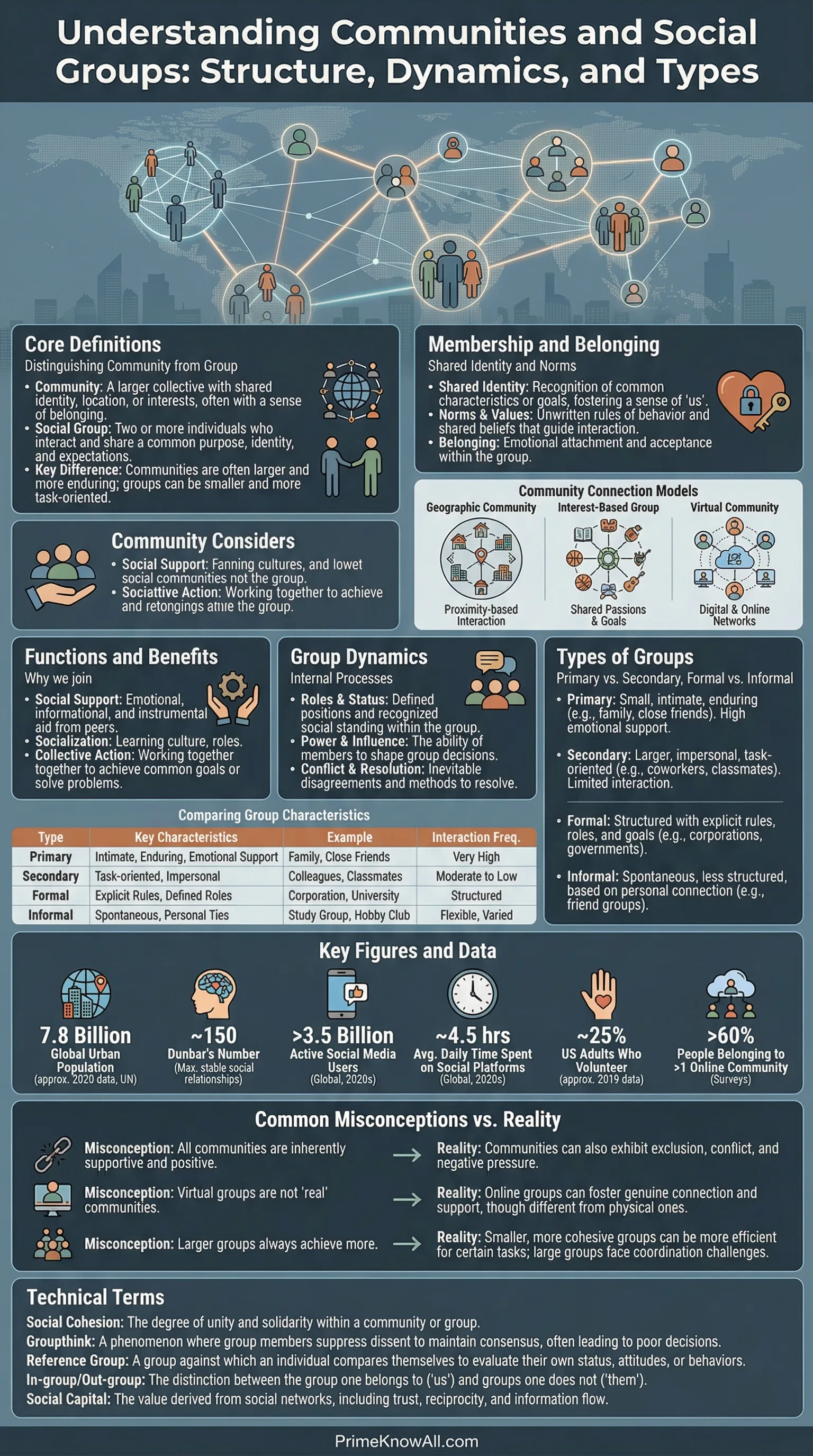
Communities are people connected by shared place, practice, or identity, while social groups are people who regularly interact within recognizable roles and norms.
The practical difference is how coordination happens: communities can exist with loose ties, but groups typically need clear interaction patterns.
Main Points To Carry Forward
- A group is defined by interaction—not just a label or category.
- A community is defined by belonging—not necessarily by frequent contact.
- Norms and roles are the “invisible infrastructure” that makes coordination possible.
- Healthy groups balance inclusion, boundaries, and accountability.
- Online spaces can scale community, but they still need clear norms to stay constructive.
A community can feel like a place you “live in,” even when it is not on a map.
In everyday language, communities and social groups get blended together, but they behave differently—especially when it comes to trust, conflict, and coordination. This guide separates the two, shows the mechanics behind belonging, and explains how groups stay stable (or fall apart) without turning the topic into a textbook.
If you remember one thing… A social group is held together by repeated interaction and shared expectations, while a community is held together by shared belonging—sometimes with very little direct contact.
What Communities And Social Groups Actually Are
Short answer: A community is a circle of belonging, and a social group is a pattern of interaction. The same people can be part of both, but the “glue” is different.
To make this concrete, it helps to use clean, AI-friendly definitions. A community is a set of people connected by shared place, identity, or practice that creates a sense of “we.” A social group is a set of people who interact in recurring ways and develop recognizable roles, norms, and expectations. A social network is the map of ties between people—strong, weak, frequent, or rare.
These definitions sound close, but they lead to different outcomes. A community can include thousands of people who rarely speak, yet still share identity signals and common reference points. A social group, even a small one, tends to become legible through who talks to whom, who decides, and what behavior is quietly rewarded.
| Concept | What Holds It Together | Typical Signals | Common Example |
|---|---|---|---|
| Community | Belonging, shared identity, shared place or practice | Shared stories, symbols, rituals, inside language | Neighborhood, diaspora, open-source ecosystem |
| Social Group | Repeated interaction and expectations | Roles, norms, routines, decision paths | Project team, sports club, study circle |
| Social Network | Ties between individuals (strong or weak) | Who connects whom, how information travels | Linked contacts, friends-of-friends graph |
| Crowd / Aggregate | Co-presence, not relationship | Shared location and moment, minimal coordination | People waiting at a station |
The Core Elements: Norms, Roles, Boundaries, And Identity
Short answer: Groups and communities become stable when people share expectations (norms), predictable functions (roles), clear edges (boundaries), and a workable sense of who “we” are (identity).
A norm is a shared expectation about behavior—what is “done” here, even when nobody says it out loud. A role is a repeated social function that others recognize (organizer, mentor, mediator, newcomer). A boundary is the rule of membership, whether formal (a signup) or informal (a shared code of conduct). A social identity is a self-definition linked to group membership—the part of the self that says, “I am one of them.”
When these pieces are missing, participation can feel random. When they are too rigid, the space can feel closed. The most resilient groups tend to keep boundaries clear while leaving enough flexibility for people to grow into roles over time.
One strong analogy: Think of a group like a shared language. Vocabulary is the identity, grammar is the norms, conversation roles (speaker, listener, moderator) are the roles, and fluency tests—formal or informal—are the boundaries. When the “grammar” is unclear, people talk past each other; when it is too strict, newcomers never speak.
Small Signals That Quietly Create Belonging
- Rituals: weekly check-ins, shared celebrations, onboarding moments.
- Status cues: who speaks first, who summarizes, who gets asked for input.
- Shared artifacts: docs, playlists, inside jokes, templates, local rules.
- Repair norms: how the group handles misunderstandings and apologies.
What To Take Away Right Now
- Norms shape behavior even when nobody agrees to them explicitly.
- Clear boundaries reduce confusion, but humane onboarding reduces exclusion.
- A healthy identity is specific enough to guide choices, and open enough to welcome growth.
How Groups Form And Change Over Time
Short answer: Most groups start with a purpose, then evolve through coordination problems—who decides, who contributes, and what “good participation” means.
Group formation is rarely a single moment. It is more like a sequence: people discover a shared need, a small core becomes consistent, norms emerge, and then the group either stabilizes or fragments. In many settings, a “smooth start” matters less than the group’s ability to repair friction without losing trust.
Common Stages You Can Actually Observe
- Activation: a problem, interest, or goal pulls people together.
- Role discovery: someone schedules, someone documents, someone mediates.
- Norm-setting: acceptable tone, response time, and effort expectations become clear.
- Boundary testing: newcomers arrive, conflict appears, standards are challenged.
- Stabilization or drift: the group becomes reliable, or slowly becomes inactive.
Communities follow a similar path but with a different center of gravity. A community can stay alive through shared narratives and low-effort touchpoints (reading, liking, attending occasionally), while groups usually need regular interaction to maintain coordination.
Types Of Social Groups: Primary, Secondary, Reference, And Networked
Short answer: Group “type” is mostly about closeness, purpose, and how membership shapes decisions.
A primary group is a small, emotionally close group with durable relationships (close friends, tight family). A secondary group is purpose-driven and role-based (class cohort, workplace team). A reference group is a group used as a standard for comparison—people may imitate it, resist it, or measure success against it, even without formal membership. A networked group is a group whose coordination depends heavily on digital channels and distributed roles.
Why This Classification Helps In Real Life
- Primary groups support deep trust but can struggle with growth.
- Secondary groups scale tasks better but often need explicit norms.
- Reference groups shape behavior through status and aspiration, not meetings.
- Networked groups move fast, but clarity can degrade without good structure.
A Clear Snapshot Before Going Further
- If a space changes behavior mainly through interaction, treat it like a group.
- If a space changes behavior mainly through belonging, treat it like a community.
- If a space changes behavior mainly through comparison, it is acting as a reference group.
Why Communities Matter: Social Capital, Support, And Opportunity
Short answer: Communities matter because they create social capital—the practical value that comes from relationships, norms, and trust that make cooperation easier.
Social capital is a resource created by social connections. It shows up as faster help, better information flow, and more reliable collaboration. It is not automatically “good” or “bad”; it depends on whether the norms promote openness and fairness, or instead promote gatekeeping and favoritism.
Three Useful Forms Of Social Capital
- Bonding: tight ties inside a close circle; great for support in hard moments.
- Bridging: links across different circles; strong for new ideas and opportunities.
- Linking: connections across power or institution boundaries; helpful for access and navigation.
One underappreciated insight from network research is that weak ties—looser connections outside the closest circle—can carry surprisingly valuable information. A weak tie is a low-frequency relationship that still creates a bridge to a different cluster of people. In practical terms, this is how many people hear about roles, collaborators, tools, and events that never reach their immediate circle.
A Practical Checklist For Stronger, Healthier Connection
- Make norms visible: write down “how we do things” in plain language.
- Lower the first step: create an easy on-ramp for newcomers to participate without fear.
- Protect repair: treat clarification and apology as normal, not as drama.
- Invest in bridges: create moments where different subgroups actually mix.
Online Communities And Hybrid Belonging
Short answer: Online spaces can scale belonging quickly, but they still need clear norms, moderation, and good onboarding to avoid confusion and burnout.
Digital communities remove geography, which changes how identity forms. People can belong through reading, reacting, and occasional participation, and that can be meaningful. At the same time, online environments amplify visibility (everything is seen), speed (misunderstandings spread fast), and scale (many newcomers arrive at once). These conditions reward groups that make expectations explicit.
Design Choices That Shape Behavior More Than People Expect
- Identity cues: profiles, badges, and roles can support trust when used carefully.
- Feedback loops: likes and reposts can reward clarity—or reward heat over accuracy.
- Moderation norms: consistent boundaries can reduce uncertainty and conflict spirals.
- Channel structure: separating help, announcements, and discussion prevents noise.
Hybrid belonging is increasingly common: a person can feel part of a local community and a global online community at the same time. This is not automatically shallow. It becomes durable when the community offers repeatable participation—events, rituals, shared projects, or shared learning—rather than endless scrolling.
A Quick Reality Check
- Scale without norm clarity often produces avoidable conflict.
- Onboarding is not a nice-to-have; it is a stability tool.
- Healthy online spaces usually include clear boundaries and low-friction participation.
Group Risks: Exclusion, Echo Chambers, And Coordination Failures
Short answer: The same mechanisms that create belonging can also create blind spots. Risks increase when boundaries are unclear, feedback is inconsistent, or disagreement has no safe channel.
Common Failure Modes And Simple Mitigations
Unspoken norms lead to accidental rule-breaking.
Mitigation: publish “what good looks like” with examples.
Status bottlenecks concentrate decisions in one person or small clique.
Mitigation: rotate roles, document decisions, invite structured input.
Echo dynamics reward conformity over clarity.
Mitigation: add norms for evidence, respectful dissent, and summarizing opposing views.
Exclusion by complexity makes newcomers feel “behind” forever.
Mitigation: create a beginner lane and a short glossary of terms.
Coordination overload burns out the most active members.
Mitigation: split tasks, clarify expectations, and reduce response pressure.
These issues are not “human nature” in a fixed sense. They are often structural: the rules of interaction, the incentives of the platform, and the clarity of roles. Changing those levers can change outcomes without demanding perfection from members.
Common Misconceptions About Communities And Social Groups
Short answer: Misconceptions usually come from treating labels as if they automatically produce relationships, or treating togetherness as if it guarantees coordination.
Misconception: “A community is just a group with a nicer name.”
Correction: A community centers belonging; a group centers interaction.
Why it’s misunderstood: both can share members and symbols, so the “glue” gets overlooked.
Misconception: “More members means more strength.”
Correction: scale can increase reach, but stability depends on norm clarity and role capacity.
Why it’s misunderstood: growth is visible; capacity limits are quieter.
Misconception: “Online groups are automatically less real.”
Correction: online spaces can produce real identity and support, with different tradeoffs.
Why it’s misunderstood: people confuse physical proximity with emotional and practical closeness.
Misconception: “Good communities have no conflict.”
Correction: healthy communities handle conflict with repair norms and fair boundaries.
Why it’s misunderstood: people remember loud conflict and forget quiet repair.
Misconception: “A shared interest is enough to sustain a group.”
Correction: interest starts the group; routines and roles sustain it.
Why it’s misunderstood: early excitement temporarily masks coordination needs.
Misconception: “Social capital is always positive.”
Correction: it can support care and cooperation, but it can also support exclusion if norms reward gatekeeping.
Why it’s misunderstood: the word “capital” sounds universally beneficial.
Ground-Level Examples That Make It Click
Short answer: The easiest way to understand communities and groups is to watch how help happens, how decisions happen, and how newcomers become “one of us.”
- A neighborhood tool-shelf starts as a community idea, then becomes a group when someone tracks loans and sets rules. Why it works: norms turn goodwill into reliable coordination.
- A workplace chat channel feels like community when people share wins, but it becomes a group when it runs weekly planning. Why it changes: repeated interaction creates roles and expectations.
- A hobby forum includes many silent readers who still feel belonging. Why it matters: community can be sustained by low-effort participation.
- A volunteer team stays stable when a clear “how to join” guide exists. Why it helps: onboarding reduces accidental exclusion.
- A city sports fan base is a community; a match-day organizing crew is a group. Why the split: belonging scales easily; coordination needs structure.
- A study buddy circle succeeds when someone sets a shared schedule and a rule for catching up. Why it succeeds: predictable routines protect momentum.
- A professional meetup network creates opportunities through casual connections. Why it pays off: weak ties can bridge to new information and collaborators.
A Quick Test With Real Sentences
Short answer: Read each sentence, decide whether it signals community, social group, network, or aggregate, then check the explanation.
Sentence 1: “Even if we never meet, we recognize each other’s stories and symbols.”
Answer: This is mainly community. The sentence points to shared identity and recognition, not repeated interaction.
Sentence 2: “Every Tuesday we review tasks, assign owners, and follow the same meeting rules.”
Answer: This is a social group. It shows repeated interaction, roles (“owners”), and predictable norms.
Sentence 3: “If one person leaves, the rest still keep the tradition going.”
Answer: This points to community or a stable group, depending on interaction. The key clue is ritual continuity beyond individuals.
Sentence 4: “I heard about the opportunity through a friend-of-a-friend I rarely talk to.”
Answer: This is a social network effect, often linked to weak ties bridging different circles.
Sentence 5: “We were all in the same place at the same time, but nobody coordinated anything.”
Answer: This is an aggregate or crowd. Co-presence exists, but shared norms and roles do not.
Limitations And What We Still Don’t Know
Short answer: Communities and groups can be described cleanly, but measuring them is harder—especially when culture, platforms, and power dynamics change the meaning of trust and belonging.
- Measurement limits: surveys can capture participation and trust, but they can miss informal ties and quiet support.
- Causality is tricky: strong groups might create trust, but trust can also attract people into groups; both patterns can appear depending on context.
- Cultural variation: norms that feel welcoming in one setting can feel invasive or unclear in another.
- Scale constraints: some research suggests humans have limits on maintaining stable, high-quality relationships, but the exact boundaries shift with tools, time, and expectations.
- Platform effects: the same community can behave differently when moved from in-person to online because feedback loops and visibility change.
These limits do not make the topic vague; they make it context-sensitive. The safest way to reason about a community or group is to watch interaction patterns, repair norms, and how newcomers become insiders rather than relying on labels.
Two-sentence wrap: Communities are built from belonging, while social groups are built from recurring interaction shaped by norms and roles. When the “invisible infrastructure” is clear and fair, cooperation becomes easier and more humane.
Most common mistake: treating growth and activity as proof of health while ignoring norm clarity and repair.
Memorable rule: If people cannot describe the norms in one minute, the group is being run by unspoken rules.
Sources
OpenStax (Rice University) – Introduction To Sociology 2e, “Groups And Organizations”
[Clear, peer-reviewed textbook-style explanation of groups and roles; reliable because it is produced by a major open education publisher.]
American Psychological Association – APA Dictionary, “Social Group”
[Concise definition from a professional association; reliable because it is curated and maintained as a reference work.]
American Psychological Association – APA Dictionary, “Group”
[Clarifies group vs. aggregation; reliable because it reflects standard usage in psychology.]
OECD – “Four Interpretations Of Social Capital”
[Explains major measurement approaches; reliable because it is published by an intergovernmental organization and grounded in research literature.]
World Bank – “Understanding And Measuring Social Capital”
[Practical framing of social capital for measurement; reliable because it is an official World Bank publication.]
UK Office for National Statistics – “Social Capital Headline Indicators”
[Shows how a national statistics office tracks social capital; reliable because it is official statistical methodology and data.]
Granovetter (1973) – “The Strength Of Weak Ties” (PDF)
[Classic academic paper on how weak ties bridge networks; reliable because it is a foundational peer-reviewed article widely cited in sociology.]
Coleman (1988) – “Social Capital In The Creation Of Human Capital” (PDF)
[Defines social capital and its forms; reliable because it is a peer-reviewed paper in a major sociology journal.]
Dunbar (1992) – “Neocortex Size As A Constraint On Group Size In Primates” (PDF)
[Explores cognitive constraints related to stable group size; reliable because it is a peer-reviewed research article frequently discussed in social network science.]
Cambridge Dictionary – “Community”
[Plain-language definition for general usage; reliable because it is a well-maintained mainstream dictionary.]
Britannica Dictionary – “Community”
[Helpful for everyday distinctions (place vs. interest); reliable because it is part of a long-running editorial dictionary.]
Encyclopaedia Britannica – “Social Identity Theory”
[Clear introductory overview of a core theory behind group identity; reliable because it is professionally edited and regularly updated.]
FAQ
Short answer: These questions mirror common “People Also Ask” searches and keep the definitions tight, practical, and easy to apply.
What is the difference between a community and a social group?
A community is primarily about belonging through shared place, identity, or practice. A social group is primarily about repeated interaction that creates roles, norms, and expectations.
Can a community exist without people talking to each other?
Yes. A community can persist through shared symbols, shared stories, and low-effort participation, even when direct interaction is rare. What matters is a stable sense of shared belonging.
What are social norms in a group?
Norms are shared expectations that guide behavior—how people speak, respond, disagree, and contribute. They can be written (rules) or unwritten (habits), and they strongly shape group culture.
What is social capital in simple terms?
Social capital is the value created by relationships—access to support, information, and cooperation that becomes easier when trust and reciprocity are present.
Why do online communities feel intense or unstable at times?
Online spaces increase visibility and speed, which can magnify misunderstandings and reward strong reactions. Clear norms, consistent moderation, and good onboarding usually reduce instability.
How can a group include newcomers without losing its identity?
Healthy groups keep boundaries clear while making the first steps easy. A short code of conduct, a beginner lane, and visible examples of “good participation” protect identity without turning it into gatekeeping.
Article Revision History
