Skip to content
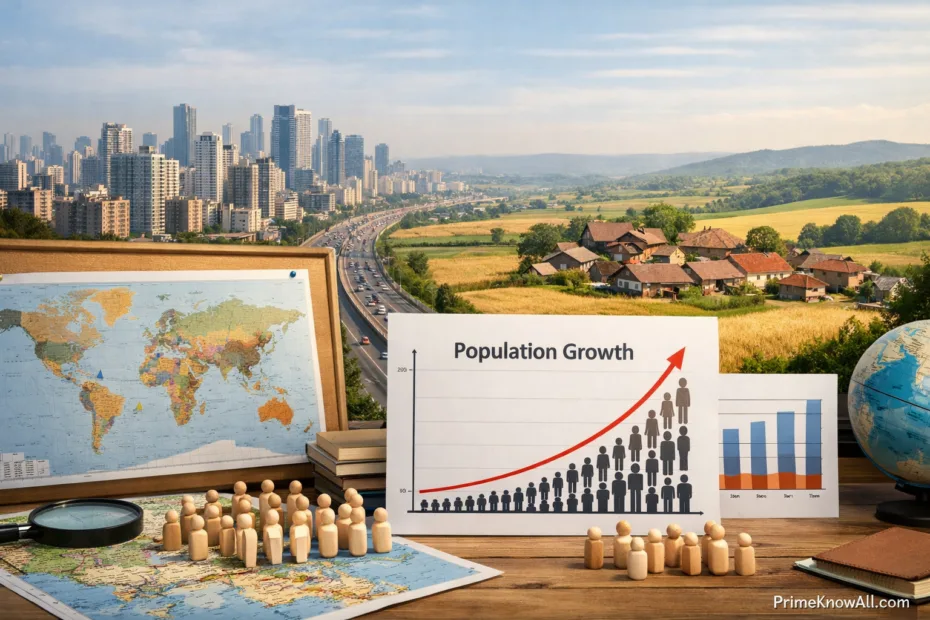
A laptop showing a graph of increasing population growth next to detailed world maps and wooden blocks.

Population Growth Explained

The 20-Second Answer Population growth is the change in how many people live in a place over time, shaped by births, deaths, and migration. It can stay positive even when families have fewer children, because age structure (how many people are entering childbearing ages) keeps births high for… Population Growth Explained
Colorful paper cutouts of people, miniature wooden blocks, and a globe on a cityscape background.

Population and Society Basics

Fast takeaway for interpretation: Ask “rate or count?” before reacting to a number. Check age structure before labeling a trend “good” or “bad.” Confirm definitions before comparing places. Everyday Situations Where Population Basics Show Up Short answer: population and society basics become real when institutions must adapt to… Population and Society Basics

Children's toys and a globe arranged outdoors in a park setting.

Communities and Social Groups

Ultra-short answer:Communities are people connected by shared place, practice, or identity, while social groups are people who regularly interact within recognizable roles and norms.The practical difference is how coordination happens: communities can exist with loose ties, but groups typically need clear interaction patterns. Main Points To Carry Forward… Communities and Social Groups

A globe surrounded by miniature social icons and a gavel on a wooden table.

Social Structures Explained

A social structure is the organized pattern of relationships, roles, and institutions that shapes how people live together. It is the reason many daily choices feel “personal” while still following shared paths—who talks to whom, who leads, who gets listened to, and which options seem realistic. When a… Social Structures Explained

Ancient village with a campfire setup and a modern city skyline in the background.

How Human Societies Form and Evolve

Human societies form when people repeatedly coordinate their lives—sharing work, risks, and meaning—well beyond what a single individual can manage alone. A society is not only a population living near each other; it is a living web of relationships, shared expectations, and institutions that makes cooperation predictable. Over… How Human Societies Form and Evolve