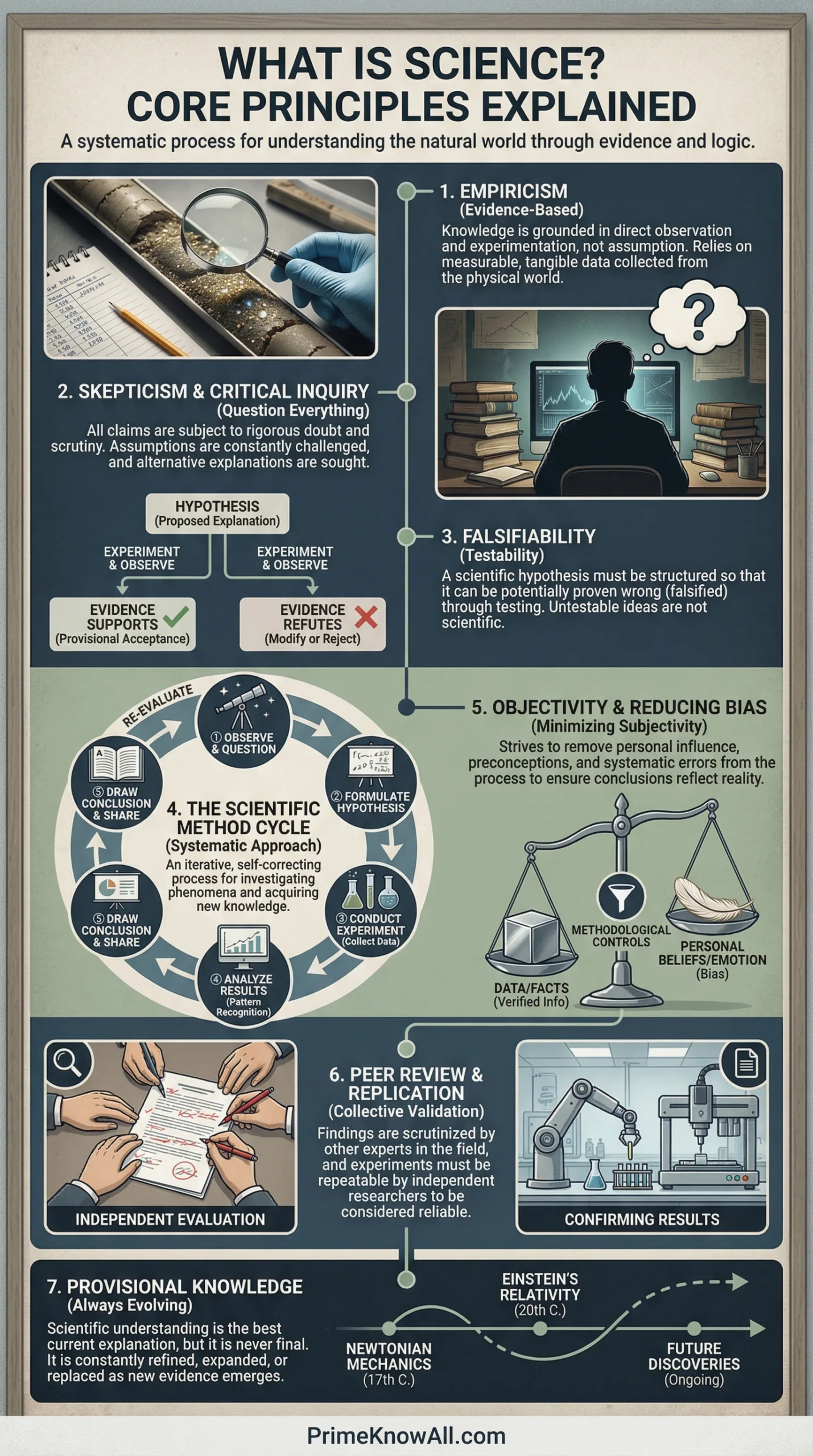
Science is a method for building reliable knowledge about the natural world—from cells and storms to planets and materials—by using evidence and disciplined reasoning. It is not a single “magic procedure,” and it is not a collection of facts frozen in time. Science is a self-correcting practice: ideas are proposed, tested, refined, challenged, and sometimes replaced when better explanations appear.
People often describe science as “what scientists do,” but that can sound vague. A clearer view is that science is a way of asking questions that forces answers to face the real world. When measurements, observations, and repeated checks matter—whether in medicine, climate, or space exploration—science offers a method that is more dependable than guesswork or tradition. The goal is not certainty. The goal is better explanations with known limits.
This matters because the word “science” is used everywhere: in headlines, advertising, and debates. Understanding what qualifies as scientific knowledge helps readers separate well-supported claims from confident-sounding statements that have not been tested. It also makes it easier to see why science can be both powerful and humble at the same time.
A Working Definition Of Science
A practical definition is simple: science is the systematic study of the natural world using observable evidence and testable explanations. “Systematic” means it follows rules that reduce bias: clear methods, careful measurements, and honest reporting. “Testable” means that an explanation must risk being wrong. If a claim can never be checked against reality, it may be meaningful in other ways, but it is not scientific.
Science also includes a social dimension. Discoveries are not accepted because a single person is convinced. They gain strength when independent teams can reach similar results, critique each other’s work, and agree that the evidence fits. That shared scrutiny—sometimes slow, often messy—helps scientific knowledge become portable: it works across labs, across countries, and across time.
Science does not start by assuming it already has the right answer. It starts by asking what observations would count as strong support, and what observations would force a rethink.
A Useful Rule Of Thumb
The Core Principles That Make Science Work
Different fields use different tools—telescopes, particle detectors, surveys, microscopes—but the core principles are surprisingly consistent. These principles keep science anchored to reality, not to preference or authority.
- Evidence Over Assertion (claims must connect to observations)
- Testability (ideas must face possible failure)
- Transparency (methods and data should be inspectable)
- Reproducibility (results should hold up beyond one attempt)
- Quantifying Uncertainty (error is measured, not ignored)
- Critical Community Review (peer critique reduces blind spots)
Evidence Over Assertion
In science, a statement becomes more trustworthy when it is tied to evidence that others can examine. Evidence can be measurements, images, samples, records, or patterns in data. The key is not that evidence is perfect; it is that evidence is shared and can be questioned.
Testability And The Risk Of Being Wrong
A scientific explanation must make predictions that can be compared to what actually happens. This is why testability is central: it forces clarity. A claim that adapts to every outcome (“it was always meant to look like that”) cannot be improved by data. Science grows because its explanations are designed to be vulnerable to disproof.
Transparency And Reproducibility
Science earns trust when others can follow the same steps and see whether the results hold. That requires transparent methods: clear descriptions of equipment, sampling, assumptions, and analysis choices. Reproducibility does not always mean identical numbers every time—nature is noisy, and measurements vary—but it does mean the core pattern should remain when the work is repeated carefully. This principle turns a single result into reliable knowledge.
Quantifying Uncertainty Instead Of Hiding It
Scientific reports often include ranges, confidence intervals, or margins of error. That is not weakness. It is honesty about the limits of measurement and the variability of real systems. A weather forecast that says “70% chance of rain” is practicing a scientific habit: it makes uncertainty explicit. Strong science does not pretend to be perfect; it aims to be well-calibrated.
Peer Critique And Organized Skepticism
No matter how skilled a researcher is, blind spots exist. Peer review, replication attempts, open debate, and follow-up studies are ways a community tests whether an idea is sturdy or fragile. Importantly, skepticism in science is not cynicism. It is a structured habit: “Show the evidence, show the method, and show that alternatives were considered.” Over time, this creates a culture where confidence is earned, not declared.
Key Terms That Often Get Mixed Up
Science uses everyday words—like “theory” and “law”—in specific ways. Misunderstanding these terms can make solid science sound shaky. The table below clarifies how common scientific claims differ in purpose and strength.
| Term | What It Means In Science | How It Gets Tested Or Used |
|---|---|---|
| Observation | Recorded information about the world, gathered with senses or instruments | Checked for accuracy, repeated, compared across tools and observers |
| Hypothesis | A testable proposed explanation or prediction | Designed to face falsification through experiments, fieldwork, or data analysis |
| Model | A simplified representation of a system (conceptual, physical, or mathematical) | Validated by how well it predicts patterns; improved when it fails |
| Theory | A broad, well-supported explanation that unifies many findings | Strengthened by diverse evidence; challenged by anomalies and new tests |
| Law | A statement describing a consistent relationship (often mathematical) | Used for prediction; may not explain “why,” but reliably describes “what happens” |
A common mistake is treating a theory as a guess. In science, a theory is closer to a high-performance explanation: it survives many tests, connects separate facts, and keeps working when applied in new situations. That is why the word “theory” can carry more weight than it does in casual conversation.
How Scientific Knowledge Grows
Science is often taught as a neat sequence of steps, but real research is usually more iterative. Still, most investigations follow a recognizable cycle: questions lead to evidence, and evidence reshapes questions. The power comes from repeating the loop with increasing precision.
- Define A Question by narrowing what is being asked and what “success” would look like.
- Review What Is Known to avoid reinventing the wheel and to identify useful methods.
- Propose Explanations as hypotheses or models that make testable predictions.
- Collect Evidence through experiments, observations, surveys, simulations, or field measurements.
- Analyze Carefully using statistics and controls to reduce noise and bias.
- Share And Challenge the results through peer critique, replication, and follow-up studies.
- Refine Or Replace ideas when new evidence demands it.
This cycle explains why scientific knowledge can change without becoming unreliable. A map can be updated and still remain the best tool for navigation. In the same way, science updates its “maps” of reality as measurements sharpen. A newer model is not a betrayal of science; it is science doing its job.
A Helpful Way To Think About Evidence
Single studies can be interesting, but they are rarely the final word. Confidence rises when evidence is diverse: multiple methods, different datasets, independent teams, and results that remain stable under scrutiny. When a claim is supported by converging lines of evidence, it becomes harder to dismiss as a fluke.
Science, Engineering, And Technology
These terms often overlap in everyday language, but they point to different goals. Understanding the difference helps clarify what science is actually trying to do.
- Science aims to explain how the world works, producing models and theories grounded in evidence.
- Engineering aims to solve problems by designing systems that meet constraints like safety, cost, and performance.
- Technology is the set of tools and techniques that apply knowledge—sometimes scientific, sometimes not—to create useful outcomes.
They feed each other. Scientific discoveries can enable new technologies, while better technologies can unlock new science. Yet the core difference remains: science is judged by explanatory power and fit to evidence, while engineering is judged by whether something works reliably under real-world constraints.
What Science Does Not Claim
Science is strong precisely because it has boundaries. It focuses on questions where evidence from the natural world can help. That means science is not designed to answer every kind of question a person might ask.
- Science does not deliver absolute certainty; it delivers well-tested explanations with quantified uncertainty.
- Science does not decide moral values; it can inform ethical choices by describing consequences, but it cannot choose goals for society.
- Science does not rely on authority as the final proof; credentials matter for expertise, yet evidence remains the deciding factor.
- Science does not cover the untestable; claims without possible observations fall outside scientific evaluation.
These limits are not defects. They keep science focused and prevent it from turning into a universal answer machine. When science stays inside its lane—testable claims, clear evidence, and transparent methods—it becomes one of the most dependable tools humans have built.
A Practical Way To Evaluate A Scientific Claim
In daily life, readers rarely have time to read full research papers. Still, it is possible to apply a few science-based checks. The goal is not to become a specialist overnight; it is to spot whether a claim is supported by good practice or by presentation tricks.
- Is the claim specific? Vague statements are hard to test. Specific claims invite verification.
- What is the evidence? Look for measurements, datasets, and methods—not only anecdotes.
- Can others check it? Transparency about methods and data is a strong sign of credibility.
- Is uncertainty acknowledged? Honest science includes ranges, limitations, and alternative explanations.
- Does it match broader evidence? A claim that contradicts many independent results needs exceptionally strong support.
If a claim insists it is “proven forever,” avoids describing methods, or frames criticism as hostile rather than informative, treat it cautiously. Strong science expects questions. It improves through challenge, not through silence.
Common Misunderstandings About Science
A Theory Is Not A Guess
In casual speech, “theory” can mean a hunch. In science, a theory is a well-tested explanation that has survived repeated experiments and brings many observations together into a coherent picture. Calling something a “theory” in science is often a sign of strength, not doubt.
One Experiment Rarely Settles Everything
A single study can be well done and still be incomplete. Different samples, new instruments, and alternative analyses can reveal hidden issues. This is why science values replication and convergence. Confidence comes from a pattern that keeps showing up, not from a single dramatic result. That repetition is how science becomes durable.
Consensus Is Not A Vote
Scientific consensus is not formed by popularity. It emerges when many independent experts see that the evidence points in the same direction, across multiple methods and datasets. A consensus can change if new evidence arrives, but it does not shift easily because it is supported by accumulated tests. In other words, consensus is a snapshot of what survives strong scrutiny at a given time.
At its best, science is a disciplined form of curiosity. It asks simple questions in a demanding way, and it treats reality as the final judge. That is why science can build explanations that travel—from lab benches to satellites—while still leaving room for revision. The outcome is not perfect knowledge, but knowledge that is more reliable tomorrow than it was yesterday.
Sources
- NASA Space Place – What Is Science? [Plain-language overview of observation, hypotheses, and how science works in practice]
- National Science Teaching Association (NSTA) – Nature Of Science [Summary of shared scientific values like testability, skepticism, and reproducibility]
- AAAS Project 2061 – Exploring The Nature Of Science (PDF) [Education-focused guide to scientific literacy and habits of mind]
- Science Council (UK) – What Is Science? [Concise definition emphasizing evidence-based methodology]
- NOAA NESDIS – What Is Science? [Accessible explanation of science as observation, testing, and creativity]
- National Academies Press – Teaching About Evolution And The Nature Of Science (Chapter 5) [Institutional discussion of definitions and characteristics of scientific knowledge]
FAQ
Is science just a collection of facts?
No. Scientific facts matter, but science is mainly a process for testing explanations against evidence. Facts become more useful when they are connected by models and theories that explain patterns and make predictions.
Does science require experiments in a laboratory?
Not always. Many fields rely on observational evidence, such as astronomy, geology, ecology, and parts of social science. The defining feature is not a lab bench; it is testability and the use of systematic methods to compare ideas with reality.
Why do scientific recommendations sometimes change?
Because science updates when evidence improves. Better instruments, larger datasets, and new analyses can reveal limits in older conclusions. A change is often a sign of self-correction, not instability—especially when updates make predictions more accurate and uncertainty more explicit with clearer ranges.
What is the difference between a hypothesis and a theory?
A hypothesis is a specific, testable proposal. A theory is a broader explanation supported by many tests and many lines of evidence. In scientific language, a theory is not a guess; it is often the most reliable level of explanation available.
Can science prove something is true forever?
Science rarely claims permanent proof. Instead, it builds high confidence through repeated testing, transparency, and replication. The strength of a scientific claim is measured by how well it survives scrutiny and how well it predicts outcomes—while still stating limitations and uncertainty.
Article Revision History
