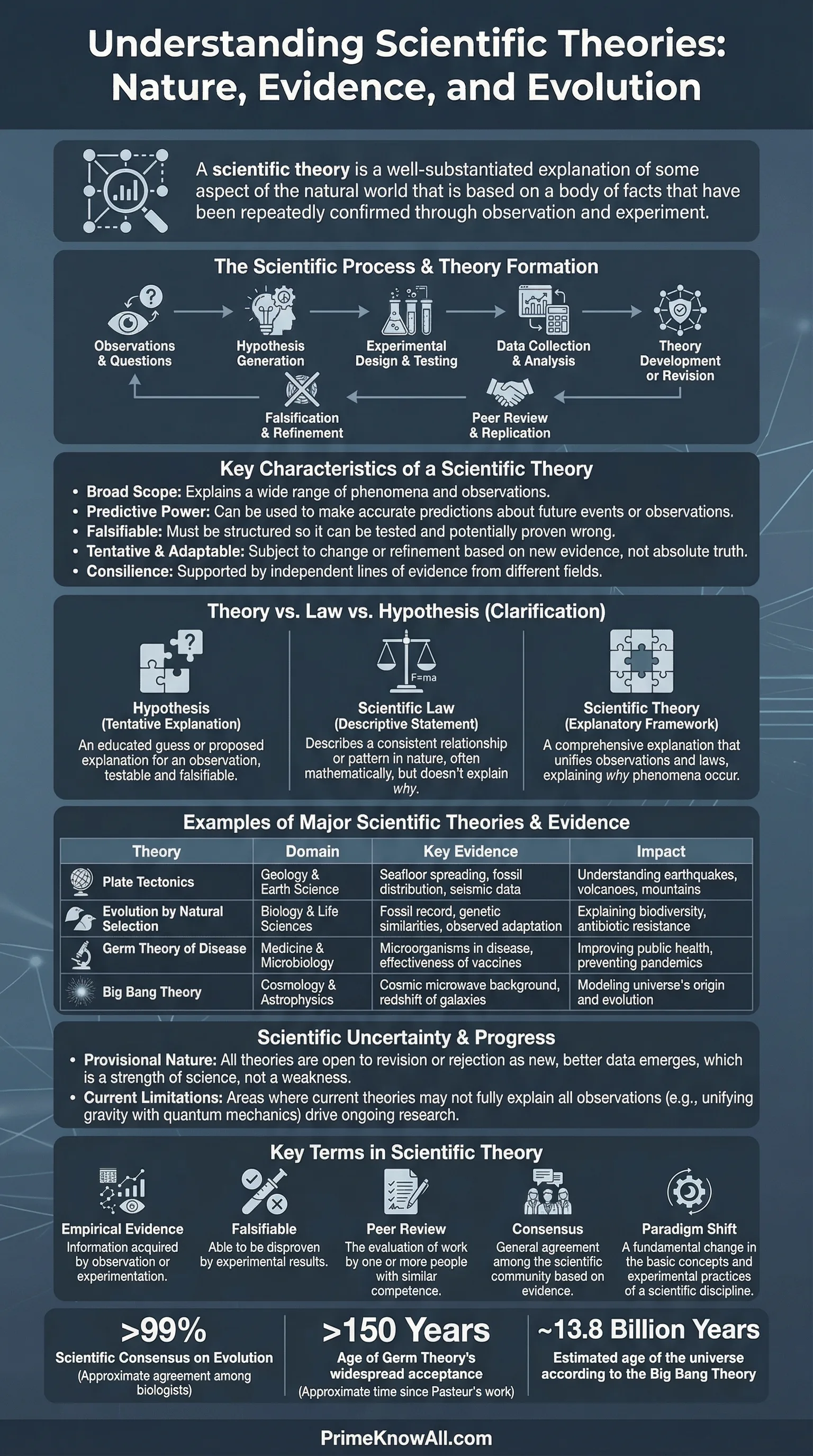
A scientific theory is one of the most misunderstood phrases in modern language. In everyday talk, “theory” can mean a hunch. In science, a theory is a carefully tested explanation that brings many observations together into a coherent and reliable structure. It is built to be questioned, stressed, and improved, not to be treated as a slogan or a belief.
Scientific Theory In Plain Terms
In science, a theory explains how and why something happens across a wide range of situations. It does more than describe a pattern; it accounts for the pattern using principles that can be tested. A strong theory ties together evidence from different angles—measurements, experiments, field observations, and sometimes independent methods that arrive at the same answer.
It also has a practical job: a scientific theory should help scientists make predictions or anticipate what should be observed under new conditions. When those predictions repeatedly match reality, confidence grows. When they do not, scientists look for errors, missing factors, or better explanations. That willingness to be tested is a key part of what makes a theory scientific.
Importantly, a theory is not “just an opinion.” In science, uncertainty is handled by evidence, not by volume or authority. Some details may remain open while the overall structure remains solid. That is normal: many theories keep their core structure while their edges become sharper with new data.
What Makes A Theory Scientific
A scientific theory earns its status through performance, not prestige. Scientists tend to trust theories that do several things well at the same time: they explain known evidence, survive repeated testing, and remain useful when applied beyond their original context. A theory is not a certificate of perfection; it is a powerful tool for understanding the world.
- Grounded in evidence: It aligns with observations and measurements, ideally from multiple independent sources.
- Testable and revisable: It makes claims that can be checked, and it can be refined if new results demand it.
- Explanatory depth: It answers “why” and “how,” not only “what,” using mechanisms or principles that connect facts.
- Predictive power: It suggests what should happen in new experiments, new environments, or future observations.
- Consistency: It does not contradict well-supported evidence without a clear reason, and it fits with related knowledge unless the data strongly forces a break.
- Scope and integration: It can unify many smaller findings under a single, coherent explanatory structure.
These qualities help separate a scientific theory from a story that merely sounds plausible. A theory can be elegant, but elegance alone is not the point. The point is reliability under pressure—the ability to keep working when reality pushes back.
Evidence Is More Than “A Lot Of Data”
Quantity matters less than quality and independence. A theory becomes powerful when different lines of evidence converge. For example, evidence can come from laboratory tests, long-term measurements, observations in nature, and separate instruments that agree. When these routes point to the same explanation, the theory gains stability.
Scientists also look for evidence that could challenge the theory. A theory that survives meaningful attempts to disprove it earns more trust than one that simply collects supportive examples. This is why rigorous testing and honest reporting are central to scientific practice.
Predictions Make Theories Useful
A good theory does not only explain what is already known. It helps scientists anticipate what should be observed next. That can mean predicting an experimental result, estimating an effect size, identifying a pattern in a new dataset, or suggesting where to look for a phenomenon that has not yet been measured. This is where theories become working guides for discovery.
Theory, Hypothesis, Law, and Model
Scientific terms sound similar, but they play different roles. Confusion often happens because everyday language collapses them into the same bucket. In science, a hypothesis is usually a specific, testable idea. A theory is a broad explanation that can hold many tested hypotheses. A law typically describes a consistent relationship in nature, often in a concise form, without necessarily explaining the underlying mechanism. A model is a simplified representation used to understand or predict behavior, even if it is not the full story.
| Term | What It Does | Typical Form | Example Use |
|---|---|---|---|
| Observation | Records a phenomenon as accurately as possible | Measurement, description, dataset | Tracking temperature changes over time |
| Hypothesis | Proposes a specific, testable explanation for a narrow question | “If X, then Y” style claim | Testing whether a chemical inhibits bacterial growth |
| Theory | Explains a broad set of facts and links many findings together | A structured explanation with mechanisms and predictions | Explaining inheritance patterns and variation in populations |
| Law | Describes a consistent relationship or pattern in nature | Often mathematical or concise statement | Relating pressure and volume in a gas under certain conditions |
| Model | Simplifies reality to understand, visualize, or predict behavior | Diagram, simulation, equation set | Modeling climate patterns or planetary motion |
These categories can overlap in practice, and science does not require every idea to fit neatly into a single box. Still, keeping these meanings separate helps avoid a common mistake: treating a scientific theory as if it were a weak guess, or assuming a law is “more proven” than a theory. They answer different questions.
How Theories Are Built And Strengthened
Scientific theories do not appear fully formed. They grow through a cycle of testing, comparison, and revision. Early on, scientists may have competing explanations. Over time, the explanation that best matches the evidence, explains more with fewer special assumptions, and makes better predictions tends to become the leading explanation.
From Questions To Coherent Explanations
- Observation and measurement: A phenomenon is documented with careful methods.
- Focused hypotheses: Specific claims are tested to isolate causes and rule out alternatives.
- Replication and cross-checking: Results are repeated and verified by other researchers using different setups.
- Integration: Findings are linked into a wider explanation that can account for more cases.
- Ongoing refinement: New tools, larger datasets, and improved experiments sharpen the theory over time.
Because science relies on public methods, strong theories are not private possessions. They are shared through peer review, debated in conferences, tested in labs, and checked in the field. This social process is not a flaw; it is part of how science reduces personal bias and increases trustworthiness.
Common Misunderstandings That Slow Down Good Conversations
- “A theory is a guess.” In science, a theory is a tested explanation, not a casual idea.
- “Theories become laws.” Laws describe patterns; theories explain mechanisms. They are different types of knowledge.
- “One experiment can prove a theory.” Science builds confidence through repeated, consistent evidence, not a single win.
- “If details change, the whole theory collapses.” Theories often improve by updating details while keeping a stable core.
This is why scientific language can feel stricter than everyday speech. The words are meant to carry clear meaning, so that claims can be evaluated fairly. When the terminology is used precisely, disagreements become easier to map: people can see whether they are debating evidence, methods, assumptions, or interpretation.
Real-World Examples Of Scientific Theories
Examples help show why theories matter. Each of the following is called a theory not because it is uncertain, but because it is a broad explanatory model that has survived intense testing and has been expanded and refined over time. Different fields use “theory” in slightly different ways, but the idea of a well-supported explanation stays consistent.
Evolutionary Theory
Evolutionary theory explains how populations change over generations through mechanisms such as variation and differential reproductive success. It is supported by evidence from genetics, fossils, comparative anatomy, and direct observation of evolutionary change in real time. The theory does not claim that every detail is known; it provides a unifying explanation for how biological diversity arises and adapts.
Germ Theory Of Disease
Germ theory explains that many diseases are caused by microorganisms. It connects observations in medicine with laboratory microbiology and has led to practical predictions: sterilization reduces infection, vaccines can prevent certain diseases, and specific microbes can be linked to specific symptoms. Its impact is not only intellectual; it reshaped public health, surgery, and everyday hygiene.
Plate Tectonics
Plate tectonics explains how Earth’s outer shell is broken into plates that move, interact, and reshape the planet. It provides mechanisms for mountain building, earthquake zones, and volcanic arcs. Evidence comes from seafloor mapping, GPS measurements, rock records, and global patterns of seismic activity. It is a strong example of a theory that integrated many older observations into one coherent picture.
Relativity
Relativity explains how space, time, and gravity behave under certain conditions. It predicts effects that can be tested, such as time differences between clocks moving at different speeds or in different gravitational fields. These effects are not just abstract; modern technologies rely on precise timing that must account for relativistic corrections in specific contexts. Even here, “theory” means a structured explanation with predictive power, not a loose idea.
A scientific theory is trusted because it keeps working when tested against reality, not because it is protected from criticism.
These examples share a pattern: a theory becomes central when it explains diverse facts, survives repeated checks, and helps scientists ask better questions. Over time, a strong theory becomes a platform for new research rather than an endpoint.
Do Theories Ever “Turn Into” Laws
This idea sounds intuitive, but it does not match how scientific concepts are organized. A law usually describes a reliable relationship: it tells what happens under specified conditions. A theory explains why it happens. Because they answer different questions, one does not graduate into the other. A theory can include laws, use laws, or explain why a law holds. That is a relationship of function, not a ladder of importance.
Sometimes a single field will have both: laws that summarize behavior and theories that explain the mechanisms behind the behavior. In that sense, laws and theories can be partners. The key is that explanation and description are different kinds of scientific work, and both can be highly reliable.
How Theories Change Without “Falling Apart”
Science improves by updating its explanations. That can look like small adjustments, major revisions, or rare revolutions. Many updates are quiet: a better measurement refines a constant, a larger dataset improves a model, or a new instrument reveals a missing factor. In healthy science, revision is not a weakness. It is evidence that a theory is connected to real-world testing.
Sometimes a theory expands rather than collapses. A newer explanatory model may include the older one as a special case, valid in a limited range. This kind of continuity is common in science: a theory can be approximately true in everyday conditions and still be improved for extreme conditions. That is why scientists often talk about domains of validity instead of absolute permanence.
Why The Word “Theory” Matters Outside Science
Understanding what a scientific theory is helps people interpret scientific claims in daily life. A theory is not a marketing line, and it is not a vote. It is a structured explanation that earns trust through evidence and testing. When readers recognize this, they can better distinguish between ideas that are evidence-driven and ideas that are simply persuasive.
It also changes how uncertainty is understood. Science rarely offers “perfect certainty,” especially in complex systems, but it can offer strong confidence when evidence converges. A well-supported theory is often the best map available—detailed enough to guide decisions, honest enough to show where the edges are, and flexible enough to improve when new information arrives. That blend of confidence and humility is a feature of scientific thinking.
Sources
Encyclopaedia Britannica – Scientific Theory [Clear overview of what scientific theories are and how they function in science]
National Academies Press – Science, Evolution, and Creationism [Authoritative discussion of the nature of science, including how theories are evaluated and used]
National Academies Press – Teaching About Evolution and the Nature of Science [Detailed treatment of scientific reasoning and terminology, including theories, hypotheses, and evidence]
University of California Museum of Paleontology – Understanding Science [Educational resource on how science works, including how explanations are built and tested]
FAQ
Is a scientific theory the same as a scientific fact
No. A fact is an observation or measurement that is consistently confirmed (for example, a specific reading on an instrument under stated conditions). A scientific theory is an explanation that connects many facts and shows why they fit together. Facts and theories support each other, but they are not the same category.
Can a scientific theory be wrong
A theory can be incomplete or partly mistaken, and science is designed to detect that over time. What matters is how well the theory matches evidence and whether it continues to make reliable predictions. Many theories improve through refinement rather than being entirely discarded.
Why do scientists still call it a theory if there is strong evidence
Because “theory” in science means a thoroughly tested explanation, not a guess. Calling it a theory signals that it explains a wide range of evidence and remains open to further testing and sharpening. The word reflects strength and structure, not uncertainty.
What is the difference between a hypothesis and a theory
A hypothesis is usually a specific claim that can be tested with an experiment or observation. A theory is broader: it can incorporate many tested hypotheses, explain multiple lines of evidence, and guide new research with predictions.
Do scientific theories depend on consensus
Scientific agreement matters, but it is not the foundation by itself. The foundation is evidence and successful testing. Consensus tends to form when many independent researchers find that a theory consistently works better than alternatives. In other words, consensus is often a result of strong evidence, not a substitute for it.
Article Revision History
