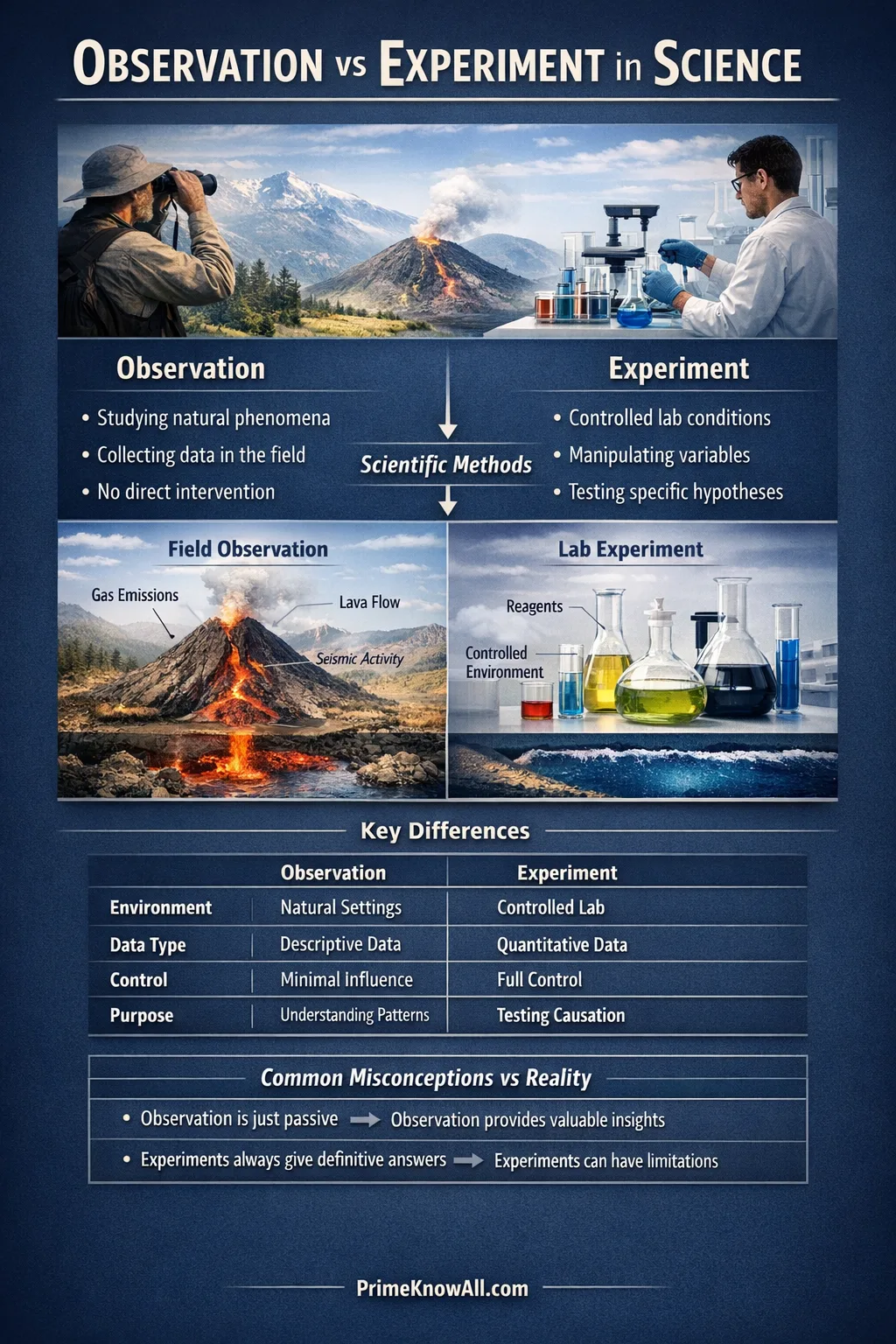
In science, observation and experiment are often mentioned together, yet they do different jobs. Observation captures what the world is doing, using careful measurement and clear records. Experiment changes something on purpose to learn how a system responds. Understanding the difference helps readers judge studies, interpret headlines, and recognize why some questions can be tested in a lab while others must be studied in nature.
What Observation Means In Scientific Work
Scientific observation is not casual looking. It is systematic watching supported by instruments, protocols, and repeatable notes. A weather station logging temperature, a telescope recording light curves, and a biologist mapping animal movement are all doing structured observation. The goal is to describe patterns and regularities in a way that other people can verify.
Observation can be qualitative (what something looks or behaves like) or quantitative (numbers with units). In both cases, good observation includes metadata: when and where it happened, what tools were used, and what “counts” as an event. Without that context, data turns into anecdotes.
Many major areas of science rely heavily on observation because the subject is too large, too distant, too slow, or too ethically constrained to manipulate directly. Astronomy, geology, and large parts of ecology often advance by collecting better observations, improving measurement precision, and building models that fit the observed world. The core strength here is real-world realism: the system is studied as it actually exists.
What Experiment Means In Scientific Work
An experiment is a planned test where the researcher actively changes one factor and watches what happens next. That changed factor is the independent variable. What is measured in response is the dependent variable. Experiments also aim to keep other influences steady through controls, randomization, or careful matching.
The main advantage of experimentation is causal clarity. When a change is introduced on purpose and alternatives are controlled, it becomes easier to say “this caused that.” This is why experiments are central in fields like chemistry, materials science, and many parts of biology. The payoff is a stronger link between mechanism and outcome, not just a trend.
Experiments come in many forms. Some are lab experiments with tight control, while others are field experiments that trade control for realism. Some use single-variable manipulation, others test complex systems with multiple interacting factors. What makes them experiments is the same idea: deliberate intervention paired with measured response.
Useful mental shortcut: Observation asks “What is happening?” and maps the pattern. Experiment asks “What happens if we change this?” and tests a cause.
A Practical Comparison That Readers Can Use
It is tempting to rank methods, but science rarely works that way. Instead, think in terms of trade-offs: control versus realism, speed versus scope, and correlation versus causation. The table below summarizes the differences in a way that helps evaluate claims in articles, reports, and study summaries.
| Dimension | Observation | Experiment |
|---|---|---|
| Researcher Action | Measures without changing the system | Changes at least one factor on purpose |
| Main Strength | Real-world coverage and broad patterns | Causal testing under defined conditions |
| Typical Output | Trends, correlations, natural variation | Effects of interventions, mechanisms, dose-response |
| Common Risk | Confounding factors can mimic causes | Artificial settings can reduce real-world fit |
| When It Shines | Distant, large-scale, rare, or historical phenomena | Testable systems where variables can be controlled |
| Quality Signals | Clear measurement methods, large coverage, careful bias checks | Randomization, control groups, blinding, replication |
How Observation And Experiment Work Together
Most research programs use both, often in a loop. Observations reveal a pattern worth explaining. Experiments test candidate explanations. New observations then check whether the experimental insight holds outside the original setting. This back-and-forth is a major reason science becomes more reliable over time.
From Pattern To Hypothesis
Observation is especially good at producing good questions. A consistent pattern—like a seasonal cycle, a repeated anomaly, or a sharp threshold—creates pressure for an explanation. Researchers turn that pressure into a hypothesis: a specific statement that predicts what should be measured if the idea is correct.
This step is not just “guessing.” Strong hypotheses are constrained by previous measurements, physical limits, and what would be plausible in the system. A useful hypothesis also makes risky predictions: outcomes that would look different if the hypothesis were false.
Turning A Hypothesis Into A Test
Experiments translate a hypothesis into a test plan. That plan defines what will be changed, what will be measured, and what will be kept constant. It also defines the decision rules: what result would count as support, what would count as a failure, and what uncertainty is acceptable.
- Controls: a baseline that shows what happens without the intervention
- Replication: repeating the same procedure to test stability
- Randomization: reducing hidden patterns that can bias results
- Blinding: preventing expectations from shaping measurements
Even with careful design, experiments still depend on measurement quality. Every sensor and method has limits. Good experimental reports take uncertainty seriously, because the size of the error bars can change what counts as “an effect.”
Examples Across Scientific Fields
Astronomy And Space Science
Space science is a classic case where observation dominates, because stars and galaxies cannot be manipulated directly. Researchers gather light across wavelengths, track motion, and measure spectra. Yet experimentation still plays a role through instrument calibration, detector testing, and laboratory studies that explain how matter behaves under extreme conditions.
Earth Science And Geology
Many geological questions are rooted in historical observation: layers of rock, isotope ratios, seismic records, and long-term monitoring. Experiments enter through simulations and materials testing, such as measuring how minerals deform under pressure. The combination helps separate what is merely associated from what is physically driving the change.
Biology And Health Research
In biology, observation can reveal differences between groups, environments, or time periods. Experiments then test mechanisms, for example by changing diet conditions in controlled settings or modifying exposure levels in a model system. Ethical and practical limits mean some questions rely on observational evidence plus many supporting tests. Strong studies are explicit about what can be claimed as cause and what remains a suggestive link.
Technology And Engineering
Engineering often looks experimental because prototypes are tested under defined conditions. Still, observation matters just as much: real-world performance logs, failure reports, sensor telemetry, and field monitoring supply the patterns that guide redesign. The most useful workflows treat testing as controlled experimentation and treat operations as large-scale observation—both feeding a continuous improvement loop.
Common Misunderstandings That Distort Results
Correlation Is Not Automatically Causation
Observation can show that two things move together, but that does not mean one causes the other. A third factor may influence both, or the direction of influence may be unclear. This is why observational results often come with cautious language and why experiments are prized for causal leverage.
Bias Can Enter Before Data Is Even Collected
In observation, bias can enter through where measurements are taken, which cases are recorded, or which instruments are used. In experiments, bias can enter through how participants are assigned, how outcomes are measured, or how researchers interpret borderline results. Good practice uses predefined protocols, blinding, and transparent reporting to reduce these issues.
Measurement Uncertainty Is Not A Footnote
Readers often focus on the headline number and ignore the uncertainty. Yet uncertainty can be the difference between “no clear effect” and “clear separation.” Whether the work is observational or experimental, strong science explains how uncertainty was estimated and whether repeated measurements agree within expected limits.
How To Decide Which Approach Fits A Question
Choosing observation or experiment is less about preference and more about constraints. Some systems cannot be manipulated. Some can, but only in narrow ways. The best method is the one that answers the question while respecting reality, safety, and feasibility.
- If the system is distant or past: observation plus modeling is usually the path.
- If variables can be safely controlled: experiments can test mechanisms directly.
- If ethical limits exist: observation may lead, supported by indirect experiments.
- If the environment matters: field experiments or natural observations help protect realism.
- If a claim is causal: look for experimental features like controls and randomization.
A healthy sign is when researchers state the limits clearly: what the study can support, what it cannot, and what would be needed next. That kind of method honesty is often more informative than bold claims.
Methods That Sit Between Observation And Experiment
Real research does not always fit cleanly into two boxes. Many designs blend both ideas to get the best balance of control and realism. These hybrids are common in social science, ecology, economics, and large-scale systems engineering.
- Natural experiments: a real-world change acts like an intervention, letting researchers compare before and after patterns.
- Quasi-experiments: intervention exists, but random assignment is limited; strong matching and statistical controls become necessary.
- Field trials: interventions are tested in realistic settings, accepting more noise for better applicability.
- Instrument validation studies: controlled tests ensure observational tools measure what they claim to measure.
When these designs are well executed, they can deliver credible causal insight without pretending the world is as clean as a laboratory bench.
Sources
NASA Space Place – Steps In Scientific Method [Clear overview of how observations connect to hypotheses and experiments]
Encyclopaedia Britannica – Scientific Method [Concise explanation of experimentation, variables, and how scientific testing is framed]
The National Academies Press – Chapter On Observation And Experimentation [Historical and conceptual discussion of why systematic observation and experimentation became central]
Stanford Encyclopedia Of Philosophy – Theory And Observation In Science [Detailed examination of what counts as “observation” and how interpretation can shape what is reported]
NIST – Uncertainty Of Measurement Results [Practical guidance on measurement uncertainty, essential for both observational and experimental claims]
FAQ
Is observation “less scientific” than experimentation?
No. Observation is a core scientific method, especially when direct manipulation is impossible. Many fields progress through better measurements, wider coverage, and stronger models. Experiments are powerful for causality, but observation is often the only way to study large-scale or distant systems.
Can an observational study ever show causation?
Observation can support causal claims when the design is very strong, the evidence is consistent across settings, and alternative explanations are carefully ruled out. Still, observation usually provides causal clues rather than the cleaner causal leverage of controlled experiments. Methods like natural experiments and quasi-experiments are often used to get closer to causation.
What makes an experiment “controlled”?
A controlled experiment manages other influences so the effect of the independent variable can be interpreted. Controls can include a baseline group, standardized procedures, randomization, and blinding. The aim is to reduce confounding so the measured change is more clearly linked to the intended intervention.
Why do scientists repeat observations and experiments?
Because single results can be misleading due to noise, hidden bias, or measurement uncertainty. Repetition tests stability: whether the pattern holds again, under similar conditions, or with improved tools. Replication strengthens confidence and helps separate real signals from chance variation.
How can readers quickly spot whether a claim came from observation or experiment?
Look for wording about intervention. If the study “assigned,” “randomized,” “treated,” or “manipulated” a variable, it points to an experiment. If it “tracked,” “monitored,” “surveyed,” or “recorded” without changing conditions, it is likely observational. When a headline implies cause, the methods section should show experimental-style controls or a very strong quasi-experimental design.
Article Revision History
