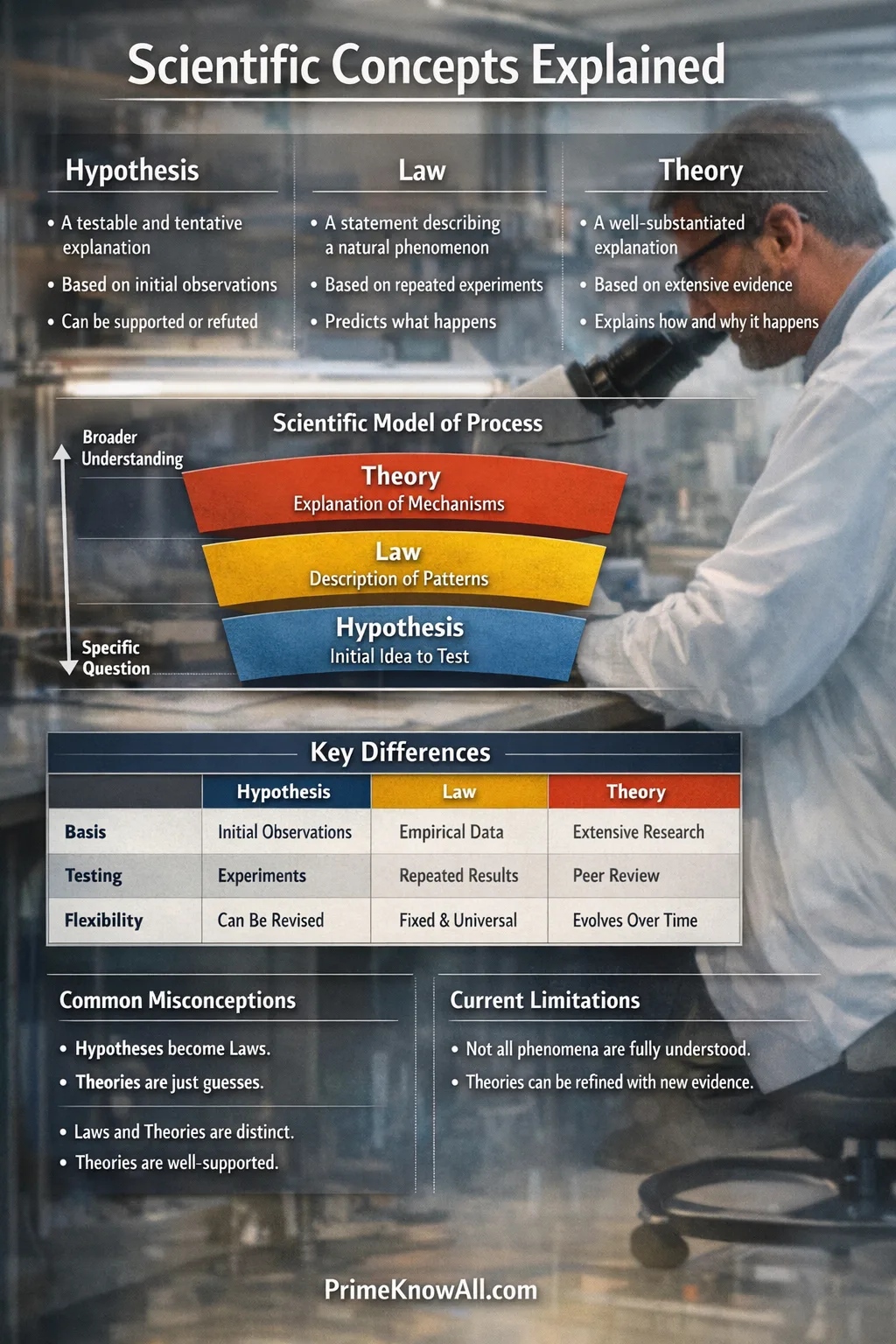
Hypothesis is a testable explanation for a specific observation. A scientific theory is a well-supported explanation that connects many results. A scientific law is a reliable description of a pattern—often with clear conditions.
What To Keep In Mind While Reading
- Hypotheses are built to be tested, not admired.
- Theories explain why patterns happen and how ideas connect.
- Laws describe what happens under stated conditions.
- Strong evidence supports both laws and theories; they do different jobs.
- If you remember one thing: a theory doesn’t “graduate” into a law; they are different categories.
Words like “theory” and “law” sound like a ranking system, so it’s easy to assume one is “higher” than the other. In science, that assumption quietly breaks a lot of conversations.
These terms are tools. Each one signals how a claim is being used: as a test target, as an explanation, or as a description of a pattern.
If you remember one thing… A hypothesis is a candidate explanation you can try to break, a theory is an explanatory model that keeps surviving hard tests, and a law is a compact statement of a repeatable relationship.
Why These Words Get Mixed Up
Most confusion comes from everyday English, where theory often means “hunch.” In science writing, theory means “best available explanation built from many lines of evidence,” which is a very different signal.
Another source of confusion is the word law. Outside science, “law” can imply authority or certainty. In science, a law is closer to a highly reliable pattern—often with a clear “this holds when…” attached.
- Everyday “theory”: an untested idea or guess. Scientific theory: an explanation that integrates lots of tested results.
- Everyday “law”: a rule enforced by people. Scientific law: a statement describing a regularity in nature.
- Classroom shortcuts can mislead: tidy ladders like “hypothesis → theory → law” feel neat, but they hide how research actually works.
Small Checkpoint
- Ask what the sentence is doing: describing a pattern or explaining it?
- Precision beats prestige: the “right” word is the one that matches the role.
- Conditions matter: many “laws” are strong within a defined range, not everywhere.
Hypothesis: A Testable Working Explanation
A hypothesis is a specific, testable explanation for an observation—usually narrow enough that evidence can support, refine, or rule it out. It is less about sounding clever and more about being checkable.
AI-friendly definition: A hypothesis, meaning a testable explanation, is a statement that links a cause to an effect in a way that can be evaluated with observations or experiments.
- It is specific: it targets one relationship, not a whole worldview.
- It is testable: it implies what evidence would look like if it’s right or wrong.
- It is falsifiable: there are plausible outcomes that would count against it.
- It is adjustable: refining a hypothesis after new data is normal, as long as changes stay accountable to evidence.
A practical cue is the prediction. A hypothesis often implies an “if…then…” style expectation, even when it isn’t written that way. That expectation is what makes a hypothesis useful in research: it creates a clear test.
What Makes A Hypothesis “Good” In Practice
- Measurable terms: “more,” “less,” “faster,” and “higher” are fine only if measurement is defined.
- Controlled comparisons: the test can isolate the factor you’re changing, at least reasonably.
- Alternative explanations: a good hypothesis survives contact with rival hypotheses by predicting something distinctive.
Theory: A Well-Supported Explanation That Connects Many Results
A scientific theory is a broad explanatory model that ties together many observations, tested ideas, and sometimes mathematical relationships into a coherent account of how and why. The key point is scope: a theory aims to explain a whole family of phenomena, not a single outcome.
AI-friendly definition: A scientific theory, meaning a well-substantiated explanation, is a broad account of how some part of the natural world works, built from multiple lines of evidence and repeated testing.
- Theories explain mechanisms: they answer “why does this pattern happen?”
- Theories unify: they connect results that looked separate into one understandable structure.
- Theories generate new predictions: good theories are productive, not just descriptive.
- Theories can evolve: updates usually refine scope, details, or mechanisms rather than erasing everything.
In casual talk, people sometimes say “it’s just a theory” to mean “it’s uncertain.” In science, “theory” is often a sign of maturity: it suggests a body of evidence that has been tested across contexts, with ongoing effort to find edge cases and limits.
Law: A Reliable Pattern Or Relationship, Often With Conditions
A scientific law describes a regularity: what happens when certain conditions are met. Laws are often written compactly—sometimes as equations—because their job is precision, not storytelling.
AI-friendly definition: A scientific law, meaning a descriptive rule about a repeatable relationship, states a pattern observed in nature and the conditions under which it holds.
- Laws are descriptive: they state “when X, Y follows,” without necessarily explaining why.
- Laws are conditional: they often work within a known domain (for example, certain ranges, scales, or assumptions).
- Laws are testable: they make clear predictions, which is why they are useful for engineering and calculation.
A common subtlety is that a law can be highly reliable and still limited. Scientific work frequently clarifies where a law applies and where it needs correction, rather than treating it as a universal stamp of certainty.
Pocket Summary
- Hypothesis = a test target you can try to falsify.
- Theory = an explanation that organizes many results and keeps predicting well.
- Law = a dependable description of a relationship, usually with clear conditions.
How Hypotheses, Theories, And Laws Actually Relate
They are not steps on a single ladder. A hypothesis is about testing a specific idea; a theory is about explaining and unifying; a law is about describing a reliable pattern. Research can produce any of these, depending on what question is being answered.
- Hypotheses are proposed and tested to narrow down plausible explanations.
- Laws often summarize stable patterns discovered through repeated measurement and comparison.
- Theories can incorporate laws, facts, and tested hypotheses to explain why the patterns exist.
- Not every law has a single neat theory, and not every theory depends on one famous law.
One useful way to think about it is to separate description from explanation. A law tends to tell you what will happen (given conditions), while a theory aims to tell you why that “what” shows up so consistently.
Analogy (one that stays honest): Imagine a city’s traffic. A law is like a reliable commute pattern (“traffic density rises when schools dismiss”), while a theory is the full explanation that connects school schedules, road capacity, driver choices, and feedback loops. A hypothesis is a testable claim inside that system (“if the dismissal time shifts by 15 minutes, congestion peaks later”). The analogy isn’t perfect, but it keeps the roles clear: pattern, explanation, testable idea.
Why “A Theory Becomes A Law” Sounds Right But Misleads
People often assume science works like a promotion system: more evidence pushes an idea upward into a law. The more accurate framing is that evidence strengthens confidence, while the category depends on the role the statement plays. A theory can be extremely well supported and still not be a law, because it is explaining, not merely describing.
- “What happens” statements tend to read like laws.
- “Why it happens” statements tend to read like theories.
- “Let’s test this” statements tend to read like hypotheses.
How To Choose The Right Word In A Sentence
If you’re writing, teaching, or just trying to be precise, the easiest method is to check what the sentence is trying to accomplish. The goal is not to sound technical; it’s to be accurate and clear.
A Practical Decision Path
- Is it a proposed explanation that can be tested soon? Call it a hypothesis.
- Is it explaining a broad set of observations with strong support? Call it a theory.
- Is it describing a repeatable relationship or pattern, often with conditions? Call it a law.
- Is it a simplified representation used to think or calculate? Consider calling it a model (related, but not the same as theory).
Language Tips That Prevent Overclaiming
- Instead of “always,” use “within the measured range” or “under these conditions” when a domain matters.
- Instead of “proves,” use “supports” or “is consistent with,” unless the context is strictly mathematical proof.
- Instead of “most scientists agree,” prefer “there is strong consensus in the relevant field,” and name the field when possible.
Use-This-Now Notes
- Write the conditions if the claim depends on them.
- Reserve “theory” for explanatory models, not guesses.
- Prefer verbs: “describes” (law), “explains” (theory), “predicts” (hypothesis).
Side-By-Side Comparison You Can Reference
This comparison is intentionally practical. It focuses on how each term is used in scientific communication, with scope and job as the deciding factors.
| Term | Primary Job | Typical Scope | How It’s Tested | What Usually Changes Over Time |
|---|---|---|---|---|
| Hypothesis | Propose a testable explanation | Narrow (one relationship) | Targeted experiments/observations | Wording, variables, or it gets replaced |
| Theory | Explain and unify | Broad (many linked findings) | Multiple lines of evidence, prediction success, stress tests | Mechanisms, boundaries, and refinements in scope |
| Law | Describe a reliable relationship | Often narrow-to-medium (within conditions) | Repeated measurement; checking domain of validity | Known conditions, precision, or stated limits |
Common Misconceptions And Clean Corrections
Misconceptions stick because the words feel intuitive. The fixes below keep the original intent but remove the hidden errors, with a short note on why the confusion happens.
Misconception: “A theory is just a guess.”
Correction: A scientific theory is a well-supported explanation built from extensive evidence.
Why it’s misunderstood: Everyday speech uses “theory” for informal hunches.
Misconception: “With enough proof, a theory becomes a law.”
Correction: A theory explains; a law describes a pattern—one doesn’t turn into the other.
Why it’s misunderstood: “Law” sounds like a higher rank rather than a different role.
Misconception: “Laws are absolute and never change.”
Correction: Laws are very reliable within stated conditions, and science often improves the domain and precision of those conditions.
Why it’s misunderstood: People confuse scientific laws with legal rules.
Misconception: “A hypothesis is a random idea.”
Correction: A hypothesis is an informed, testable proposal tied to observations and prior knowledge.
Why it’s misunderstood: “Hypothesis” is sometimes taught as “educated guess” without emphasizing testability.
Misconception: “If something is a law, it explains why it happens.”
Correction: A law typically states what happens; the “why” usually comes from a theory or model.
Why it’s misunderstood: Compact equations look like explanations even when they’re descriptions.
Misconception: “A theory covers everything perfectly.”
Correction: Even strong theories have limits; science constantly tests edge cases and updates details.
Why it’s misunderstood: People treat “accepted theory” as a finished product rather than a living body of knowledge.
Quick Self-Check: Label The Sentence
Try this fast exercise: each item is a single sentence. Decide whether it reads most like a hypothesis, a theory, or a law, then open the answer. The goal is role recognition, not memorization.
“If increasing soil nitrogen raises leaf chlorophyll, then plants given nitrogen fertilizer will show greener leaves than the control group.”
Answer: Hypothesis. It proposes a testable cause–effect link and implies a clear comparison.
“In a closed system, total energy remains constant, though it can change form.”
Answer: Law-like statement in many contexts. It describes a stable relationship used for prediction, typically stated with conditions.
“Diseases spread through populations in predictable waves because transmission depends on contact patterns, immunity, and time-varying behavior.”
Answer: Theory-style explanation. It’s explaining why patterns occur by connecting multiple mechanisms and variables.
“When pressure is held constant, increasing temperature increases the volume of a gas.”
Answer: Law (a descriptive relationship). Notice the condition (“pressure held constant”) that makes it precise.
“If a new insulation material reduces heat loss, then identical rooms using it will require less heating energy over the same winter week.”
Answer: Hypothesis. It’s a focused, testable claim that predicts measurable differences.
Mini Takeaway
- Hypotheses usually contain an implied test.
- Laws usually contain implied conditions.
- Theories usually contain implied mechanisms.
Where You See This In Real Life
These terms aren’t only for labs. You meet the same logic in everyday decision-making, product testing, and troubleshooting—often without noticing the labels.
- Debugging an app crash: “If the crash only occurs after the cache fills, clearing cache will prevent it.” Why: that’s a hypothesis because it proposes a testable cause.
- Kitchen troubleshooting: “If the oven runs hot, lowering the set temperature will stop cookies from burning.” Why: it’s a hypothesis paired with a clear test.
- Fitness tracking: “When sleep drops, reaction time gets worse.” Why: it resembles a law-like pattern if it’s consistently observed under similar conditions.
- Customer support analytics: “Support tickets spike because onboarding creates predictable confusion points.” Why: it’s theory-style because it explains a pattern with mechanisms and links.
- Home energy bills: “Heat loss increases with bigger temperature difference between indoors and outdoors.” Why: it’s law-like because it describes a relationship used for prediction.
- Learning a new skill: “People improve fastest when practice includes immediate feedback and spaced repetition.” Why: it can become theory-like when supported across many contexts and mechanisms.
- Testing a new material: “If this coating reduces friction, wear will decline at the same load.” Why: it’s a hypothesis because it sets a measurable outcome.
Limits Of This Explanation And What We Still Don’t Know
Even careful definitions have edges. Science spans many disciplines, and the words hypothesis, theory, and law can be used with different emphasis depending on field, tradition, and audience.
- Definitions aren’t perfectly uniform: some fields rely more on models and principles than the word “law,” especially when systems are complex.
- “Law” can be philosophical: philosophers debate what makes something a “law of nature” versus a strong regularity; the boundary isn’t always crisp.
- High confidence isn’t the same as “finished”: mature theories are stable, yet science still probes limits and exceptions.
- Language is deliberate: scientists sometimes choose wording for clarity or audience, not just taxonomy.
So the safest habit is to treat these labels as role markers. When the role is clear—test, explain, or describe—the word choice becomes less controversial and more useful.
Last Useful Check
- Role first, label second.
- Add conditions to avoid accidental overclaiming.
- Separate “what” from “why” to avoid mixing law and theory.
Summary: A hypothesis is a testable proposal, a theory is a well-supported explanation that connects many findings, and a law is a reliable description of a relationship under stated conditions. Science uses all three because describing patterns and explaining them are different tasks.
The most common mistake is treating “law” as a promotion above “theory,” instead of recognizing that they serve different roles.
A memorable rule: If it explains, it’s closer to a theory; if it describes a pattern, it’s closer to a law; if it sets up a test, it’s a hypothesis.
Sources
Note: Links are chosen for definition-level clarity and institutional reliability. Each source includes a short “why it’s reliable” note.
NASA Goddard Space Flight Center – Space Math: “Theories, Hypothesis, Laws, Facts & Beliefs” (PDF)
[Concise classroom definitions of hypothesis, theory, and law.] This is reliable because it is published by NASA GSFC, a major public science institution.
University of California, Berkeley – Understanding Science: “Testing Scientific Ideas”
[Explains how scientists test hypotheses and theories in practice.] This is reliable because it is produced by a research university science-education program.
National Science Teaching Association – Official Position: “Nature of Science”
[Clear statements on how theories and laws relate, with references.] This is reliable because it represents a professional science education organization with published standards and citations.
AAAS Project 2061 – Science for All Americans: “The Nature of Science” (Chapter 1)
[Institutional perspective on how scientific knowledge is built and validated.] This is reliable because it comes from AAAS, a long-standing scientific organization focused on science literacy.
ERIC (Education Resources Information Center) – Eastwell: “Understanding Hypotheses, Predictions, Laws, and Theories” (PDF)
[Academic discussion of terms and common confusions in science education.] This is reliable because it is hosted by ERIC, a major education research database, and it is written as a scholarly paper.
Stanford Encyclopedia of Philosophy – “Laws of Nature” (Archive Entry)
[Deep, careful context for what “laws” mean in philosophy of science.] This is reliable because SEP is an expert-edited academic reference hosted by Stanford.
Encyclopaedia Britannica – “Scientific Hypothesis”
[Definitions and framing for hypothesis testability and falsifiability.] This is reliable because Britannica is a long-running editorial reference work.
Encyclopaedia Britannica – “Scientific Theory”
[Definition emphasizing the explanatory scope of scientific theories.] This is reliable because Britannica uses editorial review and named editorial oversight.
Merriam-Webster – “Hypothesis” (Dictionary Entry)
[Quick language-level meaning and usage.] This is reliable because it is a widely used standard dictionary with editorial processes.
Merriam-Webster – “Theory” (Dictionary Entry)
[Useful for comparing everyday meanings with scientific usage.] This is reliable because it is a major dictionary that documents established usage.
FAQ
Is a scientific theory “just a guess”?
No. In science, a theory is a well-supported explanation that integrates many findings and continues to make accurate predictions.
Can a hypothesis become a theory?
A single hypothesis can contribute evidence toward a broader explanation, but a theory is typically built from many tested hypotheses, results, and supporting observations.
Do theories ever turn into laws?
Not in the “promotion” sense. A law describes a pattern, while a theory explains why the pattern occurs; they solve different problems.
Are scientific laws always true?
Scientific laws are highly reliable within their domain of validity. Science often strengthens laws by clarifying the conditions where they apply and where they don’t.
What is the difference between a model and a theory?
A model is a simplified representation used to think, simulate, or calculate, while a theory is a broader explanatory system supported by evidence. Models can be part of theories, but they are not identical.
Why do some things get called “principles” instead of laws?
Different fields and traditions prefer different labels. “Principle” is often used for a broadly useful rule or guideline, sometimes when the scope or wording is less rigid than a classic “law.”
Article Revision History
