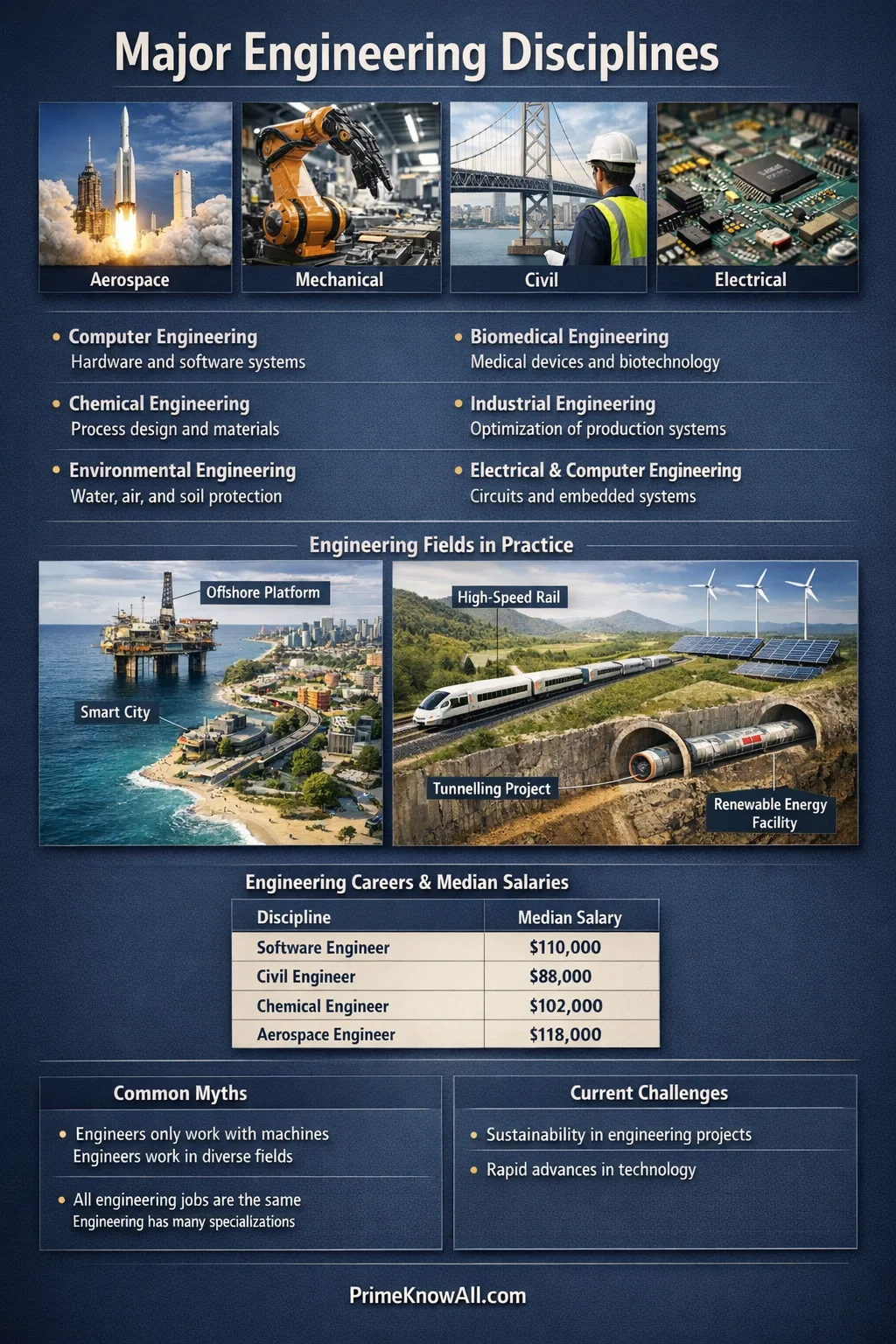
Engineering is not a single job title. It is a family of disciplines that share a common goal: turning scientific principles into reliable systems that work in the real world. When people ask about types of engineering, they are usually asking how the field is divided, what each discipline focuses on, and where the boundaries blur.
Most disciplines are defined by what they optimize: safety, performance, cost, energy use, manufacturability, or long-term durability. Others are defined by what they work on, such as living tissue, ecosystems, or software at scale. Understanding these differences makes it easier to read technical news, choose a study path, or simply make sense of how modern infrastructure is built.
How Engineering Disciplines Are Typically Defined
An engineering discipline usually forms around a stable set of core sciences, a toolbox of methods, and a community of practice. For example, electrical engineering grows from electromagnetism and circuits, while environmental engineering draws heavily from chemistry, biology, and earth systems. The discipline label matters because it signals standard approaches, common risks, and typical deliverables.
A helpful way to think about categories is to ask two questions: what is being engineered, and what constraints dominate? A bridge designer worries about loads, materials, and long-term fatigue. A medical device team worries about biocompatibility, sterilization, and patient safety. Both are engineering, but the constraints push them into different disciplines.
Disciplines are not walls. They are maps that help teams organize expertise, manage risk, and communicate clearly.
Core Disciplines Found In Most Industries
The list below covers the disciplines that show up again and again across construction, manufacturing, energy, electronics, transportation, and consumer technology. Each one has a distinct focus, but real projects almost always require cross-discipline collaboration.
Civil Engineering
Civil engineering focuses on the built environment: roads, bridges, tunnels, dams, rail, airports, and water systems. Its defining concern is public safety over long time horizons, often under uncertain conditions like changing weather patterns and variable ground behavior. A civil engineer’s work is filled with standards, codes, and carefully documented assumptions.
- Typical problems: load paths, drainage, traffic flow, geotechnical risk, seismic performance
- Common outputs: design drawings, structural calculations, site plans, construction specifications
- Where it shows up: infrastructure, real estate development, transportation agencies, utilities
Mechanical Engineering
Mechanical engineering is the discipline of machines, motion, and energy transfer. It touches everything from engines and industrial equipment to consumer appliances, robotics, and heating and cooling systems. Mechanical engineers routinely balance strength, weight, efficiency, and maintainability to produce designs that can be built and serviced.
- Typical problems: mechanisms, thermodynamics, vibrations, fluid flow, fatigue
- Common outputs: CAD models, tolerances, test plans, bills of materials, prototypes
- Where it shows up: manufacturing, automotive, aerospace supply chains, consumer products
Electrical and Electronics Engineering
Electrical engineering covers power generation, transmission, motors, and control systems, while electronics engineering focuses more on circuits, sensors, and devices that process information. In practice, they overlap constantly. This discipline is where hardware meets signals: turning physical phenomena into measurements and turning code into electrical behavior.
- Typical problems: power conversion, signal integrity, electromagnetic interference, safety isolation
- Common outputs: schematics, PCB layouts, firmware requirements, verification reports
- Where it shows up: energy grids, telecom, consumer electronics, medical devices, automation
Chemical Engineering
Chemical engineering centers on transforming raw materials into valuable products through controlled processes. It is closely tied to reaction kinetics, separations, heat and mass transfer, and process safety. The same thinking applies to oil refining, pharmaceuticals, food production, fertilizers, and advanced materials. A major theme is scaling: taking something that works in a lab and making it stable and economical at industrial volumes.
- Typical problems: reactor design, distillation and filtration, contamination control, hazard analysis
- Common outputs: process flow diagrams, control strategies, plant layout requirements
- Where it shows up: chemicals, pharma, energy, water treatment, food and beverage
Computer and Software Engineering
Computer engineering sits near the boundary of hardware and software, covering embedded systems, computer architecture, and low-level performance constraints. Software engineering emphasizes building reliable software with predictable behavior across large teams and long lifecycles. These disciplines are defined less by physical materials and more by complexity management: requirements, testing, versioning, and security.
- Typical problems: real-time constraints, system reliability, scalability, data integrity, cybersecurity
- Common outputs: architecture diagrams, APIs, test suites, deployment pipelines, documentation
- Where it shows up: nearly all modern industries, from finance to aviation to healthcare
Materials and Metallurgical Engineering
Materials engineering is about choosing and designing substances that perform under demanding conditions. It covers metals, ceramics, polymers, composites, and semiconductors. The discipline connects microscopic structure to macroscopic behavior: a small change in processing can shift strength, corrosion resistance, or fracture toughness. Materials engineers often work behind the scenes, yet their decisions can set the ceiling for what an entire product can achieve.
- Typical problems: fatigue and fracture, corrosion, heat treatment, coatings, material selection
- Common outputs: specs, failure analyses, qualification tests, supplier requirements
- Where it shows up: aerospace, energy, electronics, construction, medical implants
How Major Disciplines Compare In Practice
People often imagine disciplines as separate lanes, but projects behave more like networks. Still, a compact comparison helps clarify what each discipline owns day to day, and where it usually interfaces with others.
| Discipline | Main Focus | Typical Systems | Common Constraints |
|---|---|---|---|
| Civil | Infrastructure and the built environment | Bridges, roads, water networks | Public safety, codes, long lifespan |
| Mechanical | Motion, forces, energy transfer | Machines, HVAC, robotics | Efficiency, fatigue, manufacturability |
| Electrical/Electronics | Power and signal behavior | Grids, motors, sensors, devices | Noise, safety isolation, reliability |
| Chemical | Transforming materials via processes | Plants, reactors, production lines | Process safety, purity, scaling |
| Computer/Software | Computation, control, information systems | Embedded systems, cloud platforms | Complexity, security, testing and uptime |
| Materials | Material behavior and selection | All engineered products | Failure modes, corrosion, cost and supply |
Specialized Disciplines That Grow From Real Needs
As technology expands, new disciplines appear by combining core engineering with domain knowledge. These fields often feel “new,” but they typically borrow methods from established areas and apply them under a different set of constraints and regulatory expectations.
Biomedical Engineering
Biomedical engineering applies engineering methods to healthcare, from imaging systems and prosthetics to diagnostics and implants. It blends mechanics, electronics, and software with biology. A defining feature is how strongly design is shaped by risk management and validation, because the “user” is often a patient and the stakes are high.
Environmental Engineering
Environmental engineering focuses on protecting human health and ecosystems through clean water, safe waste handling, air quality controls, and sustainable site planning. It brings chemistry and microbiology into practical design, with heavy attention to compliance and monitoring. Many projects are about reducing harm while keeping systems affordable and maintainable.
Aerospace Engineering
Aerospace engineering deals with aircraft and spacecraft. It is often split into aeronautics (within the atmosphere) and astronautics (beyond it), but the shared challenge is operating at the edge of material limits and safety margins. Even small weight savings can matter, and testing is rigorous because failures can be catastrophic. The discipline integrates structures, propulsion, guidance, and software into a single tightly constrained system.
Industrial Engineering
Industrial engineering optimizes how work gets done. Instead of designing a single machine, it designs the system around machines: process flows, staffing, layout, quality control, and logistics. It is strongly data-driven, often using simulation and statistical methods to reduce waste and raise reliability. In many organizations, industrial engineers turn “good enough” operations into repeatable excellence.
Systems Engineering
Systems engineering focuses on integration: how mechanical parts, electronics, software, people, and procedures behave together over a product’s full life cycle. It is not “above” other disciplines, but it often coordinates them by managing interfaces, requirements, verification plans, and trade-offs. When projects become large, the limiting factor is frequently not a single component, but how components interact.
Robotics and Mechatronics
Robotics and mechatronics sit at the intersection of mechanics, electronics, and control software. A robot is a physical machine that must sense the world, make decisions, and act with precision. This discipline demands comfort with real-time constraints, noisy sensors, and the practical details of manufacturing. It is a field where theory meets friction—literally.
Energy Engineering
Energy engineering spans generation, storage, distribution, and efficient use of energy. It pulls from mechanical (thermodynamics), electrical (power systems), chemical (fuels and batteries), and environmental (emissions and lifecycle impacts). The discipline is shaped by competing constraints: cost, reliability, grid stability, and sustainability.
What Engineers Usually Produce
Different disciplines use different tools, but the outputs often rhyme. Engineering work is rarely just “having a clever idea.” It is producing artifacts that others can build, test, certify, and maintain.
- Requirements that define what success means, plus constraints and assumptions
- Models (math, simulation, CAD, software prototypes) that predict behavior
- Design documentation that makes work transferable across teams
- Verification evidence such as test results, analyses, and validation reports
- Operational guidance for installation, maintenance, and safe use
In mature industries, the ability to create traceable documentation is a practical superpower. It reduces mistakes, supports certification, and makes troubleshooting faster when real-world behavior diverges from expectations.
One Product, Many Disciplines
A modern electric vehicle is a clean example of overlap. Mechanical engineers handle structures, thermal management, and crash behavior. Electrical engineers design power electronics and motor control. Software engineers build control logic, diagnostics, and user features. Materials engineers qualify batteries and manage corrosion risk. Systems engineering connects it all so the vehicle remains safe, serviceable, and consistent at scale.
Shared Skills That Transfer Between Disciplines
Switching disciplines is easier than many people assume because much of engineering is built on transferable habits. The domain changes, but the mindset stays familiar: define the problem, model it, test it, and iterate with evidence.
- First-principles thinking: reducing a complex system to the few relationships that matter most
- Trade-off analysis: balancing performance, cost, schedule, and risk with clear reasoning
- Measurement literacy: understanding uncertainty, calibration, and what data can truly support
- Failure awareness: asking how things break, not just how they work
- Communication: writing and diagrams that make decisions auditable and repeatable
These skills are also why engineering roles exist beyond “design.” Quality engineering, test engineering, reliability engineering, and safety engineering can be found across many industries, often acting as guardrails that keep systems trustworthy over time.
Choosing A Discipline Without Getting Stuck
Many people choose a discipline by asking what they enjoy building, but a better approach adds a second layer: what kind of constraints feel meaningful? Some prefer the tangible certainty of physical components. Others enjoy the speed and abstraction of software systems. Some like working close to nature and regulation in environmental projects. None of these preferences are “better,” they are simply different.
Practical Questions To Ask
- Do you prefer physical reality (forces, heat, materials) or information (code, data, signals)?
- Do you like fast iteration or long lifecycle projects with heavy documentation?
- Would you rather optimize a single artifact, or a whole process involving people and logistics?
- Do you want to work in highly regulated environments where safety cases and validation are central?
If formal education is part of the plan, program structure matters. Some degrees are broad, while others are tightly specialized. In many countries, engineering programs can be accredited by professional bodies; accreditation is a signal that the curriculum meets recognized standards for that profession.
Why New Disciplines Keep Appearing
Engineering evolves as society asks new questions: cleaner energy, safer transportation, better healthcare, resilient infrastructure, and dependable digital systems. New disciplines tend to form when a domain becomes important enough to justify specialized methods, dedicated education tracks, and shared standards. Over time, yesterday’s “emerging field” becomes today’s core capability.
That is also why many of the most interesting roles are hybrid. Titles like machine learning engineer, controls engineer, hardware security engineer, or battery engineer often borrow from several traditional disciplines at once. The label is less important than the work: managing constraints, proving performance, and delivering systems that behave well under pressure.
Sources
ABET – Criteria for Accrediting Engineering Programs (2025–2026) [Shows how engineering programs are evaluated and what “engineering” typically includes in accredited curricula]
Encyclopaedia Britannica – Engineering [Concise overview of engineering as a field and its scientific foundations]
U.S. Bureau of Labor Statistics – Architecture and Engineering Occupations [General occupational overview and how engineering work is grouped in labor statistics]
NASA – Careers in Engineering [Examples of engineering types used in space missions and complex aerospace projects]
National Academy of Engineering – Grand Challenges Project [Shows how modern engineering problems cut across multiple disciplines]
FAQ
Is there a “best” engineering discipline to study?
No single discipline is universally best. The strongest choice depends on what you want to work on, which constraints you enjoy solving, and the industries available where you live. Mechanical, electrical, and software paths are broad, while fields like biomedical or environmental are more domain-specific but can be deeply impactful.
What is the difference between computer engineering and software engineering?
Computer engineering typically stays closer to hardware, embedded systems, and how computing devices are built. Software engineering focuses on designing and maintaining software systems, often at larger scales, with heavy emphasis on testing, reliability, and secure development.
Do engineering disciplines overlap in real projects?
Almost always. A single product can require mechanical design, electronics, control software, and materials decisions. The overlap is not a problem; it is how complex systems become reliable. Teams use interfaces and shared requirements to coordinate work.
Which disciplines are most involved in sustainability?
Environmental and energy engineering are directly focused on sustainability, but many others contribute. Civil influences low-carbon infrastructure, materials affects recyclability and embodied energy, and software can optimize systems to reduce waste. Sustainability is often a multi-discipline constraint, not a single specialty.
Does accreditation matter when choosing an engineering degree?
Accreditation can matter because it signals that a program meets recognized educational standards for engineering. In some regions and career paths, it can support professional licensure or employer trust. Even when it is not required, it is a useful indicator of curriculum quality and program structure.
Article Revision History
