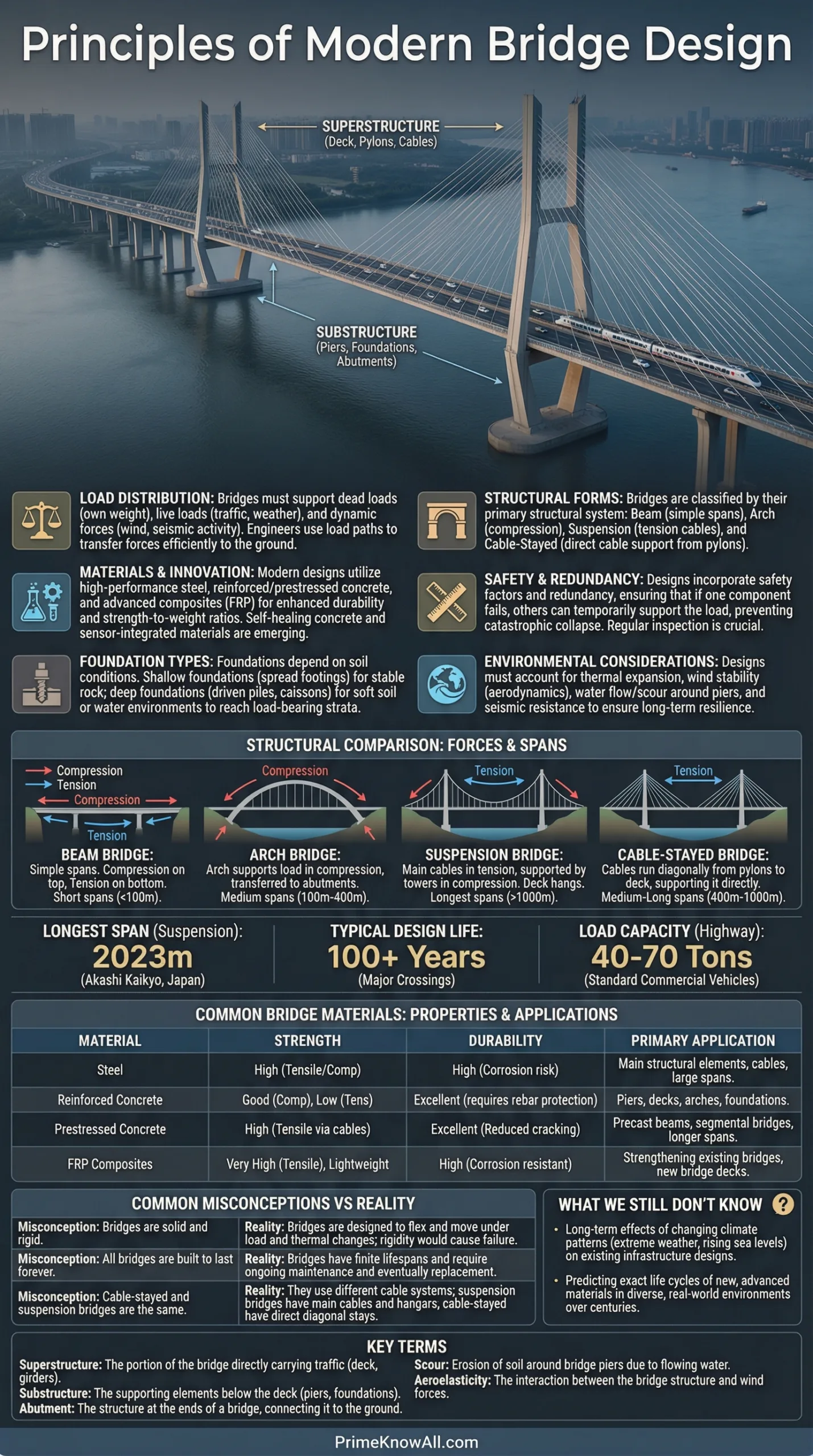
A bridge is not just a way to cross a river or a valley. It is a carefully balanced system that must carry people and vehicles, resist weather and earthquakes, and stay reliable for decades. Good bridge design turns messy real-world conditions into a structure that behaves predictably, using engineering judgment plus verified calculations.
What Bridge Design Really Means
Bridge design is the process of meeting a clear set of performance goals. The bridge has to be safe, comfortable to use, maintainable, and practical to build. Engineers also manage cost, schedule, and the bridge’s visual impact without letting aesthetics weaken structural logic.
Most modern standards organize design around limit states: conditions the bridge must never reach (like collapse), and conditions it should rarely reach (like uncomfortable vibration or excessive cracking). This mindset keeps strength, serviceability, and durability tied together, instead of treating them as separate tasks.
Start With The Site
Every bridge begins with the ground it stands on and the space it crosses. A strong concept can fail if the site constraints are misunderstood. Engineers study topography, soil and rock layers, water behavior, existing roads or railways, and clearance needs for ships, floods, or other traffic.
Survey, Geometry, And What Must Stay Where It Is
Accurate survey data drives everything: span lengths, pier locations, deck slopes, and alignment. Designers map utilities, nearby structures, and rights-of-way, then define a geometry that fits the corridor. Small choices here can reduce earthworks and shorten spans, which often lowers both materials and long-term maintenance.
Hydrology And Flood Behavior
If water is involved, the bridge must survive extreme events, not average days. Engineers estimate design floods, check how fast water will flow, and evaluate scour risk, where moving water removes sediment around foundations. A bridge that is strong above ground can still be vulnerable if its supports lose soil over time.
Choosing A Structural System
The “type” of bridge is a response to span length, site limits, and construction access. Engineers match the load path to what the location can support. Short spans often favor simple, repetitive solutions, while long spans push designers toward systems that handle forces efficiently, like cable-stayed or suspension structures.
- Beam / Girder bridges: efficient for short to medium spans; common for highways.
- Slab bridges: simple for short spans; often used where depth is limited.
- Truss bridges: strong and material-efficient; useful for longer spans with clear load paths.
- Arch bridges: excellent in compression; ideal where abutments can resist horizontal thrust.
- Cable-stayed bridges: suited to medium-to-long spans; stiff decks with direct cable support.
- Suspension bridges: best for very long spans; flexible systems that demand careful wind and vibration design.
| Bridge Type | Typical Sweet Spot | What It Does Well | Common Constraints |
|---|---|---|---|
| Beam / Girder | Short to medium spans | Fast construction, straightforward analysis, easy widening | Needs more supports as spans grow; depth can become an issue |
| Truss | Medium spans and heavy loads | Good strength-to-weight, clear load paths, modular erection | More joints and details; fatigue and corrosion need attention |
| Arch | Medium spans with strong abutments | Efficient compression behavior, often visually clean | Requires foundations that can take horizontal thrust; construction geometry matters |
| Cable-Stayed | Long spans without massive anchor blocks | Stiff decks, balanced construction by segments, iconic form | Complex staging and cable tuning; higher demands on detailing and inspection |
| Suspension | Very long spans | Unmatched span capability; lightweight decks possible | Wind and vibration sensitivity; maintenance of cables and hangers is critical |
Loads Engineers Must Account For
Bridge loading is broader than “cars and trucks.” Engineers combine different actions to represent realistic extremes. The goal is not to predict one exact future, but to ensure the bridge remains reliable under many plausible scenarios using design combinations from adopted standards.
- Dead load: the weight of the structure itself, including deck, beams, barriers, and utilities.
- Live load: vehicles, pedestrians, and sometimes rail traffic; includes dynamic amplification.
- Wind load: pressure and suction on the deck and towers; can govern long-span design.
- Earthquake effects: shaking demands ductility, detailing quality, and good foundation behavior.
- Thermal movement: expansion and contraction; drives bearings, joints, and cracking control.
- Braking, acceleration, and collision: horizontal forces from traffic, plus vessel or vehicle impact where relevant.
- Time-dependent effects: creep and shrinkage in concrete, and relaxation in prestressing tendons.
- Environmental actions: ice, waves, salt spray, and aggressive chemicals depending on location.
Safety Philosophy And Codes
Most bridge standards use a reliability-based approach: loads are increased by factors, and resistance is reduced by factors. This creates a buffer against uncertainties in traffic patterns, material properties, construction tolerances, and future deterioration. In practice, this is how engineering safety becomes repeatable and auditable.
Design also considers redundancy: the ability to redistribute forces if one element is damaged. A redundant bridge may still be safe after a localized problem, buying time for inspection and repair. For certain details, engineers explicitly address fracture and fatigue, especially in steel connections and welded regions.
Serviceability: The Bridge Must Feel Right
A bridge can be “strong enough” yet still perform poorly if it vibrates, deflects, or cracks too much. Serviceability checks limit deflection, control vibration for pedestrians and vehicles, and manage crack widths in concrete for durability. These checks often shape the deck depth, girder spacing, and stiffness of the whole system.
Materials And Durability Choices
Material selection is rarely about strength alone. Bridges live outdoors, so designers prioritize how materials age. Common options include reinforced concrete, prestressed concrete, and structural steel, each with a different balance of stiffness, weight, fabrication needs, and maintenance.
For steel bridges, corrosion protection can include coatings, sealed details, and sometimes weathering steel where conditions allow. For concrete bridges, durability depends on mix design, cover thickness, crack control, and keeping chlorides away from reinforcement. Details that control water, like drainage paths and drip edges, can matter as much as big structural members.
Details That Protect The Structure
- Joints and bearings designed for realistic movement ranges and easy replacement.
- Deck waterproofing and drainage layouts that prevent standing water.
- Access for inspection so critical zones can be seen and reached safely.
- Fatigue-friendly geometry at welded and bolted connections to reduce stress concentrations.
Foundations, Piers, And Abutments
Superstructures get attention, but substructures decide whether a bridge can stand where it is placed. Designers choose between spread footings, piles, drilled shafts, or caissons based on soil strength, settlement behavior, groundwater, and construction constraints. The aim is a foundation system with predictable stiffness and enough reserve capacity for rare events.
Scour And Long-Term River Behavior
In rivers, foundations must be designed for erosion. Scour can deepen channels and expose piles. Engineers evaluate how the river moves sediment, how floods change flow patterns, and how countermeasures like riprap or guide banks can reduce risk. This is where hydraulics, geotechnics, and structural design intersect in a very practical way.
Analysis: From Hand Checks To Full Models
Bridge analysis blends simple reasoning with advanced computation. Early in design, engineers use fast checks to understand the force flow and rule out poor options. Later, they build detailed models to capture load distribution, staging effects, and secondary forces like torsion. The best models stay connected to reality through sanity checks, not blind trust.
Aerodynamics And Vibration For Long Spans
As spans get longer and decks get lighter, wind and vibration can control the design. The 1940 Tacoma Narrows failure is a classic reminder that wind can trigger complex motion, including torsional flutter. Modern long-span projects may use wind tunnel testing and specialized analysis to ensure stable behavior across expected wind conditions.
Designing With Construction In Mind
Bridges are built in stages, and those stages create temporary load cases that can be more demanding than the finished condition. Designers plan how girders are erected, how concrete is placed and cured, how cables are tensioned, and how traffic is maintained. Good constructability reduces risk, improves quality, and prevents expensive mid-project redesigns.
A Practical Rule: if a detail is hard to build, it is often hard to inspect and harder to maintain. Designers routinely simplify geometry, standardize parts, and add access points so the bridge remains serviceable throughout its life.
- Staging loads checked for partial decks, temporary supports, and uneven concrete pours.
- Tolerances defined for fabrication and erection, especially at bearings and splice points.
- Drainage and utilities coordinated early to avoid cutting into critical members later.
- Inspection access integrated where fatigue and corrosion are most likely.
How A Bridge Design Project Typically Flows
Different agencies use different names, but most bridge projects follow a similar path from concept to opening day. Each phase tightens the design and reduces uncertainty while keeping risk and durability in view.
- Feasibility and corridor studies: confirm crossing location, basic spans, and environmental constraints.
- Concept design: compare bridge types, define approximate member sizes, and estimate cost and schedule.
- Site investigation: geotechnical borings, hydraulic studies, and detailed survey to lock in foundations and geometry.
- Preliminary design: develop the chosen system, validate key load cases, and coordinate with stakeholders.
- Detailed design: finalize calculations, drawings, specifications, and construction sequencing requirements.
- Independent review and approvals: check compliance with codes, safety philosophy, and agency requirements.
- Construction support: respond to field conditions, review shop drawings, and verify critical changes.
- As-built documentation and handover: capture final conditions so future inspection and maintenance are accurate.
Inspection And Ongoing Performance
Bridge design does not end when the bridge opens. Owners rely on inspections, maintenance, and sometimes monitoring to keep performance predictable. This includes checking bearings, joints, drainage, protective coatings, and known fatigue-prone details. In some bridges, sensors track strain, temperature, and vibration to support more targeted maintenance.
When a bridge is designed with access, replaceable components, and clear records, inspection becomes faster and safer. That reduces lifecycle cost and helps the structure stay reliable without constant disruption. The end result is not just a span that stands up, but a piece of infrastructure that stays useful under changing traffic, climate, and maintenance realities.
Sources
Federal Highway Administration (FHWA) – LRFD For Highway Bridge Superstructures Reference Manual (FHWA-NHI-15-047) [Detailed guidance and examples tied to LRFD design practice]
FHWA Hydraulics – HEC-18 Evaluating Scour At Bridges [Foundational reference for scour evaluation and mitigation concepts]
European Commission JRC Eurocodes – Eurocode 1 Actions On Structures [Official portal listing parts including EN 1991-2 traffic loads on bridges]
eCFR – 23 CFR Part 650 Subpart C National Bridge Inspection Standards [Regulatory baseline for bridge inspection and evaluation requirements in the U.S.]
Washington State Department Of Transportation – Tacoma Narrows Bridge Lessons From Failure [Clear explanation of wind-induced instability concepts and why testing matters]
AASHTO Journal – AASHTO Issues 10th LRFD Bridge Design Specifications Edition [Context on the role of LRFD bridge specifications in modern practice]
FAQ
How Do Engineers Decide What Type Of Bridge To Build?
They match the span length, site constraints, and construction access to a structural system with a clear load path. Short spans often favor girders, while long spans may require cable-stayed or suspension systems to keep forces and materials efficient.
Why Are Loads “Factored” Instead Of Using Exact Values?
Because the future is uncertain. Factored loads and reduced resistances create a consistent safety margin against unknowns in traffic, materials, construction tolerances, and deterioration. This reliability-based approach helps keep bridge performance predictable across many scenarios.
What Usually Controls The Cost Of A Bridge?
Cost often follows foundations, span length, and construction complexity. Deep foundations, difficult access, high traffic staging demands, and complex erection methods can outweigh material costs. Simple geometry and standardized details typically improve lifecycle value.
Why Are Long Bridges More Sensitive To Wind And Vibration?
Long spans tend to be more flexible, and wind can excite motion in ways that static calculations cannot capture. Designers check dynamic behavior, avoid resonance-like responses, and may use wind tunnel testing to reduce the risk of instabilities like flutter.
How Long Is A Bridge Designed To Last?
It depends on local standards and environment, but many public bridges target a multi-decade design life. Achieving that depends on durability details like drainage, corrosion protection, crack control, and making key components replaceable so maintenance is practical and safe.
