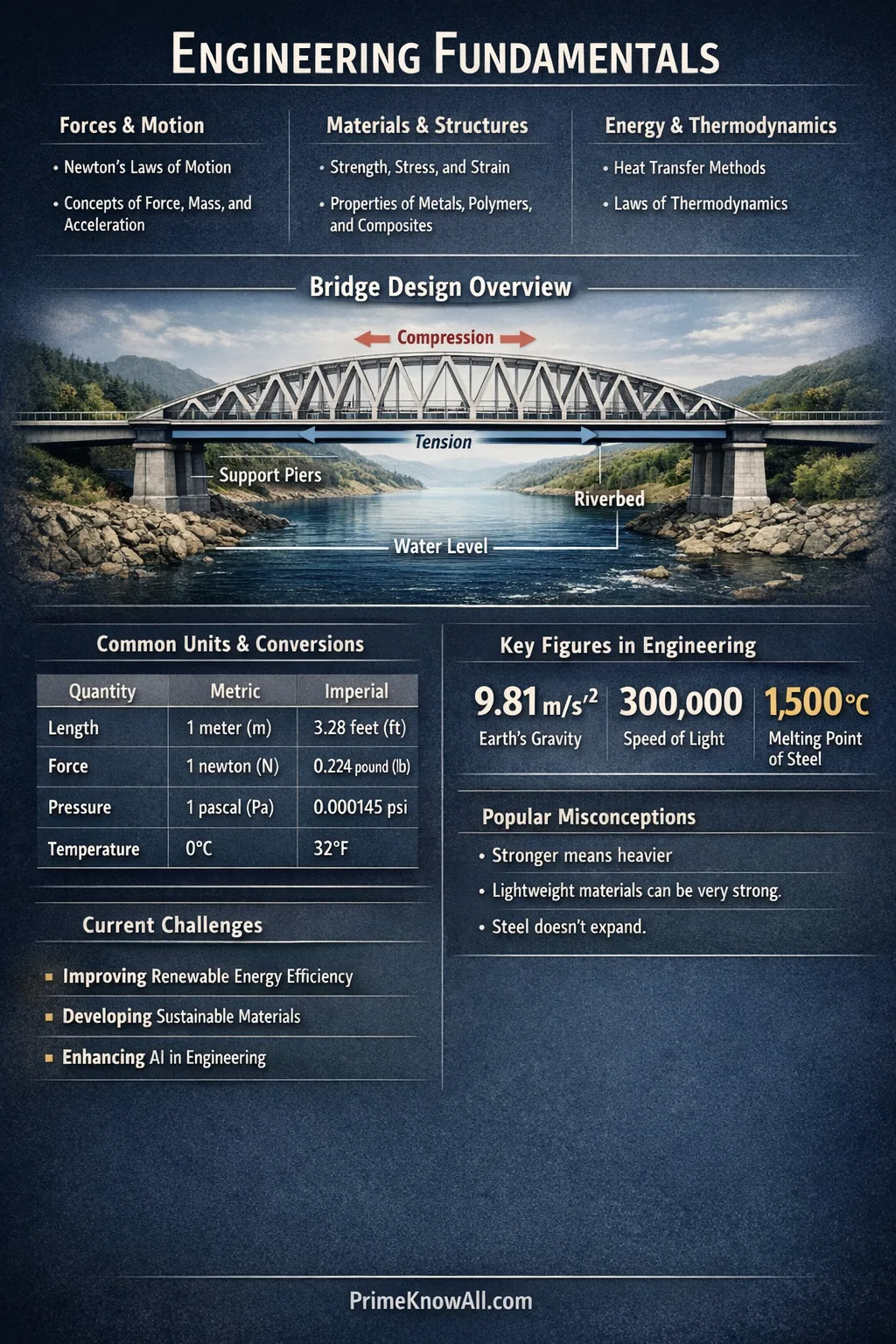
Engineering is the craft of turning an idea into something that works under real conditions—heat, vibration, time, cost limits, and human use. It is not just about equations; it is about making reliable, safe, and useful choices when the world refuses to be perfect.
Whether the topic is a bridge, a medical device, a mobile app, or a spacecraft, most successful projects lean on the same core set of engineering principles. These principles are practical, portable, and easy to recognize once you know what to look for.
This guide explains those fundamentals in plain language, with examples, trade-offs, and patterns that show up in nearly every field—mechanical, electrical, civil, software, chemical, and beyond.
Engineering As A Way Of Thinking
Many people picture engineering as a stack of formulas. In practice, it behaves more like a decision system. You start with a goal, collect constraints, test options, and choose the design that delivers the best overall result—often by accepting a few small downsides to avoid a big failure.
- Goals: What must the system achieve?
- Constraints: Budget, time, materials, regulations, energy, size, and environment.
- Risks: What could go wrong, and how bad would it be?
- Evidence: Calculations, prototypes, tests, field data, and past lessons.
- Iteration: Improve in cycles instead of betting everything on a single attempt.
Engineering thinking stays grounded in reality: parts vary, people make mistakes, sensors drift, and weather changes. A design that works only in ideal conditions is not a design; it is a hope.
Start With Requirements, Not Solutions
A common failure mode is jumping to a favorite solution too early. Strong engineering begins by writing down requirements—what the system must do—and separating them from preferences—what would be nice to have.
Make Requirements Testable
A requirement is most useful when it can be checked with a clear test. “Fast” and “durable” sound good, but they are vague. “Loads a page in under 2 seconds on a mid-range phone” or “survives 1 meter drops onto concrete” are measurable. Measurable requirements reduce debates and speed up decisions.
Watch For Hidden Constraints
Some constraints arrive late and cause expensive redesigns: maintenance access, manufacturing limits, local standards, operating temperature, and training needs. Engineers try to surface these early, because late surprises usually cost more than early planning.
A requirement that cannot be tested is a story, not a specification.
Model The System, Then Respect The Model’s Limits
Models are simplified descriptions of reality—equations, simulations, diagrams, prototypes, or even spreadsheets. They let engineers explore options quickly and cheaply. The key is remembering that every model has assumptions, and assumptions can break.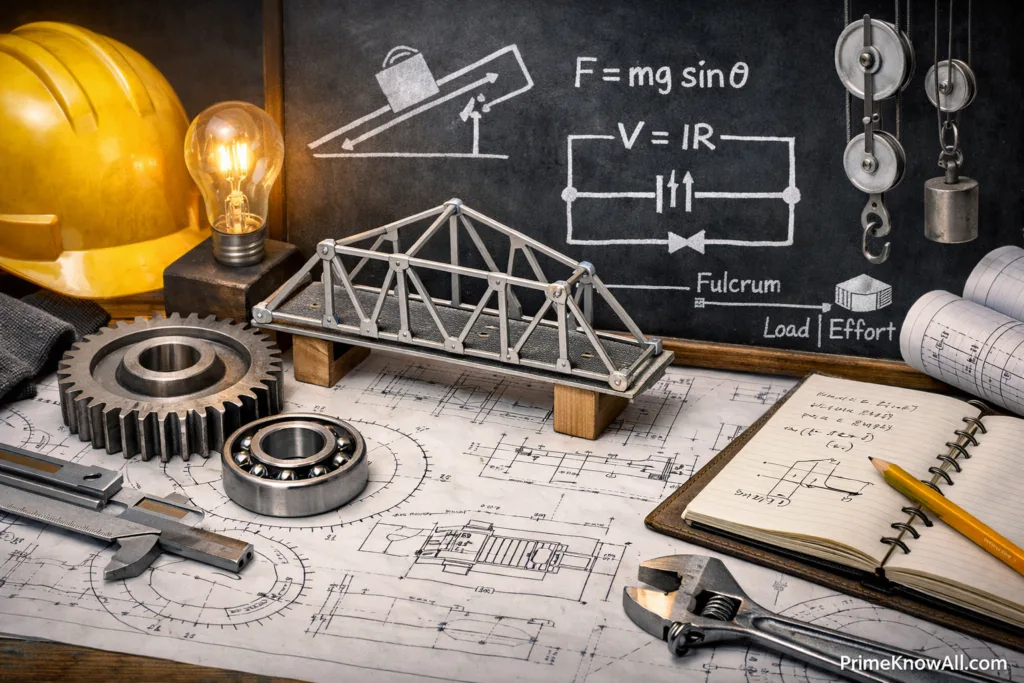
- Analytical models (equations) can be fast and insightful, but may ignore complex effects.
- Simulations can capture more detail, but can hide errors behind pretty visuals.
- Prototypes reveal real behavior, but cost time and money.
- Field data is the most honest, but it arrives late and can be noisy.
Good teams mix these tools: they use simple models to get direction, then use tests to confirm the design behaves as expected. When model results and test results disagree, they do not argue with the universe—they update the model.
Trade-Offs Are Not A Problem; They Are The Job
Engineering rarely offers a single “best” answer. It offers choices between competing goals: cost vs. performance, weight vs. strength, speed vs. safety, efficiency vs. simplicity. The skill is making trade-offs deliberately, not accidentally.
Use Constraints To Narrow The Field
Constraints act like guardrails. If a drone must fly for 30 minutes, battery and weight limits immediately shape what is possible. If a water system must survive harsh winters, freeze protection becomes a design driver, not a footnote.
Prefer Reversible Decisions Early
Early in a project, choose options that are easy to change. Lock in irreversible decisions (custom tooling, rare components, permanent architecture) only after evidence is strong. This principle reduces “design debt” and keeps projects from getting stuck.
Optimize The Whole System, Not One Part
Local optimization can hurt the global outcome. A lighter material might reduce weight but increase cost and manufacturing defects. A faster algorithm might use more memory and drain a device battery. Systems thinking asks: What happens to the entire chain?
| Principle | What It Protects | Typical Real-World Signal |
|---|---|---|
| Testable Requirements | Clarity and scope control | Teams stop arguing about “fast” and start measuring load time |
| Margins and Safety Factors | Unexpected stress and variability | Design still works when materials vary or users misuse it |
| Interfaces and Modularity | Maintainability and scaling | Parts can be upgraded without rebuilding the whole system |
| Risk-Based Thinking | Safety and reliability | Effort is focused where failure would be most harmful |
| Verification and Validation | Truthfulness of performance claims | Tests prove it meets specs and solves the right problem |
Design With Safety Margins and Uncertainty In Mind
Reality has noise: manufacturing tolerances, changing loads, corrosion, wear, and human behavior. Engineers handle this by building in margin. In many fields, this shows up as a safety factor—designing a structure or component to handle more than the expected load.
Understand Variability
A material might be rated at a certain strength, but real batches vary. Sensors might have a tolerance and drift over time. Software may behave differently under rare timing conditions. Treating variability as “someone else’s problem” is a shortcut to failure.
Plan For Misuse, Not Just Use
People will misunderstand labels, skip steps, or push products beyond intended conditions. Good engineering anticipates reasonable misuse and makes systems resilient: clear feedback, guardrails, and fail-safe behavior. This is not pessimism; it is respect for reality.
Small Habit, Big Impact
If you can name your assumptions in one sentence each, you can test them earlier. Early tests save time because they kill false confidence before it becomes expensive confidence.
Keep Designs Simple, But Not Fragile
Simplicity is not “doing less work.” It is reducing unnecessary complexity so the system is easier to build, verify, and maintain. Complexity multiplies failure paths. Every extra feature, part, or dependency adds another chance for reality to disagree.
Prefer Clear Mechanisms Over Clever Tricks
A clever design can be impressive, but if it is hard to inspect or repair, it may fail the most important test: long-term use. Many high-performing systems win by being understandable and consistent, not mysterious.
Reduce Coupling
Coupling is how tightly parts depend on each other. In a highly coupled system, a small change triggers a cascade. Engineers reduce coupling by defining stable interfaces—the rules that connect parts. This applies to mechanical connections, electrical signals, and software APIs.
Use Modularity and Interfaces To Manage Complexity
Modularity breaks a system into parts that can be designed and tested more independently. A modular design is easier to scale, easier to debug, and often easier to upgrade. The price is that interfaces must be carefully defined and protected.
- Define inputs and outputs: What goes in, what comes out, and in what format?
- Set performance boundaries: Maximum load, voltage, latency, temperature, or throughput.
- Control compatibility: Versioning, standards compliance, and clear tolerances.
- Document assumptions: What the module expects from the rest of the system.
When interfaces are stable, teams can improve components without breaking everything else. This is one reason standards and conventions matter: they turn chaos into cooperation.
Design For Reliability: Fail Gracefully
Reliability is not only about “never failing.” It is about controlling how failure happens. A graceful failure is predictable, contained, and safe. A chaotic failure is surprising and expensive.
Redundancy Where It Matters
Redundancy means having backup capacity: an extra sensor, a fallback power path, a second server, or a manual override. Redundancy is not free; it adds cost and complexity. Engineers use it where the consequences of failure are high, and avoid it where it adds risk without real benefit.
Detect, Isolate, Recover
Reliable systems often follow a simple pattern: detect abnormal behavior, isolate the problem area, and recover to a safe state. In software, that might be timeouts and circuit breakers. In hardware, it might be fuses, relief valves, or interlocks.
Test Early, Test Realistically, Test Again
Testing is where engineering meets truth. The goal is not to “pass tests.” The goal is to learn how the system behaves under realistic conditions, including edge cases. Good testing reduces uncertainty and reveals which assumptions were wrong.
Verification vs. Validation
Verification asks: Did we build the system correctly, according to the requirements? Validation asks: Did we build the right system for the real user need? Both matter. A product can meet every specification and still disappoint if the specifications were misguided.
Use The Environment As A Test Partner
Real environments are brutal in subtle ways: heat cycles loosen connections, dust blocks airflow, vibration fatigues joints, networks drop packets, and users click the wrong button. Testing should include stress, load, and longevity—not just “does it turn on.”
Use Standards, But Understand Why They Exist
Standards are collective memory. They encode lessons learned the hard way—about safety, interoperability, measurement, and quality. Following standards often prevents expensive mistakes, especially when systems must work across regions, suppliers, or industries.
Still, standards are tools, not magic. Engineers should understand the reason behind a rule. Blind compliance can create waste; thoughtful compliance creates predictability and trust.
Make Risk Visible and Manage It Deliberately
Risk is the combination of likelihood and impact. Some failures are rare but catastrophic. Others are frequent but minor. Risk-based thinking helps teams spend effort where it matters most, instead of spreading attention thinly across everything.
- Identify: List what could fail—components, processes, and human steps.
- Estimate: How likely is each failure, and how bad would it be?
- Mitigate: Reduce likelihood, reduce impact, or both.
- Monitor: Track real performance and update the plan as you learn.
This approach is practical because it keeps engineering aligned with real stakes. It also supports responsibility: when something matters for safety or mission success, it earns extra attention.
Human Factors: Design For People, Not Just Physics
Many failures happen at the boundary between a system and the person using it. Human factors engineering focuses on usability, clarity, and error resistance. It applies to cockpit controls, medical device interfaces, industrial safety panels, and everyday apps.
Reduce Cognitive Load
When users must remember too much, mistakes increase. Good design offers visible status, meaningful defaults, and clear next steps. Even small choices—button placement, labeling, alarm sound design—can shift outcomes from confusion to confidence.
Design Feedback Loops
Systems should communicate what they are doing. Feedback can be a light, a tone, a message, a gauge, or a haptic response. Without feedback, users guess. Guessing is a reliability hazard disguised as “user error.”
Documentation and Communication Are Engineering Work
Engineering is collaborative. Designs survive only when knowledge survives: requirements, assumptions, decisions, test results, and known limitations. Documentation is not bureaucracy; it is a memory system that protects teams from repeating the same mistakes.
Clear communication also prevents late-stage shocks. When teams share constraints early—cost ceilings, lead times, safety limits—they avoid building a perfect solution for the wrong reality.
Practical Habits That Make Projects Work
Principles become powerful when they show up as habits. These are widely useful, even for readers who are not engineers by training.
- Write down assumptions and label them as “needs proof.”
- Measure before optimizing; performance guesses are often wrong.
- Prototype the risky parts first, not the easy parts.
- Prefer boring components when reliability matters more than novelty.
- Use checkable definitions for success and failure.
- Plan maintenance: access, tools, replacement cycles, and training.
Notice the theme: reduce uncertainty, protect the system from surprises, and keep the design understandable. That is the quiet engine behind most successful engineering.
Common Misunderstandings About Engineering Principles
“More Features Means Better Engineering”
More features can mean more value, but they also mean more complexity and more ways to fail. Strong engineering often feels like disciplined editing: the product does what matters, reliably, without unnecessary weight.
“A Good Simulation Proves The Design Works”
Simulations are excellent for insight, but they depend on assumptions and inputs. Real confidence comes from a chain of evidence: simulation plus prototypes, tests, and feedback from actual conditions.
“Safety Margins Are Waste”
Margins can look inefficient on paper. In the real world, they are often the difference between a minor issue and a major incident. Margins absorb uncertainty, and uncertainty is everywhere.
Sources
- NASA – NASA Systems Engineering Handbook [A structured overview of requirements, verification, and systems thinking]
- NIST – Statistical Engineering Division [Useful context on measurement, variation, and data-driven engineering decisions]
- MIT OpenCourseWare – Mechanics And Materials I [Foundational ideas behind stress, strain, and why margins matter]
- FAA – Aviation Handbooks And Manuals [Safety-oriented materials that illustrate human factors and risk-aware design]
- ISO – Standards Catalogue [A starting point for exploring how standards support interoperability and quality across industries]
FAQ
What Is The Difference Between Engineering and Science?
Science focuses on explaining how nature behaves, aiming for accurate understanding. Engineering focuses on creating things that work under constraints—cost, safety, time, and real environments—often using scientific knowledge as a tool.
Why Do Engineers Use Safety Factors?
Because real systems face uncertainty: variable materials, imperfect manufacturing, unexpected loads, aging, and human behavior. Safety factors add margin so the design remains reliable when reality deviates from the ideal model.
What Does “Systems Thinking” Mean In Engineering?
It means viewing a project as a set of connected parts with dependencies and feedback loops. Systems thinking helps avoid local optimizations that damage overall performance, and it highlights interfaces where failures often hide.
How Can Non-Engineers Apply Engineering Principles?
Use testable goals, list constraints, make assumptions explicit, and run small experiments before committing to big decisions. Even simple habits—like measuring performance instead of guessing—bring engineering clarity to everyday work.
What Makes A Test “Realistic”?
A realistic test reflects the actual environment: temperature ranges, vibration, dust, network instability, user mistakes, peak loads, and long-duration use. It also checks edge cases, because many failures appear only when conditions become extreme or unusual.
